David Cameron's unannounced
visit to Basra yesterday and today – with his shadow foreign secretary William Hague – is another piece of evidence that tends to confirm our own impression of the electoral importance of the military adventure in Iraq.
That he was prepared to abandon a long-standing appointment to speak at the CBI annual conference, further confirms the importance, as does his comment before departure that: "The situation in Iraq is one of the most critical issues facing the British government and our country."
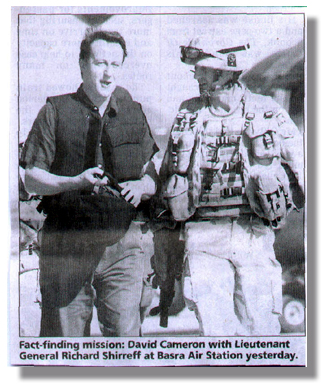
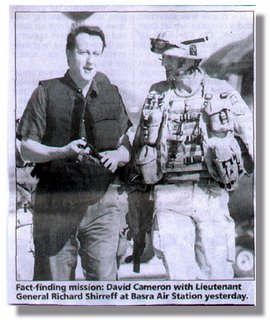
Characteristically though, Cameron - the man who came to listen - is seen in one of the few photographs published in today's newspapers (this one in the
Yorkshire Post) talking to Lieutenant General Richard Shirreff. And why the general should be wearing his helmet in a location described as "Basra Air Station" - one of the safest areas in the whole of southern Iraq - is not immediately clear.
This notwithstanding, Cameron's presence in Basra does underline the politicians' concern that, contrary to conventional wisdom, headline domestic issues will not necessarily predominate at the next election. The indications are that security, defence and foreign policy issues could be far more central than they have been in other elections.
This is not entirely because of the convergence between the main parties on the "social" issues. The campaigning in the next election will be done against the backdrop of troops deployed in Iraq and Afghanistan, and rarely has the terrorist threat been so grave. The effects of "globalisation" will have reached down to the lower levels and most voters will understand that there is a direct connection between what happens overseas and their own prosperity and safety.
Thus, assuming that the Tories can position themselves on the "soft" issues – not so much to win the argument as to neutralise them as election winners for Brown - the emphasis must then be on foreign affairs and defence. The Tories must dominate these issues in a way they have so far failed to do. It will require of "team Cameron" a major change in direction, moving away from the "social agenda" in order to give equal (or certainly more) time and prominence to the hard-edge.
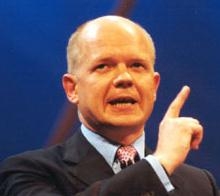
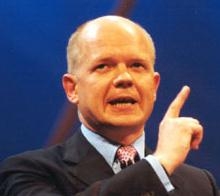
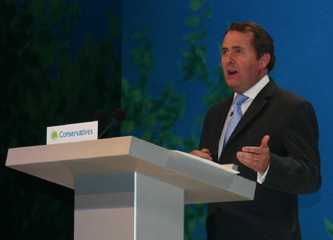
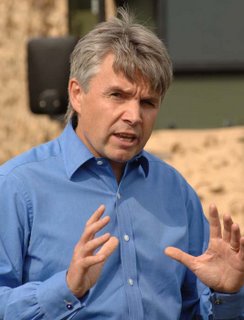
That makes the most important men in the Cameron team his shadow foreign secretary, William Hague (pictured), and his defence shadow, Liam Fox. Also, because of the huge importance of military equipment and the fact that there is – with Labour's failings – a huge open goal, the shadow minister responsible for defence procurement is a key man. He is, currently,
Gerald Howarth.
The calibre of the team, however, simply reinforces the view that the Conservatives will lose the next election. Hague, for all his early promise and his performance as Tory leader, is simply not cutting the ice.
Even recently in
The Sunday Telegraph, he argues for strengthening the international institutions, writing:
Unless we have a more representative Security Council, a more dynamic EU, a more cohesive Nato and a strengthened international effort against nuclear proliferation, the crises of coming years might well be impossible to resolve. Such goals should be at the top of the list of the objectives of British ministers. Otherwise, there is a grave danger that international institutions will not be able to find solutions to 21st-century challenges.
From Rwanda to "oil-for-food" and Darfur, the UN has proved a dismal failure, corrupt, self-serving and incapable of reform. The pages of this blog have constantly recorded the failures of the EU, not least the negotiations
on Iran, a failure also matched by the IAEA. And Hague wants a more dynamic EU and a strengthened international effort against nuclear proliferation?
Nato, struggling for a role, has not performed well over Afghanistan and is being constantly subverted by the EU. Its survival, much less greater cohesion, is not certain and it remains to be seen whether there is the political will to keep the organisation alive.
What we see here, therefore, is a total lack of new thinking, a failure to recognise that the post-war settlement is breaking down and, probably, the day of these colossal international dinosaurs is over. We need new paradigms, but we will not them from Hague.
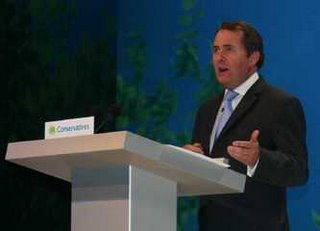
As for Liam Fox, as a Tory defence spokesman, he has proved to be a major disappointment. At one, going for the cheap soundbite while consistently missing the
bigger picture, his interviews seem to
lack coherence and he seems to have no idea of
where the defence debate should lie. Furthermore, of the few semi-original ideas he has offered, he has shown no sign of understanding the complexities of what he is saying, or given us any idea that he would be
in a position to deliver.
Perhaps, though, the Conservatives do not yet need a detailed defence policy. With more than two years to go (one assumes) before a general election, Liam Fox can happily wait until Cameron's policy commission has reported before he starts to deal with the detail.
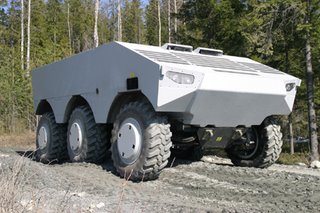
That, however, is to ignore the opportunities presented by Labour activities. For instance, the MoD is fully committed to introducing the
Future Rapid Effects System (FRES), a £14 billion re-equipment programme that requires a fundamental re-structuring of the Army and which is the main reason why so many of the traditional Country regiments have been abolished.
Few if any in the media are going to notice if Fox does not mention FRES but, so fragile are Labour's plans – and so uncertain is the system – that it represents an open goal, a huge target of opportunity that, if attacked, could score multiple brownie points for fox and his Party. Yet, on this issue, we get nothing but silence.
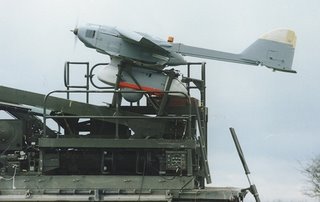
Similarly, there are huge opportunities open to Fox in attacking the government's record on unmanned aerial vehicles (UAVs) and especially its forward plans, which may lead to the expenditure of as much as £10 billion. Yet, despite seriously poor performance and some
questionable decisions in the offing, once again, we get nothing but silence.
Fox has an agenda but, clearly, that does not include behaving like an opposition spokesman and attacking the government.
While he covers the big issues, though (or fails to do so), the failures at a lower level are just as important. Small issues may be crucial in the greater scheme of things but, in politics, it is very often those small things that can make or break a government (and opposition) – who can forget the
War of Jennifer's Ear?
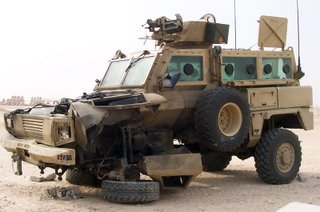
In charge of the defence procurement portfolio, however, is Gerald Howarth and he typifies the total ineptness of the Cameron experiment. For instance, whatever else could be said about the "Snatch" Land Rover issue, it was highly political, representing an egregious failure of Labour properly to equip our troops.
With Booker in the
Sunday Telegraph, we went live with the story on
17 June and
The Sunday Times picked it up
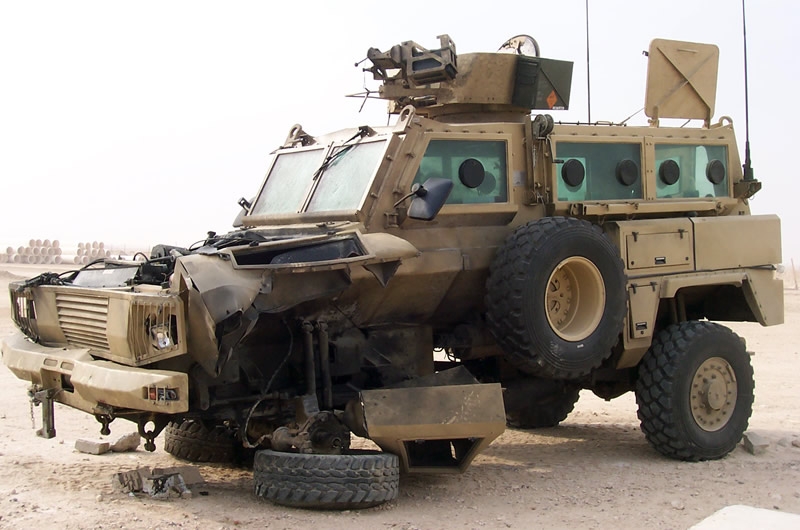
a week later. But nowhere in these stories was there a mention of Gerald Howarth, which meant that the Tories were given no "credit" for pushing the issue. And the reason was quite simple. Although he had been given the details weeks earlier, including photographs of destroyed Land Rovers and the now famous RG-31 picture (above right), from him there had been no comment – no reaction at all.
When it then emerged that Lord Drayson was to supply troops with the
dangerously fragile Pinzgauer Vector, full details were sent to Howarth who had thus a powerful story with which to approach the media.

But although in July he posted a robust piece
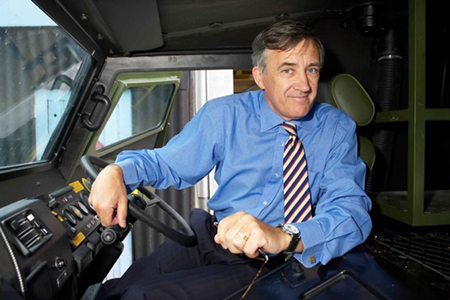
on his website, his action was entirely negated by his visit to the Pinzgauer factory. There, he allowed himself to be photographed at the wheel of a truck (pictured here) for a
corporate advertisement, praising the
superb Pinzgauer.
When it emerged that four soldiers had been killed in a "
water taxi" as they used the Shatt-al-Arab waterway for want of suitably protected vehicles, Howarth was informed. Response there was none.
When it emerged that the British Consulate was
being evacuated and that British troops in their own headquarters were being subject to
constant mortar attacks, yet no attempt was being made to
procure counter-measures, Howarth was more than informed. He was invited to supply this blog with a 1000 word piece setting out the Conservative policy on this and allied issues – with a promise that it would gain a reference in the Booker column. Promise there was but response there was none.
When the ghastly story of the government's
failure to supply adequate UAV surveillance emerged, Gerald Howarth was informed. Response there was none. And when it emerged that troops were
at risk in Afghanistan through
lack of thermal imagers, Howarth was informed. Response there was none.
Now, in a piece billed as an exposition of my view of what the (Conservative) Party must do to win the next election, I have been a long time coming to the point (or points). One thing which would now seem obvious as to what they must do – this is to fire Gerald Howarth.
As a shadow minister dealing with procurement, he is worse than useless. He has allowed one of the most dangerously useless procurement ministers in recent times, the Lord Drayson (pictured), to escape without tarnish, and even to enjoy pieces in the likes of
The Independent, which today runs a long, highly laudatory "puff", about the minister, with the headline:
Lord Drayson: Britain's top gun.
With the defence procurement goal wide open for innumerable "scores", if the shadow minister for procurement cannot even lay a glove on his opponent then it is time for him to go.
But, to focus on Howarth alone would be unfair. There is a broader issue at stake here: the Conservatives have forgotten how to campaign as an opposition. They have never really had to do so seriously and, over the eighteen years that they were in power, any skills they had have been long forgotten.
Going back to pre-Thatcher days, most knowledgeable political commentators will be aware that the rise of the Tories then owed much to the efforts of the Conservative party's research department but even more to the efforts of the Institute of Economic Affairs think-tank.
The core of that effect was, essentially, research – and the dissemination of the fruits of that research – of a calibre which, currently is no longer available. The research department has been broken up and there is no think-tank of any stature informing or guiding "team Cameron".
In opposition, however, research is also used to fuel attacks on the government and here, the Conservative effort is dire. The information which Howarth could have used – had he been able – was not supplied within the party machine. Unlike the US, where there are senior political researchers of some stature, that research function is treated as a job to be carried out by juniors, passing through to better posts – and paid accordingly.
The crucial issue here, though, is that research-driven information is best used indirectly, in servicing the media.

Bear with me on this one – I know what I am talking about. For a part of my career, I was responsible for doing the PR for an egg industry trade association, just after the start of the salmonella scare when producers were being branded killers of grannies and babies.
To get through to a hostile and uninterested media (uninterested in what we had to say, that is), we found the most effective way was to supply them with what they needed most – good, reliable information.
Then, there was a "market" for weekly information on food poisoning, which was difficult to get as the authorities had stopped releasing the figures. I was able to get it and ran a weekly service, collating and analysing the data and sending out a fact sheet to media operations. The information was not about eggs per se but it established our reputation as a trustworthy source and soon reporters were coming to us for comment and more information.
And that is how the Conservative Party needs to operate in order to win. The "big hits" by the leaders are all very well but what we need is the constant drip-drip approach with there never being a period when the Conservatives are not actually in the media, attacking the government. By contrast though, many shadow ministers produce nothing for ages and then churn out dire press releases about their agenda and expect the media to drop everything and publish it – bitching like mad when they do not.
To produce such research-based information though is actually beyond the capability of this party, dominated as it is by "team Cameron" who are only concerned with their own headlines. But then, that is of no concern to Boy and his acolytes. Winning the election is not their game. They have bigger fish to fry – the total destruction of the Conservative Party.
And that is the subject for the third and final piece.
COMMENT THREAD

 One thing that has been absent from the media storm over the Iranian hostages is any significant input from the leader of Her Majesty's official opposition, the Boy King himself, David Cameron.
 These include six new Merlin helicopters, obtained from the Danish who have agreed to wait for their batch, which will be available within a year. The other eight are the existing Chinook Mark 3 helicopters which, at the moment are languishing unused after botched "improvements" to make them suitable for the special forces. These are now to be retro-fitted with Mk2 equipment to allow them to be deployed on operations.
 Cameron might have felt, therefore, that it was just as well he added insurance, also pointing out that the House of Commons Defence Select Committee "has highlighted the need for more heavily armoured vehicles to protect our troops from roadside bombs". But there again, with a substantial number of Bulldogs (pictured) already in service and the Mastiffs coming on stream, there is little force behind such a complaint.
 The leader of an opposition party, though, might have been better off taking the high ground, commenting adversely on the government and military obsession with equipping the forces for the mythical European Rapid Reaction Force, instead of devoting energy and wealth to kitting them out to deal with the wars this nation is actually fighting, and needs to win. He could even have asked why the Navy in the Gulf was not equipped with patrol boats that can operate in the shallow waters of the northern continental shelf.