Showing posts with label equipment. Show all posts

30 January 2007

A collective failure


In 2003, Sgt Steve Roberts gets shot in a "friendly fire" incident in Iraq. Having handing in his body armour, he dies as a result. There is a six-day hearing and, on 18 December last year, Andrew Walker, the assistant deputy coroner for Oxfordshire, says: "To send soldiers into a combat zone without the appropriate basic equipment is, in my view, unforgivable and inexcusable and represents a breach of trust that the soldiers have in those in Government."

This unleashes a torrent of media comment. The BBC has the verdict as its lead item on its national televised news. Every major newspaper covered it and the Independent gave over the whole of its front page. Google News recorded over 1,300 separate media reports.

However, tragic though the death was, this was one soldier. Since the incident, the MoD has issued high-tech, state-of-the-art body armour to all troops in the field and, barring the odd case, all soldiers at risk are equipped with it.

On the other hand, yesterday, there was an inquest into the deaths of three soldiers - Pte Phillip Hewett (pictured), 2nd Lt Richard Shearer and Pte Leon Spicer. These were the three soldiers from the Staffordshire Regiment who were killed in Al Amarah, Iraq on 16 July 2005 by a roadside bomb while riding in a lightly armoured "Snatch" Land Rover.

Oxford coroner, Selena Lynch, returns a verdict of "unlawful killing" but says she can make no recommendation to the Ministry of Defence about the use of the Land Rovers because it is beyond her jurisdiction.

However, in addition to these three deaths, there have been at least 20 more soldiers who have died, in both Iraq and Afghanistan, while riding in lightly armoured "Snatch" Land Rovers. Many more have been injured, some very seriously indeed.

Furthermore, although the MoD promised that there would be an "effective capacity" of the Mastiff mine and blast-protected vehicle in Iraq by the end of last year. So far, only four have so far arrived and it will be next month before there are just 20 in place.

In Afghanistan, the situation is even worse. Troops are having to patrol (and fight) in unarmoured "WMIK" Land Rovers and the promised Pinzgauer Vector replacement is, if anything, more dangerous than the vehicles it replaces.

Nevertheless, by the early evening there had been only one media report on the verdict, on the BBC's Stoke and Staffordshire local television news. The national television and radio news did not even mention it and, in the national dailies, it got one brief "meanwhile…" in the Daily Mirror attached to the tail end of another inquest report on the "friendly fire" incident involving A-10s.

All we got from the national BBC television was the News 24 programme with an amazingly superficial "puff" for the up-armoured "Bulldog" FV432 armoured personnel carrier, embellished somewhat on the national website. With a picture of the Pinzgauer Vector and the heading, "troops get new armoured vehicles", it could almost have been written by the MoD – and will certainly trouble it not.

This dire performance was only partially remedied by a BBC Radio File on 4 documentary – co-incidentally broadcast yesterday evening. But, in the whole 40-minute programme, only the death of Pte. Hewett was discussed, along with the deaths of two other soldiers in unrelated incidents, one from heat stroke and the other from a training accident on a firing range.

Better in some respects than the appalling programme in in October, featuring the dreadful Allan Urry, this one – with Jenny Cuffe - still failed to give the equipment issue the depth of coverage it needed.

We have, of course, covered the vulnerability of the "Snatch" Land Rovers extensively on this blog. Then, immediately prior to the Coroner's finding, there were two media reports, one in The Telegraph, yesterday morning, and one at the weekend in the Observer.

From both we got Sue Smith, Pte Hewett's mother, charging that the three soldiers would still be alive today if the MoD had purchased adequately protected vehicles. But there was no attempt to widen the issue and neither newspaper even began to address the current defects in the system. Both uncritically reported on the purchase of the Pinzgauers, failing to pick up the delays in supplying the Mastiffs.

Thus have soliders been completely let down by the fourth estate. At the time of the Roberts' inquiry, we warned of the danger of focusing on the one issue of the body armour - which had actually been sorted. We wanted the journalists, who were then so full of themselves, to note that Sgt Roberts's widow, Samantha, was already saying that the body armour issue had been resolved. "This is Steve's legacy," she had said, adding: "we must ensure that these failures are not repeated with other basic kit."

But her words have gone unheeded and will continue to do so by journalists and editors alike. Our trivial, venal media is fundamentally incapable of doing its job. They can bleat and blether when it no longer matters but, when they could make the difference, they are silent. All they have to offer is their own collective failure. And so dismally ignorant are they that they do not even have enough knowledge to appreciate that they have failed. That is their legacy.

* * * *

The top photograph is of a "Snatch" Land Rover, this one operated by the support company, Welsh Guards, who are providing security for the Royal Military Police. It is pictured in Al Amarah by a smoking chimney from the local brickworks. The picture is from the "Smugmug" gallery posted by
S D C Carter, one of the finest collection of photographs of contemporary British military operations in Iraq that I have seen. Mouse-click on the face of the picture to enlarge.

COMMENT THREAD

19 December 2006

All I want for Christmas...

Any credible foreign policy for a mid-ranking, internationalist power like the United Kingdom relies on effective military forces to back it up. However, while our forces are undoubtedly first-rate, they are equipped primarily to deal with a Soviet-era threat. Yet the greatest demand in the post 9-11 scenario is for counter-insurgency forces, which need different types of equipment, issued on a different scale.

Very little of the equipment needed is actually new in concept. What in many cases makes (or should make) the difference is the scale of issue. A counter-insurgency force, for instance, will need far more light attack helicopters than a conventional armoured formation. There also needs to be a strong emphasis on force protection, focused on base defences and patrol/convoy survivability.

These are areas where the British Army is heavily deficient and to redress the inadequacies and the imbalances, we have produced our own Christmas list for Santa. It might as well be addressed to Santa for the chances of our own politicians (much less the media) paying any attention to it are pretty remote - although discussion of the list would make a fascinating feature in a Sunday newspaper. Anyhow, here goes:

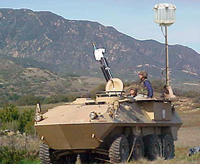
Number one on our list is dedicated to base defence. This is the US-developed lightweight counter-mortar radar, in this case mounted on a USMC Light Armoured Vehicle (LAV) which itself is equipped with an advanced 120mm mortar for counter-battery fire. The combination is a potent weapon for base and tactical commanders having to deal with hit-and-run mortar and rocket attacks on their positions - whether they be large, established bases like the Shatt al-Arab Hotel in Basra or temporary positions such as those occupied by 3rd Para in Afghanistan.

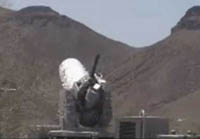
Option number two is for large, static bases - the C-RAM (Counter Rocket, Artillery and Mortar) gun based on the naval Phalanx system. This can be used to shoot down incoming mortar bombs and rockets, with an 80 percent success rate. The guns have the added advantage that the automatic firing provides audible warning of an attack, giving time for those at risk to run for cover.

The third piece of kit we desperately need is a medium tactical, high endurance UAV - or to be more specific, a UCAV (Unmanned Combat Aerial Vehicle) - the distinction being that this can carry weapons. The vehicle illustrated is the Hunter and, although there are other UAVs with similar performance, this has been fully developed to deliver low-yield precision guided missiles.

The Hunter can either be used for reconnaissance - locating enemy forces and relaying their positions to commanders, who can task other assets to deal with them - or it can be used as an attack weapon in its own right, firing missiles to take out small groups of the enemy (such as a rocket or mortar teams).

And this is the missile of choice - the Viper Strike. Originally designed as an anti-tank missile, it has been adapted to function in an anti-personnel role, with a capability also to take out light vehicles. Where so much fighting is carried out in urban environments with civilians present, the urgent need is for a weapon which minimises collateral damage. This missile has the ability to kill the occupants of one vehicle in a line, without damaging the others. Another characteristic of the weapon is its very steep attack profile - contrasting with the shallow flight-path of the typical missile - which makes it ideal for urban canyons.

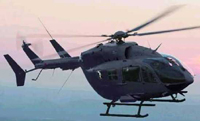
Number five on our list is a light tactical helicopter, of which many are needed. Smaller than the Lynx, they can either be one of the Eurocopter versions, an MD Enforcer or similar. They should be able to carry 4-5 troops as a rapid response force, stretchers for casevac, light weapons (including rocket pods) in the light attack role, and/or surveillance equipment for the search and observation roles. The crucial issue is the price, with their relative cheapness enabling the military to buy larger numbers of machines than at presently planned with the Future Lynx.

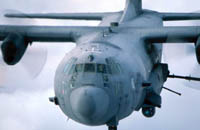
And, giving our commanders yet another option is the AC-130. With its array of gatling guns, cannon and its 105mm howitzer, its sensors and all-weather target acquisition capability, the "Spooky" as it is known, is a powerful - if expensive - addition to any armoury. It is capable both of laying down saturation fire to break up attacks and precision fire to take out specific targets. These formidable machines should be available in both Afghanistan and Iraq.

And alongside the "Spooky" we also need high-endurance, long range UAV/UCAVs such as the Predator or the more advanced MQ-9 Reaper. Although the government is currently acquiring three of these machines for Afghanistan, this seems a question of "too little - too late". We need enough to have at least one flying over every area of operation, with an organic UCAV capability. Reading just a fragment of the spec demonstrates why the MQ-9 comes into the "must have" category: it will be able to deploy the GBU-12 and EGBU-12 bombs and 500lb GBU-38 JDAM (Joint Direct Attack Munition). Flight trials have also taken place with the General Atomics Lynx SAR (Synthetic Aperture Radar) payload. Lynx also features ground moving target indicator technology...

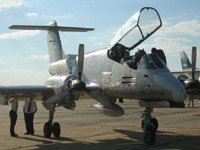
From the sublime to the ridiculous. The aircraft shown is the Argentinian-built Pucara, a twin turbo-prop ground attack aircraft used during the Falklands war. Not for one moment would I suggest that we have some of these but the picture is used to illustrate the concept of a light, cheap ground attack aircraft. At a time when the trend is towards greater sophistication, complexity and cost, against a relatively unsophisticated enemy, the "cheap and cheerful" concept ensures that there is always some capacity, as opposed to none at all - which is so often the case at the moment.

For the next item, we have the Force Protection Buffalo - equipped for mine and IED clearance. This machine is currently in service in Iraq where it provides invaluable service in detecting IEDs that would otherwise kill and main. So far, with the Cougars, which are used by bomb disposal officers, these vehicles have received over 1,000 hits from IEDs, without a single fatality. The British forces rely on a man walking in front of a vehicle (surprisingly they do not give him a red flag) and the bomb disposal officers have unarmoured "Duro" trucks. Neither is acceptable.

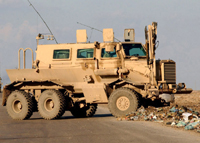
Then we need a mine/blast protected patrol and convoy escort vehicle, to replace the "Snatch" and "Wimik" Land Rovers. The 6x6 versions of the Cougar being bought by the MoD (and re-named the Mastiff) are too big and cumbersome to be used. The vehicle illustrated is the RG-31. It has proved its worth time and time again in Canadian and US hands, saving many lives in circumstances where Land Rover crews would have been killed. Nevertheless, the Australian Bushmaster would be just as acceptable as would - at a pinch - the German Dingo II.

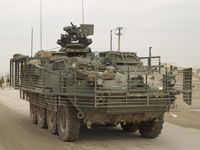
This picture shows a US Stryker wheeled armoured personnel carrier. Operations by the US in Iraq and by the Canadians in Afghanistan with their Bisons, have demonstrated the value of wheeled carriers. They are faster, quieter, more comfortable and cheaper to run - also requiring less maintenance. For sure, they do not have the cross-country performance of tracked carriers, but no one is suggesting that our Warriors should be dispensed with. Alongside tracks, though, there is a role for wheels. We need some.

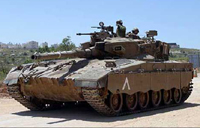
And finally... we need a new tank. The British Challenger II MBT (and the US Abrams) were built for taking out Soviet T82s at long range under all conditions. They were not built for counter-insurgency. Pictured is an Israeli-built Merkava MBT. It is not perfect but, with a personnel and stores carrying capability, it is better than other Western tanks. They performed well in Lebanon and provide a good model on which to base new designs. Not for this Christmas then, but in years to come, we want a new MBT from Santa.

As for the price tag - well, no one asks the price of Santa's gifts. If really pushed, one would have to concede that a decent number of the toys illustrated would set Gordon back several billions - perhaps as much as £5 billion. But since he is paying £15 billion a year to the EU, there is one very obvious place where he could get the money - and have some change. That would enable us to buy some more Hercules C-130J airlifters and some CH-47 Chinooks, which we also need, leaving £5 million to spend on more Vipir thermal imagers.

However, this is only my idea for a list. What would yours be? And what would the Conservatives suggest?

COMMENT THREAD