Showing posts with label defence. Show all posts

10 February 2007

On the road to disaster

The Times must be congratulated for its report today on the two attacks on the British Army in Basra yesterday, one on an Army convoy and the other on the Basra Palace base (pictured).

By contrast, the Telegraph devoted the bulk of its time and space to picking at the wound of the US A-10 "friendly fire" incident and, a long "soft focus" piece on the death of Second Lt Jonathan Bracho-Cooke, the last but one soldier to die in Iraq. It gave short shrift to the attack on the Land Rover, not even bothering to report the second of the attacks.

Meanwhile, Richard Beeston and Michael Evans, defence editor of The Times, were exploring the possible effects of the attacks on the hopes of bringing home thousands of troops within the next few months.

In their story, however, they also reveal that the two attacks yesterday not only left one soldier dead but ten wounded. In the attack on Basra Palace, seven troops were injured, two "very seriously", according to an official spokesman, as well as an Iraqi employee.

The Basra base, says the paper, "comes under almost daily attack, and commanders had been expecting a missile or rocket to be fired by the end of the week." The journalists add that the base is protected heavily by concrete blast walls and sandbags, adding: "It is rare for so many troops to be hurt by a single explosion."

Rare, it might be, but not that rare. Readers will recall our report on 19 January when six British soldiers had been wounded in a series of attacks against Basra Palace camp. That time the camp had come under fire three times during the night from a mixture of mortars, rockets and small arms. One soldier was said to have been seriously injured and the five others received lesser injuries.

This was subsequently raised in Parliament by Ann Winterton and again by Gerald Howarth, both of them reflecting the increasing awareness and concern that attacks on British bases are getting more frequent and more accurate. And it is these attacks which lead Beeston and Evans to conclude that the situation is so volatile that the expected troop withdrawal could be prejudiced.

Roger Beeston, in a separate article then offers a chilling account of the reality of patrolling the streets of Basra. He starts his piece, writing:

The young British soldier never saw where the shot came from. One moment he was patrolling the streets of a seemingly quiet residential neighbourhood in Basra, shaking hands with children and greeting old ladies. Locals even came up to assure his patrol that they supported the British presence and wanted them to stay. Minutes later the soldier, from The Rifles Regiment, was fighting for his life. A bullet had pierced his body armour and entered his chest…
When the troops arrived (in 2003), Beeston recalls, they could drive in relative safety through the streets in Land Rovers. Much of their work was on reconstruction and soldiers could be seen on their days off sunbathing or fishing the waters of the Shatt al-Arab waterway that runs past the two main British bases.

Now, Beeston's soldier informant had seen comrades shot, blown up by roadside bombs or forced to fight their way out of complex ambushes that can rage for two to three hours. Life, writes Beeston, has become so precarious for the British that all movement of personnel is conducted by helicopter and at night. The main palace complex, which houses soldiers and government officials, is permanently under siege from rockets and mortars. He continues:

Every building is protected by sandbags or blast-proof concrete walls. Helmets and body armour are compulsory. Diplomats are not allowed to leave the compound. Soldiers rarely venture beyond the perimeter in anything less conspicuous than a large armoured force, usually only deployed in battle. "Calling this a peacekeeping operation is ridiculous," said one officer. "This is war."

Even mundane missions are difficult, dangerous and costly. The patrol we joined, which led to the soldier being shot by a sniper, was providing protection for a small police training unit checking on an Iraqi police station. At the cost of one near fatality and the resources of dozens of troops and two helicopters, a local police commander received money to buy mattresses for his officers.
We are told by Beeston that British commanders and officials insist (on the record) that the job is worthwhile and that progress is being made in training the Iraqi security forces. This was endorsed by one of the more fatuous Telegraph reports and we get a diet of scarcely credible propaganda from the MoD, trying to reinforce that message.

But Beeston's picture of a garrison under siege only confirms the separate intelligence we have distilled from multiple sources over a considerable period (see, for instance, here, here and here).

Worryingly, we are told that the question of withdrawal timetables is the most hotly debated subject in Basra. Several soldiers in Iraq, Beeston writes, "questioned openly whether there was any point in being here at all … Most of the violence is directed at the British. If they were to withdraw, some argue, attacks would drop off immediately."

These soldiers have a point. Without an ongoing commitment to stay until stable government is installed, and without the resources and equipment to do a proper job, it is difficult to see what is being achieved by keeping the troops in Iraq, other than to give the increasingly bold insurgents some target practice.

But, without a British presence, it is almost certain that the Iranian-backed Militias would try to seize Basra and the valuable oil resources in the province. Most likely, they would succeed, thus undermining the whole of the Iraqi economy and destroying any chance the country might have of staging a sustained economic recovery.

What, therefore, seems unsustainable is the current policy of half-in, half out… maintaining a military presence but not giving the troops the tools to do an effective job. To continue in that vein, it seems to me, puts us on the road to disaster.

COMMENT THREAD

04 February 2007

Realism 2

As the command of Nato forces in Afghanistan passes from British Army General David Richards to his American successor, General Dan McNeil, you can take your pick of what to believe as to how the campaign is going.

According to Christina Lamb writing in The Sunday Times, the message from the outgoing British commander is very much "mission accomplished". Richards has been telling anyone who will listen that, "In many respects I think we've been more successful than I anticipated … Not only has Nato unequivocally proved it can fight but actually, militarily, it has defeated the Taliban."

Nevertheless, the loss of Musa Qala is regarded as something of a dampener but it is only this very recent incident that is allowed to cast a shadow.

Even then, the ISAF press office would prefer you to focus on its more recent success, the air strike which has killed a Taliban leader named Mullah Abdul Gafoor, and some of his associates, while they were riding in a truck through a small village just outside Musa Qala. He is said to have led the attack on Musa Qala, which wrested it from the control of the elders.

"Through this precision air strike, we have shown superior capability and we will continue to execute our plans at the time and place that is most advantageous to the Government of Afghanistan and to the peace and security of the Afghan people," says ISAF spokesman Squadron Leader Dave Marsh.

By contrast, memories are conveniently short when it comes to the recent attack on Jugroom Fort where the two Apache helicopters were pressed into service to recover the body of a L/Cpl Ford. Yet, as we pointed out, the attack was a failure. British forces were repulsed by a numerically inferior force of Taliban and, from the silence about the fate of the Fort, we must assume that it has yet to be recovered.

Thus, while, according to Christina Lamb, Nato headquarters in Kabul is saying of Musa Qala that, "We will take it back but in a manner and timing of our choosing … It's a question of if, not when," one conscious of certain uncomfortable facts. At Jugroom, some 30 Taliban saw off 200 of our élite Marines, while in Musa Qala we are told there are 200 Taliban.

Inevitably though, much of what comes from ISAF, the MoD and the British government will be propaganda, and obviously so. While we struggle to assess the current situation, the main preoccupation of the official information providers will be to hold the line. Thus we get the MoD website jibbering about the news that two Harrier GR9s (the latest version) have arrived in Afghanistan. Says the MoD:

The Harrier is part of an agile and adaptable Air Force that, person for person, is second to none. It is able to provide a winning air power contribution to joint operations in support of the UK Defence Mission.
Other than to say wearily, "Oh! P-leeze!" at such misguided jingoism, one does not wish to spend too much time and effort on this, except that the MoD then elaborates on "the strengths of the Harrier". One of these is its "versatility", demonstrated recently, it says, when an aircraft delivered 1,000 lb bombs released from ultra low level in poor conditions, in support of ground forces.

Such detail reveals a great deal: one of the acute restrictions on the operation of the Harrier fleet is the limited types of weapons available, not least the 1,000 lb bomb which requires such a substantial safety margin that it often cannot be used for close air support. Our armed forces desperately need smaller bombs, so that the Harriers can work closer to troops under attack.

With the MoD making a virtue of a deficiency, we can reliably assert that any information from - or authorised by - an official source is suspect. And even then, Richards's protestations of success are undermined by Afghan president Hamid Karzai, who said of the outgoing commander, "He's tried hard and the situation is much better. But I don't think we can declare victory."

This brings us back to the issue of air power for, such success as Richards has achieved has been heavily dependent on close air support. This is from a general who, before taking command, had criticised the American forces for being "too kinetic", yet he ordered more than 650 air strikes in September alone.

Karzai is known to be unhappy about the level of bombing and the number of innocent people being killed. Yet, without air support, there are not enough troops with the right kind of equipment to hold even the ground they occupy, much less prevail against Taliban strongholds.

Even now, according to The Observer today, Richards admits that his crucial battle at Panjway, close to Kandahar, against the Taliban last autumn was "a damned near-run thing". The Taliban came close to forcing heavily outnumbered Nato forces to give up their attack.

One official admits that Nato planners are trying to make up for a lack of people on the ground with air power. But, he says, "that can only go on for so long."

Now, as the snows begin to melt in the mountains and passes of Afghanistan, the Taliban is promising a bloody spring offensive in what is likely to be a decisive year in the battle for this country. We are 80 percent prepared and "are about to start war," says Taliban leader Mullah Hayatullah Khan. He warns that: "This will be a bloodiest year for foreign troops", adding: "Now there is great enthusiasm for suicide attacks among the Taliban and these attacks will increase in future."

Putting all this together and adding some of our own analysis, we see a situation where troops are ill-equipped for offensive operations and are not even holding their own in defensive operations. Yet they are about to face a resurgent Taliban, which seems far from being cowed, while we – the public – are forced to rely on obviously skewed propaganda in order to judge how they are faring.

What is especially disturbing here is that British tactics seem best to be summed up as a policy of "running away". We saw this in Iraq at Al Amarah. After some extremely violent fighting and incessant attacks on the base at Abu Naji, the British response was to abandon the base and take up a nomadic existence out in the desert of Maysan province, avoiding any serious contact with enemy forces.

In Afghanistan - described in detail by Pak Tribune - after pulling out from the platoon house at Musa Qala, British forces changed tactics in an uncanny parallel with the activities in Maysan province.

Instead of holding territory, they started operating out of small armoured vehicles, bedding down in the desert under the stars. Their units are called MOGs, "manoeuvre outreach groups", and the marines and soldiers say they are MOGging - living for weeks on end in the desolate moonscape that Baluchi tribes named the Desert of Death.

The paper cites Major Ben Warwick, commander of C Squadron, the Light Dragoons, whose light armoured reconnaissance vehicles were brought to Afghanistan last October. "What these mobile assets bring to the operation is the ability to appear in one place and then disappear into the desert and appear again somewhere else," he says.

That sounds terribly familiar. These are the type of tactics adopted by the then newly-born SAS in the Western Desert by its founder David Stirling - in the Second World War. But his were small, special forces operating against a conventional enemy, mainly attacking airfields where there were large numbers of vulnerable aircraft.

In guerrilla warfare – as in counter-insurgency operations - the security services have the problem of finding an elusive "hit and run" enemy. The common complaint of operations in VietNam was that the enemy was invisible and could never be brought to battle. Yet, in Afghanistan, the enemy made themselves known – and vulnerable – by attacking fixed points occupied by the British, losing large numbers of their fighters. Had we been able to sustain the "platoon house" strategy, the Taliban would have lost even more.

So, in what seems an optimal scenario for the security forces – in this case the British – what did they do? Well, they disengaged and drove off into the deserts to play at MOGging, no doubt to the strains of the theme tune to Lawrence of Arabia.

Cynical that may be but, in the context where the official organs are spinning like mad, the media is offering incomplete and partisan accounts - with analyses of such stunning triviality that many are not worth reading - we need to rely on basic principles. And these, in major respects, seem to have been ignored and continue to be ignored.

This might be acceptable if we had the "best armed forces in the world", which would mean that they would also have to have the best equipment, the best logistics and the best leadership. Then an element of innovation might be welcome. But, as we argued in our earlier piece, some of our personnel and units might be world class. Overall, however, our armed forces are seriously deficient in all manner of things – not least, it would seem, in their tactics.

That, in the face of a ruthless enemy on its own ground, seems to be a recipe for failure. Thus, once again we find ourselves warning that of the need to break out of the mould. Instead of complacently applauding ourselves for having the "best armed forces in the world", we do need a little bit a realism. In short, we need to be worrying that, in the next few, crucial months of the Afghan campaign, we could very well have an unacceptable number of dead armed forces.

COMMENT THREAD

30 January 2007

A collective failure


In 2003, Sgt Steve Roberts gets shot in a "friendly fire" incident in Iraq. Having handing in his body armour, he dies as a result. There is a six-day hearing and, on 18 December last year, Andrew Walker, the assistant deputy coroner for Oxfordshire, says: "To send soldiers into a combat zone without the appropriate basic equipment is, in my view, unforgivable and inexcusable and represents a breach of trust that the soldiers have in those in Government."

This unleashes a torrent of media comment. The BBC has the verdict as its lead item on its national televised news. Every major newspaper covered it and the Independent gave over the whole of its front page. Google News recorded over 1,300 separate media reports.

However, tragic though the death was, this was one soldier. Since the incident, the MoD has issued high-tech, state-of-the-art body armour to all troops in the field and, barring the odd case, all soldiers at risk are equipped with it.

On the other hand, yesterday, there was an inquest into the deaths of three soldiers - Pte Phillip Hewett (pictured), 2nd Lt Richard Shearer and Pte Leon Spicer. These were the three soldiers from the Staffordshire Regiment who were killed in Al Amarah, Iraq on 16 July 2005 by a roadside bomb while riding in a lightly armoured "Snatch" Land Rover.

Oxford coroner, Selena Lynch, returns a verdict of "unlawful killing" but says she can make no recommendation to the Ministry of Defence about the use of the Land Rovers because it is beyond her jurisdiction.

However, in addition to these three deaths, there have been at least 20 more soldiers who have died, in both Iraq and Afghanistan, while riding in lightly armoured "Snatch" Land Rovers. Many more have been injured, some very seriously indeed.

Furthermore, although the MoD promised that there would be an "effective capacity" of the Mastiff mine and blast-protected vehicle in Iraq by the end of last year. So far, only four have so far arrived and it will be next month before there are just 20 in place.

In Afghanistan, the situation is even worse. Troops are having to patrol (and fight) in unarmoured "WMIK" Land Rovers and the promised Pinzgauer Vector replacement is, if anything, more dangerous than the vehicles it replaces.

Nevertheless, by the early evening there had been only one media report on the verdict, on the BBC's Stoke and Staffordshire local television news. The national television and radio news did not even mention it and, in the national dailies, it got one brief "meanwhile…" in the Daily Mirror attached to the tail end of another inquest report on the "friendly fire" incident involving A-10s.

All we got from the national BBC television was the News 24 programme with an amazingly superficial "puff" for the up-armoured "Bulldog" FV432 armoured personnel carrier, embellished somewhat on the national website. With a picture of the Pinzgauer Vector and the heading, "troops get new armoured vehicles", it could almost have been written by the MoD – and will certainly trouble it not.

This dire performance was only partially remedied by a BBC Radio File on 4 documentary – co-incidentally broadcast yesterday evening. But, in the whole 40-minute programme, only the death of Pte. Hewett was discussed, along with the deaths of two other soldiers in unrelated incidents, one from heat stroke and the other from a training accident on a firing range.

Better in some respects than the appalling programme in in October, featuring the dreadful Allan Urry, this one – with Jenny Cuffe - still failed to give the equipment issue the depth of coverage it needed.

We have, of course, covered the vulnerability of the "Snatch" Land Rovers extensively on this blog. Then, immediately prior to the Coroner's finding, there were two media reports, one in The Telegraph, yesterday morning, and one at the weekend in the Observer.

From both we got Sue Smith, Pte Hewett's mother, charging that the three soldiers would still be alive today if the MoD had purchased adequately protected vehicles. But there was no attempt to widen the issue and neither newspaper even began to address the current defects in the system. Both uncritically reported on the purchase of the Pinzgauers, failing to pick up the delays in supplying the Mastiffs.

Thus have soliders been completely let down by the fourth estate. At the time of the Roberts' inquiry, we warned of the danger of focusing on the one issue of the body armour - which had actually been sorted. We wanted the journalists, who were then so full of themselves, to note that Sgt Roberts's widow, Samantha, was already saying that the body armour issue had been resolved. "This is Steve's legacy," she had said, adding: "we must ensure that these failures are not repeated with other basic kit."

But her words have gone unheeded and will continue to do so by journalists and editors alike. Our trivial, venal media is fundamentally incapable of doing its job. They can bleat and blether when it no longer matters but, when they could make the difference, they are silent. All they have to offer is their own collective failure. And so dismally ignorant are they that they do not even have enough knowledge to appreciate that they have failed. That is their legacy.

* * * *

The top photograph is of a "Snatch" Land Rover, this one operated by the support company, Welsh Guards, who are providing security for the Royal Military Police. It is pictured in Al Amarah by a smoking chimney from the local brickworks. The picture is from the "Smugmug" gallery posted by
S D C Carter, one of the finest collection of photographs of contemporary British military operations in Iraq that I have seen. Mouse-click on the face of the picture to enlarge.

COMMENT THREAD

25 January 2007

Not good enough

There are not a few people who would have me rejoice when a newspaper takes up an issue that this blog has been "banging" on about, on the basis that the more who make a fuss, the more likely it is that there will be a solution. No more so is this true than in the lamentable treatment of the pressing defence issues, but I am not able to draw any comfort at all from enhanced media concern.

The trouble is that drawing attention to a problem, with a view to getting a solution, might promote action from your "target" – usually politicians – but it might not be the right action, or the action taken might not be sufficient.

If that happens – and it does all too often – the net effect of any media activity may actually be harmful. The general perception will be that action has been taken. Few people will be interested in the details or the technicalities and will accept that the issue has been resolved. You then are left with an unresolved problem – or one not fully resolved – and the chances of getting further media interest are remote. The "book" is closed and re-opening it is more difficult than raising a matter anew.

In campaigning terms, therefore – as in much of life – it is wise not simply to remonstrate against something, or about a problem, but for a specific solution. And the operative word here is "specific". Leave the options open and cash-strapped ministers will look for the cheapest option, or those from which they can draw greatest political advantage.

Thus I was far from happy to see, earlier this week the leader in The Daily Telegraph, as good an example as any of the a wide-ranging defect, of which much of the media is guilty.

At face value, the leader was good news, ostensibly addressing my own complaint that the newspaper exploits the activities and bravery of our armed forces, simply to fill its pages, finding the diet of MoD press releases a cheap source of copy, as we allewge it did with the Apache rescue story. The quid pro quo, I have argued, is that the paper should use its power to argue for more and better resources for our troops.

Well, here we had it – the headline, "Troops need resources to safeguard our future". On the face of it, you could not ask for better than that. "We lack assault troops, logistical support and helicopters," said the Telegraph, adding: "If we do not back our military with the resources it needs – in terms of equipment, personnel and salaries – we will be jeopardising all of our safety."

The problem though is that we get little more than that. And it is the vagueness – the lack of specificity – which is the source of our great complaint. We lack "assault troops" means very little, other than a posh variation of "boots on the ground".

But, as we have argued earlier, depending on the tactics employed and the strategic objectives, the job – certainly in Afghanistan – could possibly be done more effectively with less troops. And, in any event, more of the wrong sort of troops, or troops deployed without the right equipment, can simply create targets, the overall effect of which is to increase the casualty rate while not helping to achieve strategic of tactical objectives.

Then, if "assault troops" is vague, what does "logistical support" mean? Taken literally, it could include delivering more toilet rolls in a more timely fashion.

Equally vague is the use of "helicopters". Does the paper mean more transport helicopters? If that is the case, are we talking about basic utility helicopters, like the Puma, more medium lift, like the Chinooks or even a heavy-lift capability – like the CH-53 – which we lack entirely at the moment? We doubt, however, that the paper means light assault helicopters, or even light utility, or armed reconnaissance, even if we aver that all three categories are urgently needed.

And therein lies the problem – or part of it. Presumably, if the government managed to magic out of thin air half a dozen Chinooks, the Telegraph would be happy. Having asked for "more helicopters", it could write a self-regarding editorial proclaiming, in effect, that it was "the Telegraph wot dun it", and then move on to pastures new – leaving troops better off, but still lacking key equipment and being dangerous vulnerable.

The other part of the problem is the limited scope of the paper's demands and, in this world, if you don't ask, you don't get. If the case is not made for specifics, then the politicians can hardly be criticised for not supplying them.

We would argue that the troops need assets like the AC-130; they need base protection such as the Phalanx/C-RAM anti-mortar equipment. In Afghanistan, they need tanks and Warriors. In Iraq, they need ground attack aircraft; they need better patrol and convoy escort vehicles. In fact, the Armed Forces need a whole package of "goodies" and we have only scratched the surface.

On the other hand, there are those who would argue that military equipment is a highly complex, specialised field, which is best left to experts. Neither the media nor the general public can be expected to take part in a debate about specifics.

Yet, how interesting it is that so many media outlets and so many people now have an opinion about the Eurofighter – nor least the Telegraph in its current leader. And who was it who made the decision to buy it in the first place? Ah! That would be that great military expert, Michael Heseltine.

Therein lies an important point – most big-ticket procurement decisions (and even some relatively minor ones) are made not by experts but by politicians, heavily influenced by political considerations. Rarely are they made solely for operational reasons.

And, if the likes of Des Browne, the current secretary of state for defence – who has absolutely no military background and had never, before he took on his job, shown any interest in defence – can take major decisions on defence equipment, then a newspaper should have no problem getting the requisite experts in to argue a case, one way or another. Certainly, it would be a change to have the case argued in public before rather than after the event.

One thing is very certain though – as is war far too important to be left to generals, so is the purchase of their equipment. Commendable though it may be, it is not safe simply to declare, as The Business has done this week, that "it is a case of giving them the tools and they will finish the job." Service personnel - no more or less than others – are prey to fashions and foibles, and – if they are allowed to - are quite capable of buying entirely the wrong tools, for the wrong war.

What is also emerging though is that, in the prosecution of wars, there is now a degree of choice. We seem to have entered an era of the "voluntary war" where governments can decide to commit their armed forces to a particular campaign and to withdraw at any time, at a moment unrelated to the tactical or strategic situation.

This development seems not to have been lost on the Army and might explain the unprecedented intervention of General Sir Richard Dannatt in October last. Faced with an unpopular war, for which the Army is not equipped and which probably requires complete restructuring in order to deal with it, Dannatt has called for a withdrawal.

The theme has been echoed by other senior officers and is even to be found in the Telegraph leader which applauds the "bravery and dedication of our forces in Iraq" but then effectively dismisses their efforts, telling us that our troops have an even more vital mission in Afghanistan. "Whereas our presence in Iraq is doing more harm than good," the leader says, "the campaign against Taliban insurgents still has the potential to save a country."

But there is more to this than meets the eye. The Army has a corporate view of how its should fight, as a body and, what comes over with some clarity from oral evidence given in a recent session of the House of Commons Defence Committee is that the fighting in Iraq is not regarded as "proper" fighting.

More of this emerged from Tony Blair's speech last week, where he made the distinction between "warfighting" and "peacekeeping". The references appear to acknowledge the Army's concern that the concentration on the peacekeeping activities will have a harmful effect on its ability to engage in "proper" warfare.

What is not recognised in this simplistic division, however, is that the Iraqi campaign cannot entirely be considered by such an anodyne descriptor as "peacekeeping". More accurately, it is a counter-insurgency operation and as much a war as the more conventional variety. What differs is the enemy's choice of tactics and weapons, their rather unsporting refusal to wear uniforms, carry arms openly or occupy clearly delineated lines.

Instead of shooting soldiers in open warfare, they instil fear in military opponents and local populations through use of suicide bombings, improvised explosive devices, kidnappings and beheadings. And they disguise themselves as civilians and hide among civilian populations with weapons stored and discharged from mosques, schools, hospitals, marketplaces, private residences and public roads. In this type of warfare, there are no front lines and what were previous considered the rear areas are as much in the battle as the soldiers out patrolling the streets.

The very strong impression emerging though is the tendency of the British high command to regard this type of war as an aberration and, more dangerously, an unwelcome diversion from the real business of soldiering. As we remarked earlier, the enemy is fighting the wrong kind of war.

But, instead of gearing up to meet the enemy and defeat it on the battlefield that it has chosen, the response of the Army – in particular – seems to be turning away from the challenge. The fear is that if funds from the equipment budget are diverted to gearing up for this counter-insurgency, there will be insufficient funds available to re-equip the Army to fight "proper" wars. And for the Army, that means putting at risk the project so treasured by the Generals, the £14 billion FRES project - their bid for the next generation of high-tech "toys".

Thus does the military establishment put it about that the Army is being "reduced" to the status of a gendarmerie, with the implication that successfully dealing with insurgencies is somehow less important – and even less noble – than winning "wiz-bang" wars where the troops can dash around in green-painted "toys" with the generals at their plotting boards, marshalling their forces.

The discussion over the blast protected Mastiff, in this context, is highly illuminating. While US ground forces are openly discussing purchasing an additional 4,000 mine protected vehicles, the British MoD has reluctantly invested in a mere 100 Mastiffs.

Furthermore, it has made it clear that these are temporary additions to the fleet, the high command regarding the vehicle as "non standard". It does not fit with the view of how the Army wants to fight its battles and it is concerned that, once it has left Iraq, it will have to pay to maintain equipment it does not want – at the expense of the "toys" it would prefer to have.

What this suggests is that there are two problems in relation to equipment procurement. The first is in deciding what the armed forces need, as opposed to what the generals – and even the lower ranks – want. Only then is possible to campaign for the equipment, the provision of which could well be opposed by the intended recipients.

Here is where the media (and the politicians) have to up their game. Decisions on where and under what conditions the armed forces will fight are political – they must be made by politicians – not the armed forces. It is then up to the armed forces to tell the politicians what they need to fight, and for the politicians to provide it.

But, what we are actually seeing is the tail wagging the dog. The Army, reluctant to fight in Iraq, is actually agitating for withdrawal – and refusing to gear itself for an effective prosecution of the war. Thus, the calls for equipment are relatively modest, when there should be great agitation for more, better and different equipment.

Slavishly following the whims of the generals – or deferring to them as the "experts" – does the nation no favours. And since the politicians will not call the Army's bluff, the only institution that can is the media, and especially the specialist defence correspondents.

This was the historic role of Captain Basil Lidell-Hart who as defence correspondent in the inter-war years, for both The Times and The Daily Telegraph, became a thorn in the flesh of the military establishments. He demanded the adoption of weapons and tactics which the War Office was reluctant to take on board – the lack of which so very nearly cost British the war and her freedom.

It is thus no role of the media to be cheer-leaders for the military establishment. The generals are just as capable of losing wars as winning them and, in fact, it could be argued that many wars have been won in spite of, not because of, them.
Thus, I will not and cannot rejoice in the current "gung-ho" and largely uncritical media support for the Armed Forces. To campaign for what they believe they want, or tell us they want, is not necessarily in their longer term interest, or ours.

Any support should be conditional, based on a knowledgeable appraisal of what is needed, and devoted to pursuing the national interest, not just the interests of the military establishments, who most certainly have their own agendas. And it is here that the media is simply not doing its job. This is simply not good enough.

COMMENT THREAD

22 January 2007

A glimmer of hope

The picture shows tent fabric after being exposed to a mortar bomb explosion in Basra. The damage doesn't look much but each hole has been made by a red-hot jagged fragment of steel, big enough to do serious harm to anyone the other side. And, in Iraq, tent fabric is all that stands between many of our soldiers and death or injury, soldiers who are exposed to a barrage of rocket and mortar fire every single day.

The nature of the damage is more obvious here, on the steel cover of an air-conditioning unit which has been "splashed" by mortar fragments. The photograph was taken on a British base last year. So common is this type of damage that soldiers scarcely take any notice of it, although the bombs remain just as deadly, their frequency is increasing and the accuracy of the insurgents is improving.

As of now, virtually every building on some of the bases is pock-marked with mortar damage. Steel and concrete however, are more forgiving than flesh - both deaths and injuries are mounting and, at the present rate it is only a matter of time before there is a major incident.
Yesterday was a light day with the Shatt Al-Arab Hotel exposed early in the morning to an attack by five mortar bombs, while the Basra Palace was attacked by six Katyusha rockets.

Fortunately, there were no injuries, but that was not the case last Thursday when six British soldiers were wounded in a series of attacks against Basra Palace camp. We asked, "Now will they do something?" after the camp had come under fire the three times from a mixture of mortars, rockets and small arms. One soldier was said to have been seriously injured and five others received lesser injuries.

Yesterday though was also the MP's turn to ask questions. Ann Winterton, Conservative MP for Congleton, was able to challenge the Secretary of State for Defence, Des Browne. Having already asked him last December if he would consider providing the anti-mortar equipment, C-RAM, she asked him whether:

In the light of the tragic incident at Basra palace camp last Thursday in which six soldiers were injured, one seriously, will the Secretary of State reconsider evaluation of the C-RAM anti-mortar system and counter battery radar, in order to give our bases in Iraq considerably better protection and a retaliatory response, given that existing, so-called "layered" protection methods are clearly not working?
Browne, who had been batting away questions from a variety of Conservative MPs, was surprisingly emollient. "I give the hon. Lady my reassurance," he said, "that we keep everything under review." He then added:

I know that the commanding officer in Basra keeps the issue of force protection constantly under review, and I will specifically ask him to advise me again on the capability that she asks about. However, I do not want to leave the House with the impression that there is no capability to counteract the indirect fire threat. There is indeed a very specific capability…
He would, he said, ensure that he was given a view on that in the light of the event that she mentioned, and would write to her.

Someone who did not fare as well was shadow defence secretary Liam Fox who, as we feared, relied on the substance of yesterday's Sunday Telegraph story for his attack, where Sean Rayment alleged that troops in Afghanistan had been denied essential equipment on cost grounds.

Such equipment as is required – beyond that normally acquired through the standard procurement process – is obtained though a procedure called the Urgent Operational Requirement (UOR). With that in mind, Liam Fox asked:

Can the Secretary of State tell us how many urgent operational requirements have been made of the Ministry of Defence in the past year from Afghanistan, and how many have been turned down?
Here, Browne was adamant. "All urgent operational requirements that have been approved by the chain of command have been acceded to," he said:

That is entirely as it should be, and the process of urgent operational requirements has been approved and commented upon favourably by independent investigations on a number of occasions. Contrary to media speculation over the weekend, no such requirements have been turned down on financial grounds. Indeed, over the past couple of years more than half a billion pounds have been invested in urgent operational requirements in relation to supporting our troops in both theatres. It is part of the nature of urgent operational requirements that they continually come forward and are approved.
One thing the Fox did do, though was refer to the Apache "rescue" and (rightly) point out that the Army needed a smaller helicopter. Browne's answer was odd. An alternative helicopter was available, he said, and could have been made available, but a tactical decision was made by the commandos to deploy the Apache in this particular way. This simply does not compute and, I suspect, we will be returning to this issue.

As to helicopters in general though, Browne referred to Brigadier Jerry Thomas, the commander of British Forces in Afghanistan who had stated: "I have not asked for additional helicopters and the supply system is working well, with no soldiers or marines running out of supplies." After a brief homily about the difficulty in buying these machines, he then delivered the coup de grâce, staring down Fox with the words:

Let me also say to him that there is no truth in the suggestion that urgent operational requirements in relation to night-vision goggles were turned down for financial reasons, as was reported in the press.
Although the helicopter question was good, Fox is going to need to know more about why the top brass are so reluctant to demand more machines before he is able to dent Browne. And dent Browne, he was unable to do. Relying on flawed information, he left himself wide open to attack, with no comeback. As expected, Browne exploited the opening and the game was over.

However, at least, through Ann Winterton, Browne is looking seriously at force protection. He now knows his card is marked in that, if there is a disaster in the future, he can be held directly and personally responsible. In that, there is a glimmer of hope that we might save some lives. It is only a glimmer, mind you. And imagine how quickly action would be taken if the Houses of Parliament were being mortared each day and the MPs had to sleep in unprotected tents in Palace Yard.

COMMENT THREAD

21 January 2007

An heroic failure

We did the story on Wednesday with a follow-up the following day, in which I was highly critical of the unbelievably amateur graphic published by The Daily Telegraph to illustrate the attempted rescue of Lance Corporal Ford.

Although the attempt was last Monday, it has taken this long for photographs of one of the Apache helicopters actually involved in the rescue attempt to reach the media. These have been picked up by – amongst others - the News of the World, the Mail on Sunday, the Observer and The Sunday Telegraph (print edition only).

The photographs themselves completely support our contention that the riders on the Apaches were strapped to the sides and not, as the Telegraph illustrated in its cack-handed manner, lying prone across the wings.

Some of our readers - well, one in particular - questioned whether the detail mattered, countering our view that there seems little value in using up precious space in a national newspaper with a graphic which offers a false impression of events. Arguably - and we do thus argue - if accuracy is no longer an issue, then we might as well all give up and go home, leaving the newspapers to print whatever they deem fit - right or wrong - without challenge.

But there is more to it than this. Following the incident on the Monday, the Army Air Corps was ordered to put on a demonstration of how the Apache transport was arranged, which it did at its Middle Wallop base on the Wednesday morning. Thus, apart from checking the details on the internet (which we did), the Telegraph had an opportunity to check with the Army as to the details, both that morning and later, when Channel 4 News broadcast footage of the demonstration (video grab illustrated above). That the paper did not, and persevered with publishing an inaccurate graphic, suggests an element of carelessness or even incompetence that does not fit well with a major national daily newspaper.

Even then, we have always regarded this issue as peripheral. We were concerned that, in talking up a procedure that is quite normal in the military - hanging off helicopters - the paper was missing the point. In our Thursday posting, we argued that, in its story accompanying the graphic, it could have been better employed raising the issue that we had brought up, and which had been raised by a Telegraph letter-writer - why were there no proper troop-carrying assault helicopters to convey troops in what was a pre-planned attack?

But it was Channel 4 News, in its Wednesday evening report, that raised an even more important issue. The attack site, suspected of being an important Taliban regional centre, had been under observation for two months. Yet the assault, dubbed "Operation Glacier" - where the attackers' numbers had vastly overwhelmed the defenders - had faltered in the face of ferocious fighting.
This led Channel 4 News corespondent Alex Thompson to observe:

There is, however, no getting away from the central fact of this operation, which was that it was a failure, albeit a heroic failure in some aspects… the Taliban were not flushed out of their fort, and four Marines were injured and one, of course, was killed.
His report concluded, "There will be serious questions as to why months of surveillance and planning ended up in retreat, injury and death."

It takes no imagination at all to surmise the MoD's relief that the Telegraph chose for the following day to concentrate on the "derring do" aspects of the incident, complete with its "Boys' Own" comic-book style graphic, talking up the bravery of the troops.

It must be stressed that we applaud unreservedly the bravery of these troops, but the bravery was going back for their fallen comrade, not riding the outside of a helicopter.

That activity is not even confined to the military. The picture to the right and the one above show civilian electicity workers on the skids of an MD-500, prior to and in the process of repairing high-level electricity cables. Ironically, it is just this type of helicopter that the Army so desperately needs, the "Little Bird" to which Booker referred to in his column.

While other commentators could have given the MoD a hard time as well, however, none did. A media that so lacks perspective and judgement that it is besotted with "Big Brother" fell for the "derring do" story. It shelved its critical functions and went for the easy option, letting the MoD completely off the hook and a "heroic failure" go unchallenged.

And that is important.

19 December 2006

All I want for Christmas...

Any credible foreign policy for a mid-ranking, internationalist power like the United Kingdom relies on effective military forces to back it up. However, while our forces are undoubtedly first-rate, they are equipped primarily to deal with a Soviet-era threat. Yet the greatest demand in the post 9-11 scenario is for counter-insurgency forces, which need different types of equipment, issued on a different scale.

Very little of the equipment needed is actually new in concept. What in many cases makes (or should make) the difference is the scale of issue. A counter-insurgency force, for instance, will need far more light attack helicopters than a conventional armoured formation. There also needs to be a strong emphasis on force protection, focused on base defences and patrol/convoy survivability.

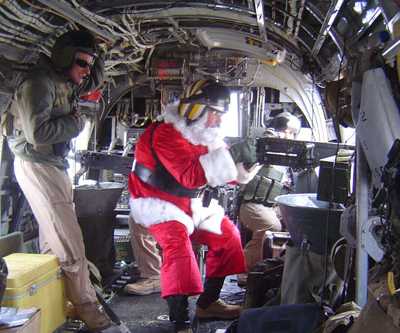
These are areas where the British Army is heavily deficient and to redress the inadequacies and the imbalances, we have produced our own Christmas list for Santa. It might as well be addressed to Santa for the chances of our own politicians (much less the media) paying any attention to it are pretty remote - although discussion of the list would make a fascinating feature in a Sunday newspaper. Anyhow, here goes:

Number one on our list is dedicated to base defence. This is the US-developed lightweight counter-mortar radar, in this case mounted on a USMC Light Armoured Vehicle (LAV) which itself is equipped with an advanced 120mm mortar for counter-battery fire. The combination is a potent weapon for base and tactical commanders having to deal with hit-and-run mortar and rocket attacks on their positions - whether they be large, established bases like the Shatt al-Arab Hotel in Basra or temporary positions such as those occupied by 3rd Para in Afghanistan.

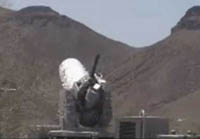
Option number two is for large, static bases - the C-RAM (Counter Rocket, Artillery and Mortar) gun based on the naval Phalanx system. This can be used to shoot down incoming mortar bombs and rockets, with an 80 percent success rate. The guns have the added advantage that the automatic firing provides audible warning of an attack, giving time for those at risk to run for cover.

The third piece of kit we desperately need is a medium tactical, high endurance UAV - or to be more specific, a UCAV (Unmanned Combat Aerial Vehicle) - the distinction being that this can carry weapons. The vehicle illustrated is the Hunter and, although there are other UAVs with similar performance, this has been fully developed to deliver low-yield precision guided missiles.

The Hunter can either be used for reconnaissance - locating enemy forces and relaying their positions to commanders, who can task other assets to deal with them - or it can be used as an attack weapon in its own right, firing missiles to take out small groups of the enemy (such as a rocket or mortar teams).

And this is the missile of choice - the Viper Strike. Originally designed as an anti-tank missile, it has been adapted to function in an anti-personnel role, with a capability also to take out light vehicles. Where so much fighting is carried out in urban environments with civilians present, the urgent need is for a weapon which minimises collateral damage. This missile has the ability to kill the occupants of one vehicle in a line, without damaging the others. Another characteristic of the weapon is its very steep attack profile - contrasting with the shallow flight-path of the typical missile - which makes it ideal for urban canyons.

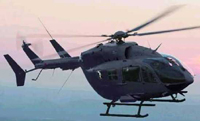
Number five on our list is a light tactical helicopter, of which many are needed. Smaller than the Lynx, they can either be one of the Eurocopter versions, an MD Enforcer or similar. They should be able to carry 4-5 troops as a rapid response force, stretchers for casevac, light weapons (including rocket pods) in the light attack role, and/or surveillance equipment for the search and observation roles. The crucial issue is the price, with their relative cheapness enabling the military to buy larger numbers of machines than at presently planned with the Future Lynx.

And, giving our commanders yet another option is the AC-130. With its array of gatling guns, cannon and its 105mm howitzer, its sensors and all-weather target acquisition capability, the "Spooky" as it is known, is a powerful - if expensive - addition to any armoury. It is capable both of laying down saturation fire to break up attacks and precision fire to take out specific targets. These formidable machines should be available in both Afghanistan and Iraq.

And alongside the "Spooky" we also need high-endurance, long range UAV/UCAVs such as the Predator or the more advanced MQ-9 Reaper. Although the government is currently acquiring three of these machines for Afghanistan, this seems a question of "too little - too late". We need enough to have at least one flying over every area of operation, with an organic UCAV capability. Reading just a fragment of the spec demonstrates why the MQ-9 comes into the "must have" category: it will be able to deploy the GBU-12 and EGBU-12 bombs and 500lb GBU-38 JDAM (Joint Direct Attack Munition). Flight trials have also taken place with the General Atomics Lynx SAR (Synthetic Aperture Radar) payload. Lynx also features ground moving target indicator technology...

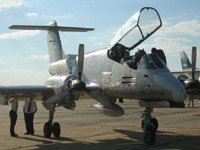
From the sublime to the ridiculous. The aircraft shown is the Argentinian-built Pucara, a twin turbo-prop ground attack aircraft used during the Falklands war. Not for one moment would I suggest that we have some of these but the picture is used to illustrate the concept of a light, cheap ground attack aircraft. At a time when the trend is towards greater sophistication, complexity and cost, against a relatively unsophisticated enemy, the "cheap and cheerful" concept ensures that there is always some capacity, as opposed to none at all - which is so often the case at the moment.

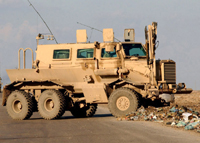
For the next item, we have the Force Protection Buffalo - equipped for mine and IED clearance. This machine is currently in service in Iraq where it provides invaluable service in detecting IEDs that would otherwise kill and main. So far, with the Cougars, which are used by bomb disposal officers, these vehicles have received over 1,000 hits from IEDs, without a single fatality. The British forces rely on a man walking in front of a vehicle (surprisingly they do not give him a red flag) and the bomb disposal officers have unarmoured "Duro" trucks. Neither is acceptable.

Then we need a mine/blast protected patrol and convoy escort vehicle, to replace the "Snatch" and "Wimik" Land Rovers. The 6x6 versions of the Cougar being bought by the MoD (and re-named the Mastiff) are too big and cumbersome to be used. The vehicle illustrated is the RG-31. It has proved its worth time and time again in Canadian and US hands, saving many lives in circumstances where Land Rover crews would have been killed. Nevertheless, the Australian Bushmaster would be just as acceptable as would - at a pinch - the German Dingo II.

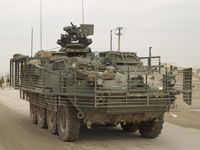
This picture shows a US Stryker wheeled armoured personnel carrier. Operations by the US in Iraq and by the Canadians in Afghanistan with their Bisons, have demonstrated the value of wheeled carriers. They are faster, quieter, more comfortable and cheaper to run - also requiring less maintenance. For sure, they do not have the cross-country performance of tracked carriers, but no one is suggesting that our Warriors should be dispensed with. Alongside tracks, though, there is a role for wheels. We need some.

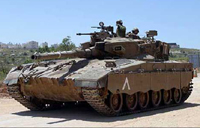
And finally... we need a new tank. The British Challenger II MBT (and the US Abrams) were built for taking out Soviet T82s at long range under all conditions. They were not built for counter-insurgency. Pictured is an Israeli-built Merkava MBT. It is not perfect but, with a personnel and stores carrying capability, it is better than other Western tanks. They performed well in Lebanon and provide a good model on which to base new designs. Not for this Christmas then, but in years to come, we want a new MBT from Santa.

As for the price tag - well, no one asks the price of Santa's gifts. If really pushed, one would have to concede that a decent number of the toys illustrated would set Gordon back several billions - perhaps as much as £5 billion. But since he is paying £15 billion a year to the EU, there is one very obvious place where he could get the money - and have some change. That would enable us to buy some more Hercules C-130J airlifters and some CH-47 Chinooks, which we also need, leaving £5 million to spend on more Vipir thermal imagers.

However, this is only my idea for a list. What would yours be? And what would the Conservatives suggest?

COMMENT THREAD