19 September 2006

Making you feel better

The next three weeks it is party conference time - a pretty miserable interval for anyone in Britain who is interested in serious politics. We are now to be tormented by the slap-stick version as practised by our joke political parties, of which we suffer three – the Liberal Democrats (most often known as the Lib-Dims), the (New) Labour Party (or Zanu-Lab as it is sometimes called) and the Conservative Party (more usually called the Tories, by friends and enemies alike).

The Lib-Dims go first, filling their agenda with endless policy debates of increasing unreality – like the current proposals to increase annual car tax from £190 for a modest saloon to £2000, and to add £2000 to the annual Council Tax bill. To follow is Zanu-Lab and then come the Tories, all with their carefully controlled agendas and stage-managed presentations.

Unsurprisingly, while the media pretends to take all this garbage seriously, filling acres of news space and wasting gigawatts of broadcasting power on coverage - and the more pretentious of the blogging community rush in to play at being journalists - sensible people in the political game try to arrange their holidays for this period or find urgent work abroad.

By contrast, for this short period, even our real government in Brussels looks vaguely interesting, especially as it is on the verge of being hoist with its own petard.

The precise cause of its embarrassment is the successful gathering by the OneSeat online campaign of a one million signature petition, addressed to the EU commission, demanding the end of the mad merry-go-round of alternating EU parliament sessions between Strasbourg and Brussels – wasting €200 million a year into the bargain.

This has put the commission on the spot as it has been a strong supporter of what it calls "participatory democracy" as a means of bringing "Europe closer to its citizens", leading communications commissioner Margot Wallström to be strongly in favour of this petition.

With the now failed EUs constitution having introduced a provision for one million signatures to become a "citizen initiative" for legislation, the fragrant Margot argues that Brussels must listen. "For the commission it is very important to show that we are welcoming an initiative involving so many citizens as this does and that we are happy to receive it," she says.

But there is one teensy, weensy little fly in the ointment – or nigger in the woodpile, if you prefer. The commission has absolutely now power to decide on whether Strasbourg remains a seat of the EU parliament. This bound up in the Treaty of Amsterdam, put in after John Major had been bounced by Chirac in 1992 at the Edinburgh European Council. What is in the treaties cannot be changed except by unanimity amongst the member states – and France will never allow the change.

Thus does our Margot declare, "This is not for the commission to decide on," adding rather plaintively, "but I think it is a matter of the attitude towards these types of initiatives and for citizens to know that there is somebody who listens or there is somewhere you can go with your strong views."

So there you are. We now know that there is someone out there who listens, to whom we can go with our "strong views". I am sure you all feel better for knowing that, even though it won’t make a blind bit of difference.

COMMENT THREAD

18 September 2006

A Eurosceptic paper?

Buried in the nether regions of The Daily Telegraph business section today is the most remarkable claim that "UK is now top dog in Brussels".

The story is penned by Edmund Conway who has previewed an as-yet unpublished report by the Europhile group "Business for New Europe" (BNE), comprised in the main of refugees from the now defunct Britain in Europe – itself an offshoot of the European Movement.

I cannot imagine that the Telegraph's Edmund Conway was totally unaware of these Europhile links, especially as the current chairman of BNE, Roland Rudd, is a former board member of Britain in Europe and the board is stacked with members like Leon Brittan, former EU commissioner.

But if Conway was aware of these links, he did not see fit to pass the knowledge on to his readers, telling us that the report was to be "published today by a group of leading businessmen." Only later in the piece does he identify the BNE and then only as a "campaign group" whose backers include WPP chief executive Sir Martin Sorrell, Carphone Warehouse chief executive Charles Dunstone, Reuters chairman Sir Niall Fitzgerald - to a man enthusiastic Europhiles.

We then get the undiluted message that BNE wishes to present – with not a hint of critical appraisal – followed by a quote from "Former European Commissioner Christopher Tugendhat". He is allowed to say, "This is a timely reminder of how much the European Commission has changed in recent years." But not said in Conway's piece is that Tugendhat is also a member of the advisory council of – you guessed it, Business for New Europe.

The funny thing is that many people are still under the impression that The Daily Telegraph is a eurosceptic newspaper. If it is, it has a funny way of showing it.

COMMENT THREAD

More grand but futile statements

It was only nine days ago that we wrote about grand but futile statements in relation to Darfur. Somewhat to our surprise, though, it seems Tony Blair does not read our blog, although perhaps he should. It would have saved him from making yet another er… grand but futile statement.

This one is in a letter to his 24 European Union "colleagues", telling them that he knows "…we are all determined to ensure that the international community does not fail to protect our fellow human beings facing slaughter," adding, "I am committed to do everything I can on this."

Doing everything he can is, in the real world, everything short of doing something effective. Such is the situation that Sudan president Omar al-Bashir has refused the deployment of UN troops, to take over when the mandate for the African Union peacekeeping force expires next month and, without his permission, the UN will not happen. China, amongst others, will make sure of that.

Thus, while president Bush is angry that "the United Nations hasn't acted" and wants to see a more robust effort, nothing is going to happen unless either the United States or some other country takes the lead with another "coalition of the willing".

Traditionally – with the disastrous exception of Somalia – the US avoids Africa, regarding it as a European sphere of interest, which leaves either France or Great Britain to take the lead. France will not – and possibly cannot – and Great Britain certainly cannot. When it comes to military assets, the cupboard is not only bare, the varnish has been stripped.

That, of course, leaves the "soft power" European Union – essentially the same group of countries that cavilled over sending an additional troops to Afghanistan and agonised over sending a mere 1,200 to the DRC.

The chances of the EU getting its act together and mobilising a sizeable body of troops to enter Sudan by force, therefore, is precisely nil. Effectively recognising that, all Blair is asking is that the EU should Eplay a central role in mobilising world opinion". He also wants the EU "strongly" to call upon government of Sudan and non-signatories to the cease-fire alike to stop immediately the violence in northern Darfur.

However, president Omar al-Bashir, having seen off the United Nations, is hardly likely to be impressed by the EU's calls and declamations so, as The Times remarks this morning, even the Sudanese first vice-president has forecast that further atrocities are inevitable.

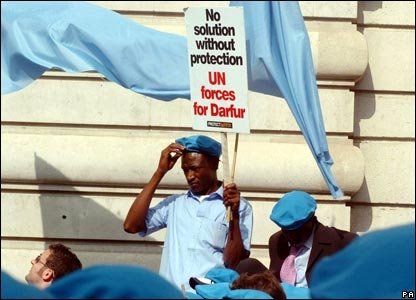
So it was that yesterday, peace activists around the world staged a day of action to highlight the "forgotten war". In New York, an estimated 20,000 gathered in Central Park to demand that the U.S. government pressure the Sudanese to stop the killings. "The world must act and it must do so now because time is not on our side," former US secretary of state Madeleine Albright said.

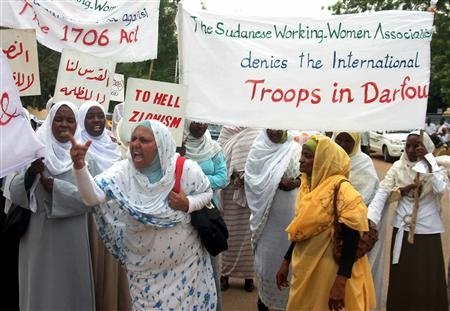
A similar demonstration was held in London, with Christian, Muslim and Jewish leaders delivering a plea and saying prayers outside No. 10, while another demonstration, this time in Khartoum (above right), marched on UN offices to oppose the deployment of peacekeepers.

It seems though that they have nothing to fear. While our leaders wring their hands and content themselves with grand but futile statements, the shadow of the 1994 Rwandan massacre looms large. In a grown-up world, we would be mobilising to stop genocide in Darfur.

It isn't going to happen.

COMMENT THREAD

17 September 2006

Another own goal

The closure of up to 60 hospital departments, planned by the government to enable it to meet the requirements of the EU's Working Time Directive, has been supported by the medical establishment, "as the only way to guarantee the highest standards of care for patients".

So says Jo Revill, health editor for The Observer today in a carefully spun article that effectively means the EU is causing the closure of key departments in hospitals throughout the country.

The squeeze started with the application of the Working Times Directive to doctors in training on 1 August 2004, when their average working week was restricted to 58 hours. That, itself – as we remarked at the time – was a popular move as there had been much concern about over-worked junior doctors making mistakes, and health care suffering as a result. But, from 1st August next year, the noose gets tighter when the permitted time drops to 56 hours and, two years later, it becomes 48 hours.

However, it is not only the restriction on hours which is causing the problem but a case in September 2003 (Landeshaupstadt Keil v Jaeger) when the ECJ held that all time spent by a doctor on-call in a hospital constitutes working time for the purposes of the directive.

Subsequently, the commission sought to redefine working time for doctors but its proposals have not progressed the case stands. Thus, as the Department of Health puts it, where work is of "low intensity", resident on-call arrangements would "not be a sensible use of doctors' time". Thus it "advises" employers to go back to first principles and look at "whether the service for patients could be delivered completely differently".

Combined with the growing NHS deficit, which means that health trusts are unable to fill the gaps with more doctors, delivering services "completely differently" means a "massive reconfiguration of hospital services", resulting in the closure of departments.

Mostly, it will affect the closure of casualty departments, small midwife-led maternity units and children's centres in smaller hospitals. It could also involve the closure of some hospitals in towns where they serve populations of less than 250,000.

However, the leaders of both the Royal College of Physicians and the British Medical Association are supporting proposals, agreeing that the Working Time Directive had made it increasingly difficult to maintain full emergency services running 24 hours a day in many hospitals.

The ultimate irony is that the directive need not have applied at all. It is part of the Social Chapter, from which Major excluded the UK during the Maastricht negotiations, and which Blair adopted when he came to power in 1997. That the health service is now having problems now is entirely due to Blair’s initial euro-enthusiasm when he came into office, making it a classic own goal.

It is fitting that, as he is on his way out, the fruits of that enthusiasm are now becoming apparent but, as always, it will not be Blair (or his family) that pays the price.

COMMENT THREAD

None so blind...

After my rant last Friday about the stupidity of Mary Ann Sieghart in The Times, for devoting her whole column to a complaint about the new seat belt law which come into force tomorrow, while failing to mention that the law was implementing an EU directive, today it is the turn of The Sunday Telegraph to exhibit exactly the same level of stupidity.

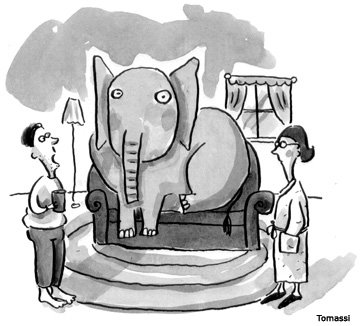
Even in their own terms, this is dismal hackery but, in their determination to avoid confronting the elephant in the room, these hacks are missing an even bigger story. Not only is the EU imposing "safety" laws of dubious value, it is also stopping the UK government from introducing much-needed road safety measures that would prevent thousands of accidents.

Dealing first with the Telegraph article, we have no less than two dismal hacks, Ben Leapman and Roya Nikkhah, blathering under the title, "Doubts and confusion as child car seat rules are tightened up".

We are told that, "Rules on car seats for children look like stalling before they get started, with the minister responsible for their introduction describing it all as 'a bit confusing'", with critics railing against the law because "it takes little account of children's varying size and weight…".

Then we get a quote from Pat Harris, the founder of Belt Up School Kids, adding his own brand of confusion with a declaration that, "We believe the Government should delay their introduction."

Someone please should have told him that not only is this law implementing an EU directive, it should have been implemented in May and, if the government delayed any further, we would be up in front of the EU court of justice a risk of massive fines for failing to obey our government in Brussels.
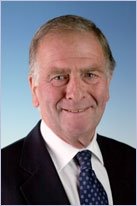
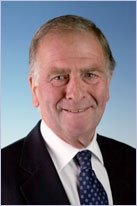
Roger Gale MPBut, to compound their own stupidity, the hacks then turn to Roger Gale, the Conservative MP for North Thanet, who is given space to describe the new law as "the nanny state run amok". "Of course, parents want to protect children in cars," he burbles, but laws have to be sensible and enforceable". Not a single mention of the EU.

Why, one must ask of the hacks, ask Gale? He has no transport portfolio in the opposition ranks. What not ask the shadow transport minister, who actually represented the opposition when it was debated in the House?

That apart, the problem once again, of course, is that the ordinary reader, unaware of the issues, would take this article at face value, and thus would be further ill-informed rather than instructed – this seemingly being the role of the modern media. And it is this "leaving out" which does so much damage in distorting the debate about how badly we are governed.

Three classic examples of this occurred earlier this year during the committee stage of the Road Safety Bill. The Conservatives, adopting the new, "non-confrontational" approach of their new master, the Boy King, decided to support its main provisions but also decided to introduce a series of constructive amendments, tightening up safety where there was real evidence of a need.

One of those was a proposal by Owen Paterson, shadow transport minister, to make mandatory "blind spot" mirrors on foreign trucks. This was not particularly controversial. It had been brought to the attention of committee members by the experience of the wife of Julian Brazier, MP for Canterbury. She had had a horrible experience when overtaking a Hungarian lorry on the M2 – very near the constituency of Dr Stephen Ladyman, the transport minister.

She had been pushed into the central barrier, and the young Hungarian driver was aghast and horrified at what had happened. His lorry was completely legal according to Hungarian regulations, but did not have a wide-angled mirror fitted to the passenger side of his lorry. As a result, he simply did not see her.

The important issue here was that an EU directive was already in force making it compulsory for all new heavy goods vehicles to have wide-angled mirrors from 26 January 2007. Furthermore, Holland and Belgium had already gone down that route and sought permission from the Commission to make it compulsory to fit Class 4 wide-angled mirrors to all HGVs.

Analysis had already shown that the retrofitting of mirrors had been effective and there was clear anecdotal evidence of the danger. Thus, the directive as it stood was not good enough because it would apply only to new vehicles.

The idea was supported by David Kidney, Labour MP for Stafford, who recounted his own horror story. A constituent of his had told him he was luck to be alive because when driving home on the motorway he had been overtaking a lorry from Turkey which pulled out and struck his car, turning it round completely. He found himself driving at 70 mph in the wrong direction down the middle lane of a three-lane motorway.

Nevertheless, despite this, Dr Ladyman advised the Committee against accepting this new clause. It was not, he said, because he did not believe I was not right in identifying this as a very real issue. All Kent MPs, he said - of which he is one, with a wafer-thin majority of 612, were aware of the problem. But, he added, "it is more complex than the hon. Member for North Shropshire (Owen Paterson) realises."

That complexity, it turned out was EU law and what is known the "occupied field" doctrine – which prevents member states legislating in areas where the EU already has competence (which it gained under the Maastricht Treaty).

Simply, because of that, the minister said, we could not enforce any requirement on foreign lorries. We could require it for our own lorries, and when they go abroad and have the same problem on the other side of the cab it would be useful, but it would not help with foreign lorries coming into the UK. All he could offer was the assurance that the Commission had identified a problem and had started a consultation on how to insist on retro-fitting. But, he could give no indication as to when the issue would be resolved or indeed whether.

This, concluded Dr Ladyman, was an area the Commission has competence. "The structural requirements for vehicles are a matter for the EC. We can require things to be done on our own vehicles, and that is probably what the Dutch have done, but we cannot require changes to made to every vehicle entering the country."

Another amendment was a highly technical proposal requiring all HGVs to be fitted with an audible warning system that shall sound if the driver exits the vehicle when the brakes were not applied.

This, as with the mirror amendment, was introduced by Owen Paterson, after he had been told that approximately seven people a year were killed in accidents involving a driver hitching the tractor unit of a semi-articulated trailer to a stationary trailer, often in a yard.

The problems was that, when the airbrakes have no air, they are applied and, therefore, a parked trailer in the yard will be safe and secure with the brakes on, because there is no air coming through. But, when the tractor unit is reversed up, the driver will sense a big clunk as the big, greasy black disc - the fifth wheel - connects to the coupling on the trailer. What should happen then is that the driver applies the handbrake so that the whole unit of tractor and trailer is connected.

Sadly, that often did not happen. Instead, with the trailer airbrakes still not connected, and because the driver felt that the unit is stable, he jumped across the catwalk and connects the hoses that introduce air to the air brakes. Immediately, the air brakes come off. At that point, because the handbrake is not applied and the air takes the trailer brakes off, the whole unit begins to move.

For self-preservation the driver should sit tight, but all too often he jumps down, frantically scrambling for the cab to try to apply the handbrake in the vehicle. Alternatively, the whole unit runs backwards and crushes someone else in the goods yard.

For that reason, Paterson proposed an alarm to be fitted to every heavy goods vehicle so that when the driver jumped down from the cab without the brakes on, an alarm goes off - a simple, common-sense solution. Again, the costs were modest about £100 on a rig that may cost £100,000.

Once again, Dr. Ladyman conceded that there was a real problem. However, he said, "the sort of regulation that he suggests cannot be introduced unilaterally in the United Kingdom; it would have to be a matter for European-type approval." So, once again, his solution was “to work with the Commission and with European "colleagues" to "make them realise the benefits of including the provision in future changes to regulations." Because this was an "occupied field", this great sovereign nation of ours had no powers to make laws in this area.

However, it was not only the Conservatives that introduced amendments. Dr Brian Iddon, the Labour MP for Bolton South, also proposed one, which the opposition strongly supported. This was to require, by 2007, the compulsory fitting of reflective tape markings on the sides of HGVs in order to reduce side collisions.

Here, there was already an EU law in preparation, a technical specification had been agreed and the tape was commercially available. But the law was not expected to come into force until 2011 while, each year – according to the Transport Research Laboratory - an estimated that 30 to 34 occupants of cars were killed every year in collisions with the tail end of HGVs and that another 40 to 44 people were killed in collisions with the side of HGVs. Additionally, there were many serious injuries.

The tape had a proven record of reducing such collisions and, at the rate of 385 a year, there would be 1,540 more collisions if the measure was not introduced until 2011, when the EU was expected to make it mandatory.

Furthermore, for earlier introduction, there was cross party support and Henry Bellingham had a particularly strong reason to be in favour. His stepfather had been killed when travelling south on a dual carriageway section of the A1. He had driven under a lorry that was squatting in the central reservation with its trailer in the fast lane on an unlit section. No one travelling at 70 mph could have stopped in time. What was more, the industry was in favour and the cost was modest – about £100 per vehicle – and the application of the tape could be arranged easily and quickly. There was no case for any further delay in a measure which had been in the pipeline for time years.
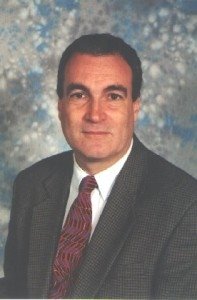
Dr Dr Stephen Ladyman, transport minister - hands tied by EU lawOnce again, however, Dr. Ladyman opposed the measure. A "persuasive case" had been made, he agreed. But, while the government could permit the use of the tape, it could not make it a requirement, "because of obligations under United Nations Economic Commission for Europe measures and EU directives". We could not, he added, "make any unilateral requirement of vehicles in this country". If we were to change the legislation in the way suggested, "our partners in the European Union would certainly object and take infraction proceedings against us". The amendment and the clause were "redundant and perhaps illegal… we would certainly be breaking EU law and proceedings would be taken against us."

It was left to Dr Iddon to remark that he was "tempted to break certain European laws because they are barmy". His personal opinion was that Britain should be given the chance to go ahead on these sorts of issues unilaterally without having to wait for the rest of Europe to join us. But it was not to be.

Thus, in three proposed amendments, where there was no dispute about their merits – and widespread support for them – the EU doctrine of the "occupied field" intruded and Members of Parliament and a Minister were disbarred from making laws in our own House of Parliament which would have, indisputably, saved lives - all because, in 1990, we had given away our power to legislate on road safety.

The point here is that we are not dealing with "Euromyths" or eurosceptic scare stories about things which might happen in the future. This was "here and now", the ordinary, boring business of Parliament, going about its routine business of making and amending laws, to make Britain a safer, better place. And neither the MPs of both main parties, including members of the governing party, and our own transport minister, were allowed to do the job for which they were elected.

And was any of this of any interest at all to the MSM? Don't even bother answering. Blind, stupid, ignorant, or what…?

(amended 21 September)

COMMENT THREAD

16 September 2006

Putting it all together

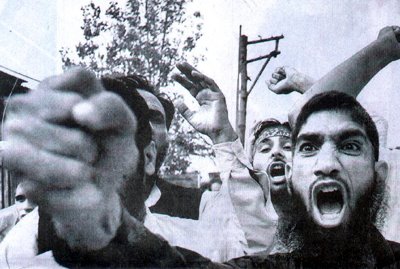
A Muslim demonstrating against the Pope's speechMore than anything else, the photograph tells you all… the face of Islam as it protests against the imagined slight from the Pope, heedless of the fact that no offence was intended or in fact given.

Now, we are told, the Pope has apologised although, as my colleague indicates, the words used hardly convey any regret. And nor should they.

In fact, the last thing the Pope should do is apologise – there has been far too much apologising of late. It is about time the Western world recognised that, when you are dealing with figures such as the one pictured above – face contorted with hate – you do not apologise.

You send them a signal that affirms your own rights and values. If that hatred then turns to violence which threatens our own wellbeing – as it has done – you respond first with counter-threats and then, if the violence does not end, you kill those responsible for it. This is the way it has always been. To pretend otherwise is to ignore history – and the consequences of submission.

The fatal weakness for Western society, however, is that we are rich enough to delegate the killing to our armed forces. And because it is happening – by and large – in far distant lands, we can detach ourselves from it, ignore it or even disown the actions being carried out on our behalf.

However, for us as a society to send off our troops to kill and be killed – and then either to ignore or forget them – is nothing new. Veterans of the Burma campaign in 1945 dubbed their own 14th Army the "forgotten 14th". Conscripts returning from the fighting in the Korean War speak of even their close "mates" being unaware of the reason for their absences and, despite the occasional viciousness if the fighting during the Malaysian insurgency, that too rarely hit the headlines. It was another "forgotten war".

What is different now though, is the global reach of the enemy and its focus on Western civilisation as its enemy. The jihadists are not content merely with expelling what they believe to be foreign occupiers. They are also intent on bringing the war to their enemy.

In times past, defeats in far distant lands would have had no immediate repercussions on the homeland. This was especially true of colonial wars, where actual defeats did occur, which had no measurable effect on the well-being of the domestic population.

Now, enemies that our troops are fighting in Afghanistan or Iraq are the trainers and supporters of our own domestic terrorists and could even become the "fighters" who plant bombs on London tubes or international aircraft. If we lose militarily in any of these far flung places, a newly invigorated and emboldened enemy would not hesitate to strike harder and deeper so, unlike those times past, we stand to suffer the consequences locally.

To win these wars, many things must come together, all of which are inter-linked and inter-dependent.

Firstly, the government of the day must support them – in terms of political support and in providing the resources and strategic direction, against clear and attainable objectives. But those things alone are not enough. The government itself must be committed to winning. It must be prepared to meet changing circumstances and devote all or any resources necessary to winning and must maintain political, media and public support for its actions.

Secondly, there must be the support of parliament, or its least its tolerance. In the absence of both, Members of Parliament can undermine political resolve and, in extremis, bring down the government if it feels strongly enough.

Crucially, in order to keep both government members and the politicians "on side", there must also be the broad support of the media – or at the very least, the absence of a concerted "anti-war" campaign which will weaken political resolve and mobilise public hostility in a way that will affect the electoral base of the government.

Then there must be public support but, again, not necessarily active support – merely the absence of overt hostility of such an intensity that any or all of the wars become significant electoral issues, to the extent that continued prosecution could bring down the government in a general election – or even force a vote of confidence in Parliament.

Finally, for the purposes of this discussion (there are, undoubtedly other issues), the armed forces must have the right leadership, sufficient numbers of trained personnel, the resources and equipment, and they must employ the tactics most appropriate for the situation on the ground.

As to fulfilling all the winning criteria, what we see with Iraq and Afghanistan is an absence of attainable objectives and, stemming from that, the lack of strategic direction. No one is sure precisely what is attainable, in either Iraq or Afghanistan. There is, instead, the vague declared objective of bringing "security" so that the respective elected governments can govern effectively and maintain law and order but the forces on the ground have neither the resources, numbers or equipment to attain that objective.

Arguably – and it is a highly contentious proposition – the government could provide those resources but, given that both the wars in Afghanistan and Iraq are unpopular (the former not quite as much as the latter) and expensive enough as it is, to increase those resources might increase the unpopularity to such an extent that resistance stiffens to the extent that they become electoral liabilities.

That the government seems unwilling then to increase the resources to a level where either war becomes winnable, that suggests that it is not actually committed to winning, but is merely going through the motions. It is evidently not prepared to invest the political capital that will ensure victory. And this is where the media comes in.

As a surrogate for public opinion (politicians and the government generally believing that the media does represent public opinion) and with the ability to marshal public sentiment either for or against the wars, the media is crucial.

Given active support for the wars, a good understanding of what is necessary on the ground to win and, and the ability knowledgeably to evaluate weaknesses and demand appropriate remedies, the media is in a position to bolster political and public support. It could, on the one hand, enable to the government to do what it wishes to do to win the wars, but has not done for fear of the electoral consequences, or stiffen its resolve when it fails to take the necessary steps.

In effect, it is probably not an exaggeration to assert that the media are the key to winning these current wars. And, if they are the key to winning, the absence of their support can also lose them for us.

Here there are many problems. On balance, it is probably fair to say that none of the media outlets are wildly enthusiastic about the government having committed our forces to these wars but the general – but by no means firm – consensus is that, since we are committed, we need to win them.

From there it is possible – tentatively at least – to identify where the problems with the media lie. Essentially, there seem to be two. Firstly, the media – rather like the government – has only a vague idea of what the strategic objectives are and then, what it takes – by way of resources – actually to achieve victory.

Perhaps, though, it is the latter that is more important - and certainly more urgent. Given that tactical victories can be sustained, strategic objectives can emerge and be refined in the space created by military success. And, if that is they case, this is where the media are dismally failing.

To offer two egregious examples, both from The Daily Telegraph, the first is an opinion article three days ago from Allan Mallinson, a former Army officer. Under the title, "The Army needs 10,000 more men", he asserts that undermanning in the Army must be resolved, with a rapid boost to the current establishment.

That may be the case – and we would not disagree – but Mallinson also criticises expenditure on equipment projects, many of which are – he asserts - left over from the Cold War. In this, he cites the Eurofighter, asking what is the point safeguarding the skies from a non-existent threat if there aren't enough utility helicopters to fly the Army about a growing number of battlefields? He then continues:

A century ago, pondering the uncertainties of the late-Victorian world, the great historian of the Army, Sir John Fortescue, remarked on a sentimental public tendency: "The popular admiration was not very intelligent, nor was it very helpfully guided by the press.

Neither the one nor the other, pardonably enough, knew anything of the history of the army." Given the events of late, a sentimental, parsimonious tendency is not pardonable today. The habit of success is relatively new, and failure is a possibility. That should be the starting point for the debate the new CGS wants.
Fine sentiments, but Mallinson, in his current role, is the "press" and while he calls most strongly for more men, he makes no case for the vast range of additional – and expensive – equipment that we need to win the wars. And, as we remarked earlier, men without the right equipment in the right quantity are simply targets.

Thus do we come to the grand old man of journalism, W F Deedes, who two days ago wrote in his notebook section a lament four our "hard-pressed soldiers". He then writes:

I take note of the Ministry of Defence's assurance that they are now doing all they can to supply the Army in Afghanistan with what it needs, for we are in crisis there. But it cannot give them what we don't possess, such as heavy-lift helicopters.

There are other items, as there are in Iraq, which the Army ought to have, but cannot expect to get because they are not available.

Has the MoD's procurement policy been at fault, as some declare? Or did the Treasury hold the MoD's purse strings too tightly for too long? Churchill once sagely described the problem of rearmament as "first year, nothing; second year, a trickle; third year, a flood". When did the MoD first become aware of what the intentions of our internationally minded Prime Minister would require of them? How did the Treasury respond?
The piece continues in this vein, leaving nothing more than a series of unanswered questions. This is not good enough. To the questions Deedes poses, there are answers – and the answers are known. It is simply cheap and sloppy journalism to take such an easy way out, instead of identifying the problems and demanding action.

And, if the Telegraph is bad, none are any better. We have a media which – on current form – had demonstrated that it is incapable of doing a job which, currently, only it can do. It was not always thus. Lord Beaverbrook, for instance, in the days when The Daily Express was the most powerful newspaper in the land, was at the forefront in campaigning for better equipment for the Royal Air Force, getting right down to detail as to which aircraft should be bought, and why.

Putting it all together, therefore, we have a situation now where we not only have a bad media, but one which has within it capability to loose us the wars in Iraq and Afghanistan – which it seems intent on doing.

COMMENT THREAD

05 September 2006

Europe Day

Jean Monnet and Robert SchumanAlthough the EU is quick to denounce "Euromyths", what very few people realise is that the European Union itself is based on a foundation of its own myths, assiduously cultivated to project an entirely false image of modernity.

No greater myth can be found that in the commission's carefully crafted account of Europe Day, which it "celebrates" today, coincidentally alongside the Russians who celebrate "Victory Day", the anniversary of the end of what it calls "The Great Patriotic War".

Claims the commission, "probably very few people in Europe know that on 9 May 1950 the first move was made towards the creation of what is now known as the European Union," thus perpetuating the myth that this indeed was the first (and successful) attempt at creating a construct, the intellectual genesis of which actually lies in the 1920s, as a reaction to the problems arising out of the First World War.

But, claims the commission, in Paris that day, against the background of the threat of a Third World War engulfing the whole of Europe, the French Foreign Minister Robert Schuman read to the international press a declaration calling France, Germany and other European countries to pool together their coal and steel production as "the first concrete foundation of a European federation". The narrative continues:

What he proposed was the creation of a supranational European Institution, charged with the management of the coal and steel industry, the very sector which was, at that time, the basis of all military power. The countries which he called upon had almost destroyed each other in a dreadful conflict which had left after it a sense of material and moral desolation.
Thus, concludes the commission, "Everything... began that day".

Needless to say, the reality is very different. Far from the heroic Schuman standing at the centre of the "project", he turns out to be little more than an unwitting stooge, manipulated by one man who had made its his life's work to set up a "government for Europe".

That man, of course, was Jean Monnet. At the time, he was nearing the end of implementing his four-year plan for the "modernisation" of France. Already, he had seen two post-war attempts at creating his "government" fail, the OEEC, created on the back of the Marshall Plan, and the Council of Europe. With a sense of resigned detachment, he had decided that neither of them could

…ever give concrete expression to European unity. Amid these vast groupings of countries, the common interest was too indistinct, and common disciplines were too lax. A start would have to be made by doing something more practical and more ambitious. National sovereignty would have to be tackled more boldly and on a narrower front.
However, if Monnet was sure that something much "more practical and ambitious" was needed to achieve the desired goal, then events in the late spring of 1950 conspired to create precisely the opportunity he was looking for.

During 1949, West Germany had finally emerged to self-government under the Chancellorship of Konrad Adenauer. Under its Basic Law, passed on 8 May 1949, the new Federal Democratic Republic, or FDR, was based on a federation of the eleven highly decentralised Land governments which, on British insistence, retained considerable power, guaranteed by a constitutional court. In crucial respects the federal government, centred in Bonn, could not act without the consent of the Länder. In particular, all international treaties had to be ratified by the Länder through their legislative assembly, the Bundesrat.

At the time, the new Germany, under the guidance of Ludwig Erhard, was already showing signs of a remarkable economic recovery. This raised the question of how the new nation should be assimilated into the western European community. At the Council of Europe in August 1949 Churchill had shocked many delegates by proposing that she should be given the warmest of welcomes. Two of the western occupying powers, the USA and Britain, wanted to see her continue on the road towards full economic recovery and nationhood as soon as possible. But this had provoked a deep rift with France, which wanted to continue exercising control over the German economy, for fear that she might once again become too strong a political and economic rival.

The argument centred on that old bone of contention, the coal and steel industries of the Ruhr, heartland of Germany's economy and formerly the arsenal of her war machine. In 1948, France had demanded the setting up of an International Ruhr Authority, which would enable French officials to control Germany's coal and steel production and ensure that a substantial part of that production was diverted to aid French reconstruction. It was a curious echo of France's disastrous policy after the First World War. Naturally the new West Germany was bitterly opposed to such an authority. Equally so were the other two occupying powers, America and Britain.

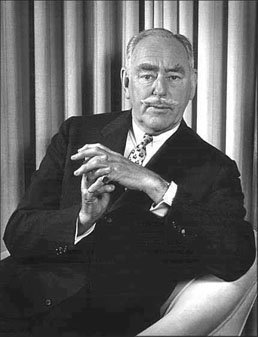
For over two years this dispute had festered, without resolution. But in the spring of 1950 the US Secretary of State Dean Acheson finally lost patience. He issued France with what amounted to an ultimatum. On 11 May there would be a foreign ministers' meeting in London; and unless the French could offer a satisfactory compromise proposal, the USA would impose a solution on all parties.

Disused (now) blast furnaces on the Ruhr - the foundation of the EUThis gave Monnet the opportunity for which he had been waiting. For years he had dreamed of building a "United States of Europe", beginning by integrating the coal and steel industries, and setting up a supranational authority to run them. This was the idea first put forward in the 1920s, by Coudenhove and Louis Loucheur, and partly implemented by Luxembourg steel magnate, Emil Mayrisch in 1926. It was the idea Monnet himself had outlined to Paul-Henri Spaak in 1941 and in a memorandum he had written in Algiers in 1943.

What Monnet had in mind was that the coal and steel industries, not just of France and Germany but of other western European countries, should be placed under the direction of a supranational authority: just as over dinner in Paris in 1917 he and Arthur Salter had come up with a similar plan for the control of allied shipping.

When Monnet came to commit his plan to paper, he was obviously troubled by how much he dare reveal of its real underlying purpose. Before getting to its final stage, it went through nine separate drafts. In the first, the pooling of coal and steel was regarded as "the first step of a Franco-German Union".

The second opened it up to the "first step of a Franco-German Union and a European federation". By the fifth draft, this had been changed to "Europe must be organised on a federal basis. A Franco-German Union is an essential element is this". The seventh demanded that "Europe must be organised on a Federal basis". But, by the final draft, almost all this was missing. All he would allow himself was a reference to the pool being "the first step of a European federation", a vague term which could mean different things to different people.

Although what Monnet really had in mind was the creation of a European entity with all the attributes of a state, the anodyne phrasing was deliberately chosen with a view to making it difficult to dilute by converting it into just another intergovernmental body. It was also couched in this fashion so that it would not scare off national governments by emphasising that its purpose was to override their sovereignty.

Dean Acheson - US Secretary of State and 'unwitting' conspirator in the creation of the EUOnce his memorandum was complete, Monnet's next problem was how to get it adopted. He could not act as the champion of his own plan. As a natural behind-the-scenes operator, his style was always to act indirectly. He needed to win over very senior support in the French government. In this, he had few problems as he had constant contact with senior members of the French government. His obvious choice was foreign minister, Robert Schuman. It would be he that would have to face US Secretary of State Dean Acheson in a few days time. Monnet knew that his officials had few ideas to offer. He would most likely, therefore, be receptive to some new ideas.

Furthermore, as a potential advocate, Schuman had other advantages. Born in 1886 in Luxembourg to a German mother, he was fluent in both German and French, having read law at the universities of Berlin, Munich and Bonn. He had then moved to Alsace Lorraine when it was under German rule, which meant that in 1914 he had been recruited into the German army. Yet in the Second World War, when Alsace Lorraine was again part of Germany, he had, as a French citizen, been arrested by the Gestapo. He was thus a perfect witness to the need to resolve the Franco-German conflict.

To get to Schuman, Monnet approached his chef de cabinet Bernard Clappier, telling him to advise his boss that he had some ideas for the London conference. He had expected Clappier to call him back but, by Friday 28 April, Monnet had heard nothing. Fearing that Schuman was not interested, Monnet sent a copy of his memorandum to prime minister Georges Bidault, via his closest aide, again asking for it to passed on. In the memorandum, Monnet wrote of the "German situation" becoming a cancer that would be dangerous to peace. For future peace, he wrote, the creation of a dynamic Europe is indispensable:

We must therefore abandon the forms of the past and enter the path of transformation, both by creating common basic economic conditions and by setting up new authorities accepted by the sovereign nations. Europe has never existed. It is not the addition of sovereign nations met together in councils that makes an entity of them. We must genuinely create Europe; it must become manifest to itself…
Alas for Bidault, who thereby missed his chance of immortality, the memorandum did not reach him. Meanwhile, Clappier had re-appeared full of apologies. Monnet gave him a copy of the memorandum and immediately decided that Schuman should see it. He caught him at Gare de l'Est, as he was sitting in a train, waiting to go to Metz for the weekend. When Schuman returned to Paris, after studying the document, he had adopted the plan wholeheartedly. It had now become the "Schuman Plan", although in reality it was not his at all. In the final analysis, he was not even committed to it, except as a device to get him off a hook.

Once Schuman had agreed, the contents of the Plan were passed by his office in great secrecy to the German chancellor, Konrad Adenauer, in the hope of securing his provisional agreement. Other governments, especially the British, were not told. According to Professor Bernard Lavergne, a prominent political commentator of the time, who was to publish a highly critical study of the plan:

The curious thing was that M. Bidault, the Premier, was – at least, at first – not at all favourable to the Plan which, in early May, was suddenly sprung on him by his Foreign Minister, M. Schuman. And oddly enough – though this was typical of M. Schuman's furtive statesmanship and diplomacy – neither was M. François-Poncet, the French High Commissioner, nor the Quay d’Orsay, or even the French Government, properly informed of what was going on during the days that preceded the "Schuman bombshell" of 9 May.
However, "as a result of a curious coincidence", Dean Acheson was already on his way to the summit in London, and had decided to go via Paris to confer informally with Schuman. By another "coincidence", Monnet was present at their meeting. As Monnet disingenuously put it, "courtesy and honesty obliged us to take Acheson into our confidence". The Plan was also presented to the French Cabinet, but only in a most perfunctory way:

Only three or four ministers were informed about it (the Plan), and when, finally, on 8 May, the Council of Ministers met, no serious discussion took place at all. Schuman gave them a rough sketch of the Plan, and, without really knowing what it was all about, they gave it their blessing.
Schuman then took an audacious step. He would announce "his" plan by appealing directly to the peoples of Europe, through the media. In a radio broadcast on 9 May 1950 – today officially commemorated as "Europe Day" – he revealed Monnet's plan to the world. "World peace", he began,

…cannot be safeguarded without the making of creative efforts proportionate to the dangers which threaten it. The contribution which an organised and living Europe can bring to civilisation is indispensable to the maintenance of peaceful relations. In taking upon herself for more than 20 years the role of champion of a united Europe, France has always had as her essential aim the service of peace. A united Europe was not achieved and we had war. Europe will not be made all at once, or according to a single plan. It will be built through concrete achievements which first create a de facto solidarity. The coming together of the nations of Europe requires the elimination of the age-old opposition of France and Germany…

With this aim in view the French Government proposes that action be taken immediately on one limited but decisive point…it proposes that Franco-German production of coal and steel as a whole be placed under a common High Authority, within the framework of an organisation open to the participation of the other countries of Europe. The pooling of coal and steel production should immediately provide for the setting up of common foundations for economic development as a first step in the federation of Europe.
After describing how "the solidarity in production thus established will make it plain that any war between France and Germany becomes not merely unthinkable, but materially impossible", he went on to say that this would help simply and speedily to achieve "that fusion of interest which is indispensable to the establishment of a common economic system".

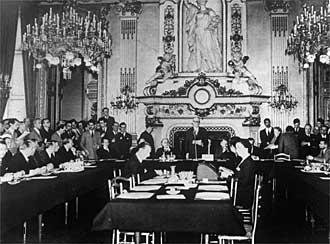
Schuman announcing 'his' plan - like so much to do with the history of the EU, the photograph is a fake.  At the time, Monnet failed to arrange for photographers to be present, so the 'historic' event was reconstructed some days after 9 MayThis was the "Schuman Declaration" which now occupies pride of place on the EU's Europa website as the document "which led to the creation of what is now the European Union". Yet, according to one historian, although the plan was immediately greeted with great excitement by the press, the curious thing was that literally nobody knew exactly what it was about, not even Schuman.

The whole thing was an elaborate charade, a meticulous coup by the puppet-master extraordinaire, Jean Monnet, to a plan he and his colleague Arthur Salter had devised all those years ago, to deal with a different war and an entirely different geopolitical situations.

But, with the backing of the commission, the myth endures. Hilariously, though, when I addressed a group of 150 sixth-formers recently, on the history of the European Union, not one of them knew that 9 May was "Europe Day". For all the effort the EU has expended on cultivating its core myth, it has failed to have any decisive impact. It is truly an idea whose time has gone.

The core of this narrative is drawn from The Great Deception by Christopher Booker and Richard North.

COMMENT THREAD