19 October 2006

Passing of a great man

Some of our readers might have heard the sad news of the death of Lord Harris of High Cross. Yes, yes, I know he was in his eighties but that does not alter the fact that his passing fills one with great sorrow both on the political and, in my case, personal level.

Ralph Harris was one of the people responsible for the intellectual underpinning of the Thatcherite revolution. His colleague, Arthur Seldon, died last year. (And, by a strange coincidence, I attended yesterday the memorial meeting for Sir Alfred Sherman, a somewhat more controversial figure but one whose achievements must not be overlooked. Lady Thatcher was present, looking fragile but well.) Sadly, that generation is going and we shall all be the poorer for it.

I have known Ralph since my teens (though he actually thought he had known me as a young child) as my father attended the IEA lunches in the late sixties and early seventies, when their ideas were generally considered to be a brand of harmless lunacy at best. Even in those days Ralph cultivated his persona of the Edwardian gentleman, hats, moustaches, waistcoats and walking sticks included.

What mattered above all was not his mannerism, not even his fantastically ebullient personality – nobody could ever forget Ralph even after a brief meeting – but his hard-headed approach to Britain’s problems.

Neither he nor Arthur Seldon would have been welcomed in the wishy-washy, condescendingly tory-toff Conservative Party of David Cameron. They would both have been horrified to hear that a Conservative Party leader could snootily dismiss the notion of choice in education for all. I can still remember Ralph Harris’s tones when he talked about that public school boy Anthony Crosland vowing to destroy “every f***ing grammar school”. [Apologies for the implied swearing – those are the words Crosland used.]

Ralph Harris came from a working class family in north London, went to a grammar school and thence to the University of Cambridge. He knew the importance of good education for people who wanted to rise and achieve; he, as well as Arthur Seldon, knew that the working classes had been perfectly capable of looking after themselves and their families; they knew how destructive the welfare state, imposed largely by do-gooding middle class politicians, been to working class families and, beyond that, to the whole of this country’s society.

Lord Harris with Arthur Seldon and Friedrich HayekWhen, in 1956, Antony Fisher decided that the best way to combat the prevailing socialist ideology of the time was to set up a think-tank that would generate ideas and argue the issues according to rigid intellectual principles, he recruited Ralph Harris from St Andrews University to be the new general director. Harris recruited Arthur Seldon to be the editorial director.

As John Blundell, the present General Director of the Institute of Economic Affairs put it:
Over the fireplace in the boardroom at 2 Lord North Street, the very room in which this conversation takes place, hang four framed photographic portraits. Top left is 1974 Nobel Laureate F. A. Hayek and top right is the entrepreneur Antony G. A. Fisher.

Below Hayek is his pupil Arthur Seldon and below Fisher is his protégé Ralph Harris. This arrangement is quite deliberate and many is the time in that room when, speaking about the IEA, I have, pointing up to all four great men and moving my finger clockwise from Hayek, said: ‘Hayek advises Fisher; Fisher recruits Harris; Harris meets Seldon. In nine words, that is the start of the IEA.’
Well, the rest is history, though it took a long time and a great deal of work for the ideas to seep through to the media, the political class and a sufficiently large part of the population to make some of them, at least, come true.

Ralph, himself, has always acknowledged that the battle has been only half-won, what with ever greater regulation being imposed on the privatized sector and no attempt to reform and transform the public sector. They won some of the battles of ideas but not others.

It was not in Ralph’s nature to rest on his laurels. He continued to be involved in IEA affairs even after he formally retired; he founded the Centre for Research into Communist Economies (now Centre for Research into Post-Communist Economies), which taught many of the East European reformers, continuing even now to provide them with intellectual backing; he founded and continued to be active in FOREST, the pro-smokers’ rights organization, speaking frequently on the subject in the House of Lords whither he had been sent by Margaret Thatcher in 1979 (typically, he chose to sit as a cross-bencher).

Perhaps, his greatest achievement after the founding of the IEA was the founding of the Bruges Group in 1989 to be an independent euro-sceptic think-tank. He was its first chairman and, as is his wont, continued to be interested in its affairs, turning up for meetings in his trilby and brandishing a walking stick.

After my father’s death I saw little of Ralph for several years. Then, in the early eighties I translated a book by Gorbachev’s economic adviser, Abel Aganbegyan, whom Ralph met in the Soviet Union. The book was called “Moving the Mountain”, which amused Ralph and his wife no end, as Mr Agabengyan himself resembles a mountain of no mean proportions.

The book was published to some notice and my own copies were put aside. Then one day I received a letter on House of Lords stationery from Lord Harris of High Cross. He had read the book, noted the name of the translator (a most unusual behaviour) and decided to get in touch.

We remained on friendly terms and fond as he was of my parents, he found it extraordinarily pleasing to be working or, at least, discussing work with me, especially in the Bruges Group. Ralph had been in favour of the Common Market in the sixties, seeing in it the salvation for Britain’s sclerotic, socialist economy. As time went on and the supposed free market failed to materialize and as the European project came to resemble ever more that hated socialist system, he became more and more euro-sceptic, favouring speedy withdrawal and a rebuilding of Britain.

This summer Ralph introduced the Bruges Group meeting, which I then chaired, at which Jim Bennett, author of “The Anglosphere Challenge” and founder of the Anglosphere Institute spoke. Ralph was beside himself with excitement at the new (and sometimes not so new) ideas he was listening to. He explained that he fully intended to read and study the subject as he had not really thought about these various matters before quite in those terms.

Nothing could sum up Ralph Harris better than this excitement when faced with new ideas, new concepts at an age when many people feel that they deserve a rest and after a life-time of achievement.

The last time I saw Ralph was just a few weeks ago, also at a Bruges Group meeting, when Andrew Roberts (another stalwart Anglospherist) spoke about his latest book, “The History of the English Speaking Peoples Since 1900”. True to himself, Ralph was the first in the queue for the book (though he sent me off to get him a glass of wine, just as he would enquire minutely at CRCE meetings about the food on the table and ask me to fill his plate with all the nicest things).

And this morning he died, seemingly of a heart attack. Our feelings go out to his wife, Josie, and his family. We shall not see his like again.

18 October 2006

The great disconnect

There has been a modicum of excitement on the blogosphere of late, with the arrival of a brash new kid on the block in the form of the UK's first and only internet television station dedicated entirely to politics.

Rejoicing in the name 18 Doughty Street, an opportunity to test this new genre came today with the release of an interview from the previous evening. This was between one of the station founders, Tim Montgomerie, and shadow secretary of state for defence Liam Fox in an extended discussion lasting – with a pre-made video insert - a full 42 minutes.

If this service is going to have any value at all, it is precisely its ability to devote considerable more time to unfashionable politicians than is afforded by the main broadcast networks. It can offer a "soft" format, unconstrained by the time limits normally imposed, giving the interviewee every opportunity to put over that which he or she wishes to present. And this is without the filter of the hard-edged media personality who is more concerned with creating an entertainment experience than in gleaning information.

Obviously, there must be something more to this than simply sitting politicians in the corner of a set, pointing cameras at them and letting them talk. For an interview to make sense and convey interest, it must have a shape. Thus the guiding mind of the interviewer is still massively important.

Whether the format succeeds, though, is a little bit difficult to judge on the basis on one interview on one subject, in the early days of the experiment. Looking at it as objectively as one can, the test on this particular occasion – where the shadow secretary of state for defence was being interviewed – was to determine whether the man knew anything about defence, and whether his ideas on that subject were credible.

More to the point, it could be argued, the real measure of a successful interview would be whether a non-expert observer could adduce from the line of questioning that Liam Fox was credible and knew what he was talking about – or not as the case may be.

Under the guidance of Tim Montgomerie, it has to be said that we heard a great deal about Fox's ideas on fuel security and how there is a convergence between defence and environmental policy - in that reducing our need for oil and increasing energy security is a Good Thing. Liam, we learned, will even send you a leaflet on this, called "over a barrel".

However, when it came to a discussion on defence, one has to say that we are not very much further forward. This may be a reflection of the fact that Liam Fox does not know very much about defence, but it cannot be said that this emerged during his interview. He simply was not asked.

Call me pedantic if you will, but if you are asking a potential defence minister about his plans in a new government, and you actually have troops engaged in a shooting war, then you would tend to ask him a few details about this. You would ask about defence objectives, force numbers required to achieve those objectives, and the force structures, equipment and broad strategy. You would ask this specifically in terms of Afghanistan, in terms of Iraq and then more generally in terms of what a defence minister might want and expect his armed forces to do.

Here in fact was the great disconnect. Armed forces are extraordinarily task-orientated but, to achieve any of their tasks, they need quite specific structures and equipment, and the numbers of men and women on the ground.

As to Iraq, we went into the invasion – the war phase – with an armoured division designed and equipped to fight a Cold War enemy, against a conventional, badly equipped, disorganised and unmotivated enemy. We then took on a counterinsurgency / policing task, against a formidable, highly motivated and increasingly sophisticated enemy, for which our troops were (and are) inadequate in numbers, ill equipped, ill trained and poorly motivated.

But did we get any detail from Mr Fox as to what force structures, equipment, etc, he would want for troops in Iraq … or in Afghanistan, or to guard our trade or energy routes? Did he have a view on the largest and most expensive procurement programme ever devised for the Army, the £14 billion Future Rapid Effects System? Did we learn whether that was the right move?

On a broader level, should we have an air-portable Rapid Reaction Force at all, for which FRES is designed, or should we be thinking more in terms of long-term counterinsurgency campaigns and nation rebuilding? Should we be going ahead with the Joint Strike Fighter? Do we need two new aircraft carriers? How many destroyers and frigates do we need? How many more assault ships? Should we continue with the Eurofighter, and what other aircraft does the RAF need?

OK… I think you can guess that none of those details emerged from 18 Doughty Street. Should Tim have sought to elucidate them? Well, it would have been interesting if he had tried – it would have been even more interesting had he succeeded. But he did not try.

Am I expecting too much… being too demanding? I don’t know, but if operations like Doughty Street, with all the access and all the time in the world, don't ask these sort of questions, is there any point of having them?

COMMENT THREAD

16 October 2006

Another patronising, holier-than-thou post

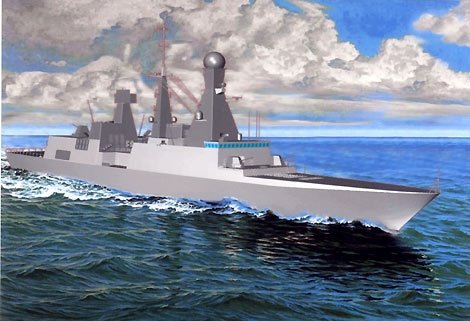
The abortive (for the UK) Horizon projectThere was something close approaching joy in the EU Referendum household this morning at the sight of The Daily Telegraph with its front page headline declaring: "Navy 'too weak' for big role in Korea blockade".

Not, as you will appreciate, was there any comfort to be gained from the message. But the very fact that a British newspaper has actually noticed something like this and is able to detach itself from its feminine side long enough to report it on the front page is indeed something to celebrate.

Equally, one took considerable enjoyment from the leader – something almost of a throwback to the days of Empire, the headline trumpeting: "Britain's obligation to blockade North Korea".

And then… what a wonderful opening line: "If you want to engage in gunboat diplomacy, it helps to have some gunboats."

How true. How so very true.

Thus says the newly-masculine Telegraph, Britain has been in the vanguard of those pressing for sanctions on North Korea after its detonation of a nuclear device. And "now that the UN Security Council has authorised those sanctions, it falls to us to assist in their enforcement in any way we can, in particular via a blockade of North Korean trade."

Yup… go with that – and with the next bit:

…just as the Army has been starved of the resources to do its job in Iraq and Afghanistan, so there are serious question marks over whether the Navy is equipped for this task. Since Labour came to power in 1997, the Navy has lost a third of its ships. We should be able to rustle up a couple of frigates or destroyers, a submarine, even an aircraft carrier.
The trouble is that the paper seems to lose it a bit – it goes on to say:

But as the Sea Harrier was withdrawn from service earlier this year, and its replacement does not arrive until 2013, those ships will be defenceless against missile fire. Unless our fleet shelters under the protection of the French or the Americans, its air defences are pitiful; were the Falklands crisis to recur today, our task force would be sunk before ever sighting Port Stanley.
Gone are the days of Desmond Wettern, when a Daily Telegraph correspondent was regarded as a world authority on naval issues. We are now reduced to this abysmal degree of ignorance. And ignorance it is – this is not "techie" pedantry: there is no way a Sea Harrier was ever and could ever be considered as part of a missile defence – it is (was) an air superiority fighter and its role would only be (as in the Falklands) to intercept enemy aircraft. Whether it could handle North Korean Mig 29s is another matter.

Furthermore, in any fleet, an aircraft carrier is an extremely vulnerable and attractive missile target and, therefore, far from contributing to missile defences, requires the deployment of considerable assets to protect it from attack.

One can see the point the Telegraph is trying to make though. The news piece sets it out:

…senior navy officers expressed deep concern about their ability to defend their ships against a hostile missile or fighter threat after a decision was enforced six months ago to scrap the Sea Harrier fighter. As a result of government cutbacks any British ships deployed to the South China Sea to enforce the UN resolution would depend on the American or French navies to provide "beyond visual range" air defence with their aircraft carriers.

The Navy has been cut by almost a third since Labour came into power, and the admission by Royal Navy commanders that they were struggling to find suitable ships to deploy to the UN force will raise further questions about the Labour government's handling of the armed forces' budget. Britain's military commitments to Iraq and North Korea have exposed glaring deficiencies in resources and equipment.
Thus do we get "defence correspondent" Thomas Harding citing a "naval officer", writing: "… without the Sea Harriers the ships will be vulnerable to attack if there are no US Navy Aegis class ships in the area. … The Fleet will not have adequate air defence until the first Type 45 destroyer enters service in three years."

This then allows the newspaper leader-writer, by way of a conclusion, to twitter: "It will be a disgrace if Labour's neglect of our Armed Forces renders us unable to play our part."

But I must stop doing this - dismissing Harding and his ragbag of fellow hacks as intellectual pygmies. One must not be so arrogant or opinionated. It is totally unreasonable to expect newspaper writers to know anything of what they are writing.

Far be it for me to point out, therefore, that the Type 45 Destroyers (or their equivalent) would have been with us years ago but for the er… Conservative government’s obsession with trying to develop a common European frigate - the ill-fated Horizon project.

And now for the Type 45 - spot the differenceOne must not say that they are also grossly over-priced and that this is entirely due to the insistence on fitting European missile systems. Nor must one note what we got from Mr Thomas bloody Harding on the day of the first Type 45 launch. We simply must not remind people that he trilled that the Type 45 was a 'quantum leap forward' for the Navy, faithfully reproducing the MoD press release, almost to the letter.

My critical piece, incidentally, was headed, "A retreat from defence", commenting on the inadequacies of British journalists, but I now realise that this was simply unwarranted arrogance.

All this is behind me now. Mr Harding is a Great Man and the Wondrous Daily Telegraph has now pronounced that the reason we are short of ships is entirely the fault of the Labour Party. Who am I to disagree with that, or even mention that, had the Conservative Party gained power at the last election, things might not have been any different?

Me, I'm just an ignorant blogger.

COMMENT THREAD

15 October 2006

Before defeat becomes a rout

There is a certain child-like naïveté to the media coverage of General Dannett's remarks which has now run unabated for two days, taking pole position in The Sunday Times this morning.

If one was to see such quality in coursework offered by sixth form pupils, though, one would smile indulgently and take the time out to correct it. But we are not dealing with a sixth form here so much as a situation where the children have taken over and there is no grown-up in a position to set them straight.

Without such guidance, the media narrative has settled on this being an instance of, variously a "brave", "honest", "blunt" soldier – even now a "soldier's soldier" who has courageously "told the truth" about the problems in Iraq. He is even described as having "put a rocket up the politicians who were making life hell for his beleaguered troops", thus leaving Tony Blair variously "battered" and attempting to "play down the rift", with the government "engulfed in a firestorm".

Some hacks write about "damage limitation", others applaud Dannatt's candour while others, with all the pomposity and gravitas that their platform affords them, are calling for his resignation.

This is absolutely classic of the "biff-bam", soap opera, personality-driven style of news reporting that we have to suffer these days, where everything is reduced by these intellectual pygmies to its most basic elements and then expressed in one-dimensional terms with all the subtlety and depth of a Tom and Jerry cartoon.

What none of these prattling children even begin to do, though, is examine – much less evaluate – the issues to which Dannatt spoke. And, in endorsing his call for a "phased extraction", the neglect of years is returning to haunt them. Atrophied through years of under-use, their limited brains are quite unable to grasp that the UK is already in the process of withdrawal from Iraq and is seeking to complete the process as fast as is politically and humanly possible.

That is the missing element – the spectre at the feast. It has been brought about by the fact that the British Army is not and has not been for some time up to the task of maintaining order in Southern Iraq. The "best soldiers in the world" are very far from the best – and not even "good enough". That we have, "the best Army in the world" comes from exactly the same stable as, "our NHS is the envy of the world" – with about as much foundation.

Like every other British employer, the Army is struggling with the aftermath of the collapse in the education system, having to deal with recruits of low educational attainment at a time when the technical demands on individual soldiers are increasing.

With competition from other industries, an increasingly unmilitaristic society and the relative poor pay and conditions, it is also having the greatest difficulty recruiting (and keeping) good officers, a situation only temporarily ameliorated by the influx of high quality females attracted by gender equality provisions.

And, if manpower is often of poor quality and insufficient in numbers, so is much of the equipment - as we have recorded on this blog – a great deal of it dangerously so. Furthermore, equipment which could or should be available has either not been thought of, is thought unnecessary or is simply too expensive.

A defeatist attitude amongst British forces is now evident, witness the incident on 3 October when a British soldier was killed and another seriously injured after three mortar shells landed inside the Shaat al-Arab Hotel base in Basra. Rather than any determination to avenge colleagues, what was particularly chilling was the almost off-hand way that British Army spokesman, Major Charlie Burbridge, was cited as saying, "It is a major challenge to stop these sorts of attacks."

Yet, challenge though it might be, it is by no means impossible. Faced with the same problem, the US Marines have developed lightweight counter-mortar radar which can be used to detect incoming rounds and direct helicopters or other assets to deal with the terrorists.

Yet that is simply not an option for the British. Even if they had the radar, they have neither the helicopters nor the rapid armoured vehicles that they would need to combat this threat. Instead, they must take the casualties and hope that, in due course, it will all end.

What is perfectly illustrated by this example is that equipment (and manpower) inadequacies have a significant effect on the tactics adopted – for the very simple reason that certain options require certain equipment - and thence morale and capability. Lacking the necessary (much less desirable) equipment, tactics are often inferior, capabilities are limited and morale falls as a result.

But there is also a peculiarly British arrogance in this theatre where commanders have mistakenly believed that skills acquired in Belfast and other public order operations are necessarily transferable to Iraq, slowing down and sometimes completely inhibiting the development of more appropriate (and effective), theatre-specific tactics.

All of this means that the British Army in Iraq is the next best thing to a failing organisation. You do not need to be the Chief of General Staff to realise that its continued presence will serve only to exacerbate the security situation – and expose British troops to continued casualties. But that is the situation into which General Sir Richard Dannett – as professional head of the Army (its chief uniformed bureaucrat) – has walked.

The degree to which the situation has deteriorated is well illustrated by this BBC report and this local report. With the British roundly having been accused of causing the chaos and the security decline in southern Iraq, especially Basra, by their leniency with the militias and their parties, no one believes the sitation is recoverable. The British presence is simply no longer desired.

Knowing that his Army is not up to the job in Iraq and that the government is neither willing nor able to provide the men and material necessary for it to improve its performance - even if that was possible - Dannatt's only option is withdrawal. And not only does he know this – the government knows it and agrees. Furthermore, the decision to withdraw was made some time ago (when, precisely, we do not know, as the policy change was never announced), so Dannatt's difficulties lie not with the government but elsewhere.

Arguably, Dannatt's central, professional problem is how to extract the Army from Iraq in one piece, without the catastrophic loss of morale that would accompany an enforced withdrawal or open defeat. His public problem, therefore, is how to dress a defeat up as – if not a victory – "a job well done", giving sufficient of a figleaf for the Army to walk away without too much immediate loss of face.

If you thus read his statements, from a military point of view, what he is saying is nonsense. Troops being present, doing their job, will invite a hostile reaction. That is both necessary and welcome in the normal run of things as it is only by provoking the enemy can you bring him to battle and defeat him.

But Dannatt has no intention of even trying to defeat the enemy so, by declaring the obvious, he is simply attempting to create a public climate where withdrawal is seen, on the one hand, to be operationally desirable and, on the other, not as a retreat or a defeat. That is where the media have probably made their biggest error. Somehow, they seem to believe that Dannatt is talking through them to the politicians. They cannot seem to cope with the possibility that he is using them to talk to the wider media as well as the public.

If that is why a Chief of the Defence Staff is talking to the media then, despite the spluttering of Charles Moore and Matthew Parris, he will remain in office. It will show that he knows – as does the government – that he has to get his troops out before a defeat becomes a rout.

COMMENT THREAD

14 October 2006

What is it going to take?

One of the most egregious long-term failures of our media (and some of our domestic politicians) must surely be their complete inability to come to terms with the EU's Galileo satellite navigation system.

Not only has it failed to pursue the question of why we need an expensive duplicate system, when the US has committed to providing its own "Navstar" GPS entirely free of charge, but it has also faithfully parroted the EU mantra that Galileo is a "civilian system under civilian control".

Even without evidence to the contrary, though, it is self evident that GPS is a dual-use system – it has both civil and military applications. Furthermore, since the sharp end of each satellites is simply nothing more than a transmitter, the actual function of the system is user defined. Although fitted with the same equipment, a red truck with a blue flashing light rushing to a fire may be civilian while a green truck filled with men with guns rushing off to a fire-fight is a military application.

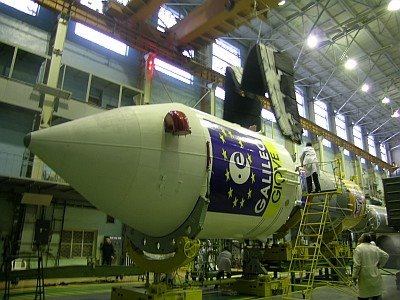
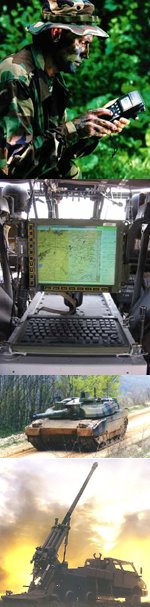
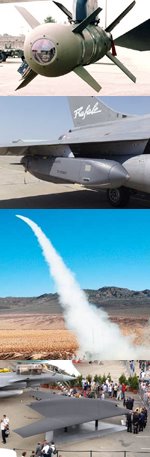
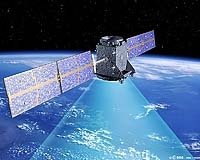
That Galileo does have many military applications (some of which are illustrated, left and right) has considerable political implications. Yet, even though the French defence minister, Michèle Alliot-Marie, confirmed as early as December 2004 that the system had military applications that the French intended to use, the media has largely stuck to the legend that it is a civilian system.

As time has progressed, however, it has become increasingly clear that the business model on which Galileo is based is unlikely to recover anything like the original investment and, two years ago it was clearly evident that the economics would be largely dependent on the spin-offs from arm sales.

Add to that the partner nations, which include China, India, Ukraine and Russia (the latter doing deals for hi-tech military equipment with EADS) and the possibilities for mischief are endless, especially as there is no effective politico-military control system within the EU that could mirror the US system and keep Galileo out of enemy hands. In that sense, the fact that it is a "civilian" rather than (originally) a military system – like "Navstar" is a disadvantage.

With the EU now warning that costs are "spiralling out of control" – all the indications short of certainty are that the military dimension will play a larger and much more important part in the development of the system

Thus, when one finds as of 12 October that EU transport commissioner Jacques "Wheel" Barrot - nominally in charge of Galileo development – has been telling a conference in open session that although, "Galileo was supposed to be a civilian system… I wonder whether we shouldn't question that," this is highly significant

"Using it for military purposes, for defence purposes ... would be very interesting in terms of paying for the infrastructure and the investment," he says, affirming that which we have been maintaining all along – that it is essential to the economics of the programme.

As we have written, unrestricted military application of the Galileo system has massive implications, not least for our relations with the United States and our Nato partnership. Thus, at this stage, where it now becoming clearly evident that there is a military dimension to the system, one would have thought that the MSM would now be taking an interest and kicking off a debate.

But, to date, there has been nothing. Surely, though, there must come a point when this can no longer be put down to the innate stupidity and ignorance of the MSM hacks, and one has to look to something more profound to explain their inertia? Whatever that might be, it is certainly germane to ask what is it going to take for them to take an interest in such a vital matter?

COMMENT THREAD

13 October 2006

Nobel prizes, Turkey and France

It would appear that the Norwegian Nobel Committee shares this blog’s view that there is something farcical about the whole idea of a peace prize. Let us recall the citation. The prize is to be awarded to

the person who shall have done the most or the best work for fraternity among nations, for the abolition or reduction of standing armies and for the holding and promotion of peace congresses.
Well, failing such luminaries of peace congresses as SecGen Annan, Jimmy Carter or Bill Clinton, the committee decided on someone who has actually achieved something though not, perhaps, anything to do with the citation.

This year’s Nobel Peace Prize went to
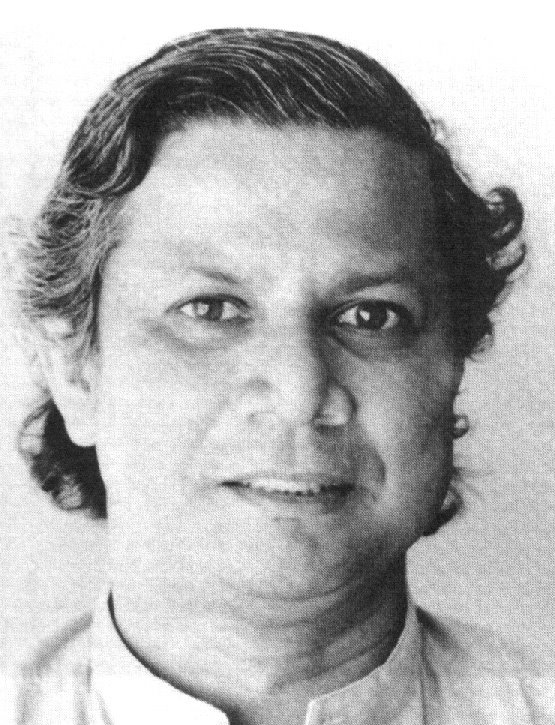
Bangladeshi Muhammad Yunus and the Grameen Bank for their efforts to help "create economic and social development from below" in their home country by using innovative economic programs such as microcredit lending.
Microbanking may well be a very helpful development. Certainly, in that it emphasises individual entrepreneurship, private property and fiscal responsibility rather than feckless claims of aid money, it has a sense of purpose. One could even argue, as the Nobel committee did:
Lasting peace cannot be achieved unless large population groups find ways to break out of poverty.
Since NGO activity and large amounts of aid money are guaranteed to keep people in poverty we look forward to a complete ban of peace prizes or, indeed, any kind of prizes to those organizations. Nevertheless, we cannot help feeling that there is a certain desperation about the award. Best they can do, I suppose.

Meanwhile, I have to acknowledge to have been wrong in my prediction about the Literature Prize. The award went to a man who is reasonably well known, though it is not clear how many people have read him outside Turkey. Furthermore, Orhan Pamuk does not appear to be an anti-American ranter but a man who has tried to think hard and write about the complicated history of Turkey and her even more complicated present and future.Still, as the International Herald Tribune put it rather delicately:
The Swedish Academy never offers nonliterary reasons for its choices and presents itself as being uninfluenced by politics. But last year's winner, the British playwright Harold Pinter, is a prominent critic of the British and American governments, and the academy does not appear to be immune to the political implications of its decisions.

"You're beginning to notice a certain sensitivity to trends - they are giving the prize as a symbolic statement for one thing or another," Arne Ruth, former editor in chief of the daily newspaper Dagens Nyheter, said in an interview. Of Pamuk, he said: "He is a symbol of the relationship between Europe and Turkey, and they couldn't have overlooked this when they made their choice."


Pamuk, who said in 2004 that he had begun "to get involved in a sort of political war against the Turkish state and the establishment," is spending a semester teaching at Columbia University in New York. Nationalist Turks have not forgiven Pamuk for an interview last year in which he denounced the mass killing of Armenians by the Ottoman Empire in World War I. He narrowly escaped prosecution after the remarks were deemed anti-Turkish and a group of nationalists began a criminal case against him.
Pamuk is one of those who calls the 1915 massacre genocide, something the Turkish government refuses to do (possibly because it does not want to start paying out compensation to descendants of victims and survivors).

Interestingly enough, this is an issue that will go on being discussed in Europe as the question of whether Turkey should ever be a member of the EU continues to haunt Europe as the spectre of Communism once did.

The Trib sees it as a coincidence that

on Thursday, one house of the French Parliament approved a law making it a crime to deny that the Turkish killing of Armenians from 1915 to 1917 constituted genocide.
Furthermore,

the Armenian foreign minister, Vartan Oskanian, praised what he said were Pamuk's courageous words about the past, in a statement that was bound to irritate Turkey.
One can see why many Turks might feel that the prize was not given on the basis of literary merit only, though many others must feel rather proud that one of their writers is being acknowledged in the West.

What of that new French law, then?

Well, France had decided that the massacres should be called genocide back in 2001. What the new law that, so far, has passed only the lower chamber and still needs to get through the Senate, says that it will actually be a crime to deny that this was genocide.
According to the legislation that was carried by 106 votes to 19, anyone denying the genocide would be sentenced to one year in prison and ordered to pay a 45,000-euro (56,570 U.S. dollars) fine.
Armenia has expressed herself to be delighted with this development while Turkey is extremely annoyed. To be expected, both of those reactions. The EU has also voiced reservations.
"If this law were to indeed enter into force, it would prohibit the debate and the dialogue which is necessary for reconciliation on this issue," said a commission spokeswoman.
This was the enlargement spokeswoman, Krisztina Nagy, who happens to be Hungarian. She also expressed the view that historical events should not be decided by lawyers and legislators but by historians. Exactly what we said about Holocaust-denying.

The EU’s main concern at the moment is the relationship with Turkey and how it will reflect on possible accession negotiations. But there is a certain irony here. Orhan Pamuk was threatened with prosecution and possible imprisonment because he has insisted on calling the massacre genocide. If the French law goes through, anyone who denies that it was genocide will be prosecuted and imprisoned. A neat balance, one might say.

President Chirac has also realized that the Armenian issue is a good one to flaunt if he wants to keep Turkey out of the EU. A couple of weeks ago he went to Armenia and made much of the fact that this was only the second CIS country he has visited after Russia.

While some of his Armenian hosts thought the visit showed their country’s growing regional importance, others were a little less impressed and wondered about the real reason.
"Judging by the deeds and the words of Jacques Chirac [during the visit], his thoughts were in neighboring Turkey rather than in Armenia," commented former Armenian Foreign Minister Aleksander Arzumanian in a 6 October interview with the Russian newspaper Izvestia. "And this is understandable, as now serious problems have emerged between united Europe and Turkey."
Mr Arzumanian’s understanding of what is going on in Europe seems to be lacking in substance and subtlety if he thinks that there is such a thing as a “united Europe”, but, at least, he has grasped that Chirac’s thinking is somewhat tortuous. Other commentators have gone even further:
Other analysts see regional issues as motivating the French president’s trip. A desire to compete with Russia and, maybe, the United States for influence in the South Caucasus could be one explanation, said David Hovhannisian, a political scientist and former Armenian ambassador to Syria. Chirac is also interested in Iran, Armenia’s southern neighbor and a longtime ally, with an eye to participation in infrastructure and non-military nuclear projects, Hovhannisian added. Armenian Foreign Minister Vartan Oskanian told reporters after Chirac left that the French president "was very interested to learn" President Kocharian’s opinion about Iran’s nuclear capabilities.

Richard Giragossian, a Washington-based political scientist, however, argued during a public lecture in Yerevan on 5 October that France’s influential Armenian community rather than any geopolitical factors prompted the trip. This opinion was partly shared by the 168 Zham daily, which said that the visit had acted as "triple PR" - for Chirac himself, for Kocharian and for Armenia, which used the opportunity to tout the country as a foreign investment destination. The trip included a concert for 100,000 in downtown Yerevan by French crooner Charles Aznavour, the son of Armenian immigrants.
Whenever l’escroc Chirac decides to tout France as a power that might compete with the United States and, in this case, Russia, one has to ask oneself whatever happened to the common foreign and security policy.

Whichever way one looks at it, we are likely to hear a good deal more from France on the subject of those massacres (woops, sorry, genocide). Whether the French politicians really care one way or another is something else again.
12 October 2006

Get some professionals in

Over on Purple Scorpion is an interesting commentary on one of the latest developments in the long-running sage of the REACH directive. It is one of several pieces on the general issue of EU regulation, a theme also developed by Tim Worstall, with some interesting comments on his post.

Taking in our posts on the subject (here and here) this means that the blogosphere is making the running on a crucial issue which, so far, has had only very limited exposure in the MSM.

On an entirely unrelated issue, the blog Winds of change points up a study from a Canadian military think tank. This is on the fascinating subject of blast-resistant vehicles, written in such a way as to be accessible to the non-technical reader and thereby illustrating the broader relevance of the issue.

If we had a halfway decent media, that is precisely the sort of thing we would be seeing in our newspapers and on television, and be hearing on the radio. But, instead, we get low-grade superficialities such as that which we reported earlier or the banal trivialities in which the media now seem to excel.

How interesting it is, therefore, to have the Daily Telegraph's Shane Richmond quoting a fellow hack telling us that, "informed opinion is everything - as opposed to the largely uninformed opinion that the ranks of citizen journalists, can through no fault of their own, provide".

This is also a newspaper which is investing heavily in its electronic services, running a stable of corporate blogs as a means of dealing with the challenge of the internet. But, instead of exploiting the freedom of the medium which actually allows you to put up more detailed, discursive posts, with cross links to other sites and with multiple pictures and diagrams, the paper has gone the other way, homing in on the superficial, the trivial and the personal.

Critical though I am of British bloggers, this low-grade material typifies and illustrates all that is wrong with the MSM. Furthermore, although none of these "clogs" has its own "hit counter", the number of comments and referrals from links are low, suggesting that traffic is way below the newspaper's expectations. And, if they did not have the umbrella of the brand on which to rely, I suspect that many of them would be struggling to get their daily hit rates into double figures.

Effectively, what this tends to confirm is precisely the theme of my previous piece. Within the MSM, we are not dealing with any great conspiracy to shape the news agenda. More likely, we are suffering the attentions of a bunch of feckless amateurs who are totally out of their depth when it comes to serious issues. And it is not going to get better until they get some professionals in.

COMMENT THREAD

The march of the amateurs

We have spent considerable time chuntering that the MSM does not give any space to defence procurement. Now, however, equipping the armed forces is at last on the agenda and we are beginning to see some articles on the issue. But, if the Guardian is any guide, they might as well not bother.

In a piece headed, "British military bites the bullet", with Mark Oliver asking, "Is the British military underfunded, or just spending badly," we find that the years of ignoring the subject, combined with the inherent ignorance and laziness of the MSM, produces something so distorted it is hardly worth reading.

The one thing Oliver does not do is answer his own question - to which the answer is "yes" - yes, it is underfunded and it (or the MoD) is spending badly. But there is a strong European element to the mis-spending, which The Guardian does not even begin to address (although it does mention the Eurofighter and the Type 45 Destroyers), so I thought it would be helpful to put together some examples of Euro-wastage. These are just some of them:

The joint US/UK Tracer/FSCS programme to develop a tracked armoured reconnaissance vehicle. For the British Army, this was to replace the ageing Scimitar CV(R)T. However, the MoD pulled out in 2000 before the first prototype was ready in order to pursue a European project, losing at least £131 million for absolutely no gain.
The Future Command and Liaison Vehicle - the "Panther": Italian-built at a cost of £413,000 each, these supposedly carry out some of the roles of "Tracer" (above) but are useless for patrolling or other functions in either Afghanistan or Iraq. The cost of £166 million for 401 vehicles is, therefore, dead money.

The "Cobra" anti-battery radar - high tech equipment for detecting the source of artillery shells, mortars and rockets. German-built, 10 sets were procured at £17.8 million each. Buying US-built "Firefinder" systems at less than £10 million each would have saved £82 million, giving the Army a perfectly acceptable anti-artillery capability.

The "Trigat" projects - medium and long-range anti-tank missiles. British participation in these European projects (appropriately, developed by "Euromissile") cost us over £314 million before we had to pull out after the systems failed to deliver, leaving the MoD with a total loss. A rush purchase of US-built Javelin missiles had to be made to equip the Army.

The Multi-Role Armoured Vehicle (MRAV) project, named the "Boxer" - a joint German, Dutch and British venture, managed as a European project. The MoD pulled out after the vehicle proved too big and too heavy for the RAF's fleet of Hercules transports, with a total loss to the defence budget of £48 million.
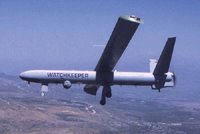
The MoD has spent (or has committed) £1045 million to developing Unmanned Aerial Vehicles (UAVs), first the Phoenix - losing £345 million - and now the Watchkeeper, to be built by the French-owned Thales company. Yet, despite this extraordinary expenditure, the MoD has no UAV capability in theatre and is having to spend upwards of £60 million on buying/leasing US Predator UAVs. Had we bought proven US systems in the first place, we might have saved more than £400 million.
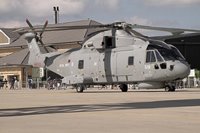
The MoD has bought 22 of these European Westland-Augusta Merlin HC3 transport helicopters. Working out the purchase price is near impossible but at an estimated £30 million each, US equivalents would have been less than half-price. alternatively, the RAF could have bought Chinooks at £25 million each, saving £110 million in total and considerably more on maintenance, the Merlins currently exceeding expected maintenance costs by over 200 percent.

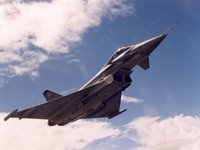
At over £60 million each, these Eurofighter aircraft are an acknowledged Cold War relic. Although rated highly as an inteceptor, current versions have no ground attack capability. US-built F-16s, an adequate fighter with a proven ground attack capability would have cost in the order of £20 million each. With 232 on order, notionally, the MoD could have saved upwards of £10 billion.

Not only the aircraft but also the weapons - the European-designed Storm Shadow air-launched cruise missile costs an amazing £1,000,000 each - for what is effectively a 1,000lb bomb. Having bought 900 of them, the MoD could have saved over £830 million if it had purchased the US equivalent, the JASSM.

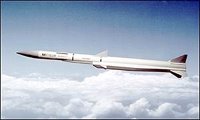
The Eurofighter is also to be equipped with European-designed air-to-air missiles. These are known as the Meteor. With the total costs at over £1.4 billion, purchase of US-designed Raytheon missiles (which are being bought anyway as a stop-gap, until the Meteor is ready) would have saved the MoD some £900 million.

In the rush for European harmonisation, the MoD joined with the French and Italians on the "Horizon" programme for a common frigate. Formalised in 1992, the UK eventually pulled out in April 1999 after failure to agree a common specification and complaints of "unfocused management", with an estimated loss of £537 million, leaving the French and Italians to continue with the project.

Co-operation did not end with the Horizon project. Although the MoD decided to go it alone with the platform, emerging as the Type 45 Destroyer, the ship is equipped with European-designed missile launchers and missiles, which largely account for the huge cost of £1 billion per ship, some £400 million more than the Australians are paying for the more capable US-designed Arleigh Burke class missile destroyers. With five ships now planned, that is a saving of £2 billion.

For the Type 23 anti-submarine frigates, we developed our own type 2087 sonar, at £9 million per set. But the development costs were an additional £300 million, given as a free gift to the French company which bought up the UK manufacturer, leaving it free to sell cut-price versions to the French Navy. Had we bought from the Americans, we could have saved that £300 million.

And finally, the EU's Galileo satellite navigation system. By the time it is fully operational, the UK will have paid £400 million towards its development and commissioning costs - the system being then used to underpin the European Rapid Reaction Force. But the US "Navstar" GPS is already available - and free of charge. The £400 million is a total waste of money for a duplicate system.

Putting these all together - but excluding the Eurofighter costs, which are a special case - the excess payments, for no gain whatsoever, come to £8.8 billion. That is considerably more than is spent in any one year on procurement. That would buy a ridiculous 35,000 RG-31 mine protected vehicles or 350 Chinook helicopters.

That is the measure of the wastage on European projects and, the amazing thing is, the MSM can't even begin to work it all out. Read the Guardian piece and see how amateur Mr Oliver really is.

COMMENT THREAD

11 October 2006

The most likely person wins

When explanations are given in old-fashioned detective stories, one often finds the likes of Miss Marple saying primly that well, of course, in books it is the least likely person who might be the culprit but in real life it is the most likely one (usually the husband or wife or heir to the money) who is probably guilty. And so it is with the next SecGen of the United Nations: the South Korean Foreign Minister Ban Ki-moon was always the most likely candidate. On Monday he was officially nominated by the Security Council and will, without doubt, be endorsed by the General Assembly.

As the decision (by acclamation) on Ban was taken just before a special meeting to discuss what if anything is happening in North Korea and what if anything can be done about it, John Bolton was given a superb opportunity to make some political capital:
It's really quite an appropriate juxtaposition that today, 61 years after the temporary division of the Korean Peninsula at the end of World War II, that we're electing a foreign minister of South Korea secretary general of this organization and meeting, as well, to consider the testing by the North Koreans of a nuclear device.
Yes, indeed. What would have happened if the Soviet Union had not been in a huff in 1950 and the UN would not have authorized military protection of South Korea against the aggressive North?

Ban is another UN apparatchik, Kofi Annan (father of Kojo) being the first of that breed to become SecGen, though he had spent only ten years in that organization. The rest of his career was diplomatic. As the International Herald Tribune puts it:
Soft-spoken and retiring, Ban presents a sharp contrast to Annan, who won a Nobel Peace Prize, made pronouncements on violations of international law and gained diplomatic rock star status before a series of setbacks - mismanagement of the oil-for- food program, sexual exploitation by blue-helmeted peacekeepers and scandals in the UN procurement office - tarnished his reputation during his second term.
Hmm. SecGen Annan may have made pronouncements (usually in an anti-American way) but his record was considerably tarnished even before he had risen to that illustrious post or had won the Nobel Peace Prize. Annan was, let us not forget it, the head of the Department of Peacekeeping Operations (DPKO) between March 1993 and December 1996, during which we had such delightful occurrences as the slaughter of around 800,000 in Rwanda and the massacre of around 8,000 men and boys in Srebrenice. In both cases the UN troops played an important part, in the first by not going in despite the desperate pleas from the officers on the ground, in the second by disarming the population and then retreating in the face of a Serbian onslaught. Indeed, the Dutch UN troops in Srebrenice apparently shepherded the men and boys onto the buses that would take them to their deaths.

This and other events (let us not forget Darfur, also not mentioned by Warren Hoge of the New York Times in his article) were discussed in a long essay by Adam LeBor in the Sunday Times magazine on October 1. The piece that presents the case against Annan, a rather less spectacular case for him, a summing up and a brief financial overview, is based on LeBor’s forthcoming book: “Complicity with Evil: The United Nations in the Age of Modern Genocide”. I think we can safely predict that a few feathers will be ruffled by that volume.

I do not know how the book will cover the wider issue of the UN but, at the risk of repeating what has been said many times before, I have to say that the UN is an impossible proposition. It was impossible from the very beginning. As the late, great Professor Leonard Schapiro wrote in his essay “My Fifty Years in Social Science” in 1980:
For the most blatant exercise in international cynicism it is unnecessary to go further than the Charter of the United Nations itself: “We, the Peoples of United Nations, … determined to reaffirm our faith in fundamental human rights, in the dignity and worth of the human person …” signed by the USSR, Byelorussia and the Ukraine.
The very idea of having those two Soviet republics sitting in the UN General Assembly as if they were independent nations was preposterous. And one must not forget that the Charter was signed round about the time Stalin was gearing up to his second purge, not completed because of his death.

If the UN was a farce then, it is an even bigger farce now. How many of the member states know what “fundamental human rights, dignity and worth of the human person” means? Mr Ban, like his predecessor, is promising to reform the United Nations. What is he going to do with the Human Rights Council with its members Cuba, Saudi Arabia and others of that ilk?

What of the stupendous sums that the organization devours and the seriously unbalanced way in which those sums are supplied by some members? (Britain is one of the biggest contributors but her “membership fee” pales into insignificance in comparison to the fantastic sums the endless attacked and berated United States hands over.)

The UN is not simply a collection of the member countries, though given who these countries are, that would be bad enough. It is an unaccountable organization that lays claim to supranational authority, the biggest and strongest of the tranzis, whose aim it is to create some kind of rules across the world, which will be obeyed by the democratically elected governments and constitutionally established courts of various countries. Because, let’s face it, no-one else will obey.

It remains to be seen what Ban Ki-moon will make of it all. I, for one, shall miss the entertainment provided by Kofi Annan (father of Kojo). But somehow I do not think the man will fade from the transnational scene.

The fame and the glory

It is a fierce irony that two people who could not be further apart ideologically are currently devoting considerable time and energy to promoting the same cause – a debate on "Europe". Their positioning on the issue, however, raises wider questions about whether it is possible to defeat the European Union.

As to the two putative debaters, in one corner is the fragrant one, not richly endowed in brain cells – the one and only Margot Wallström, EU commissioner for communication, with her Plan D and her fatuous European citizens consulations supported by the King Baudouin Foundation.

Brooding in the other corner is the man who revels in the description "Eurosceptic Yorkshire multi-millionaire", the egregious Paul Sykes who, on Monday, is to launch his "Speakout" campaign on Europe.

But, or so we are told by the Yorkshire Post, Sykes is only one of five people financing the campaign, designed to counter the "conspiracy of silence" on "Europe", with neither of the major parties wanting to debate an issue which has previously caused division.

"We want to secure a nationwide referendum on returning seven vital powers – trade, borders, public spending, law-making, regional government, fishing and farming – from Brussels to Britain", declares Sykes. "Without these rights and powers it is no good pretending any longer that we are a self-governing nation."

Of course we're not a self-governing nation but, by and large, who gives a damn? Certainly not the bulk of the political classes or the soap-opera loving masses who are clearly content with the status quo.

Thus, it is that the Yorkshire Post editorial suggests that, "in the current political environment, Mr Sykes cuts a Canute-like figure in his valiant attempt to stop a seemingly inexorable tide." The editorial continues:

The two likely prime ministerial candidates at the next election, David Cameron and Gordon Brown, both tend to keep their Euroscepticism well hidden. And while surveys show that the EU is a major concern for most voters, it ranks low on their totem pole compared with other matters such as health, education and rising crime. In such circumstances, neither Mr Cameron nor Mr Brown is likely to risk inflaming part rows by raising the European issue.
Apart from the ludicrous error in suggesting that the Boy Camoron has any Eurosceptic inclinations, the YP has a point. Largely, Sykes and his wealthy colleagues (if they exist) are wasting their time. In fact, the editorial goes on to say, in so many words, just that.

It is some consolation that, on the other side of the divide, the ennui and lack of interest is just as prevalent. One notes that the Europhiles got there first with their own "Speakout" campaign, via the Institute for Citizenship, setting up a discussion forum under the banner vision for Europe.

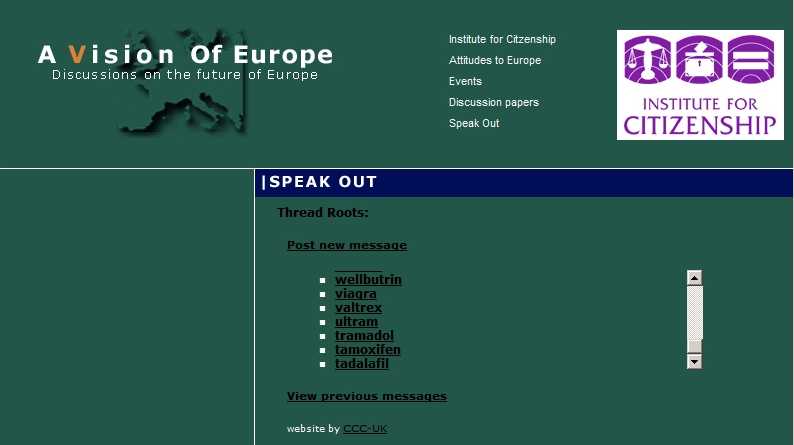
Hilariously, though, the site has been spammed by ads for viagra and other pharmaceuticals (see below - double-click to enlarge), a fate that could so easily befall our own forum as we are constantly assailed by fraudsters trying to sign on a members, requiring constant vigilance in fending them off.


But, if Sykes – with his £10 million or whatever amount he does actually intend to spend – is wasting his time and, if the EU with all its millions to spend, is failing to get its message across, what chance have the rest of us?

Although Sykes and Wallström are not the only ones calling for a debate, people are just not interested in the European Union. Even we, nerds amongst nerds, find the subject tedious and, as far as the blog goes, we get our highest hit rates when we do not write about the EU. In fact, the less we write about the EU, the higher our hit-rate. But, if we really wanted our hit rate to soar, we would abandon politics altogether and post video clips – one such on U-tube taking better than a half-million hits (see below right).

The comparison is perhaps invidious, given the subject matter of the video, but it need not be the case that the EU attracts so little attention. That it does simply reflects the human condition: people tend not to concern themselves about things they cannot change. And, as long as our membership of the EU is not in question – as long as it stays off the agenda – it is not going to become a mainstream issue.

To make this any different is beyond the resources of Mr Sykes – or any of us. It is going to take one or other of the two mainstream parties to make a conscious decision to put membership on the agenda, pledging to the British people that they intend to take the nation out of the EU. Since neither have the slightest intention of doing such a thing, the subject is going to remain politically dormant unless change is forced upon them.

The question is, therefore, what would it take for either Labour or the Conservatives to take up the cause? In broad terms, the answer is simplicity itself: when or if either party feels that it is of such importance that it cannot win an election without taking it on board. And here, the one tenable scenario is that the Not-the-Conservative Party failing to win power at the next election. In that happy event, Camoron would undoubtedly fall on his sword and, in our dreams, the Party would elect a staunchly Eurosceptic leader who would lead us to the promised land.

That may be the dream, but it is more like a fantasy. Does anyone seriously think that the current group of intellectually challenged pygmies is going to blame its lack of devotion to the Eurosceptic cause as a reason for its failure?

For anyone who does think that, Booker pointed out the obvious this weekend. The BBC line is that the chief reason the Tories lost three elections was that although their recent leaders had all begun by taking a moderate line on "Europe", each had been dragged by the party's Eurosceptics into becoming ever more extreme. And this, he writes, chimes with Camoron's insistence that the Tories failed because "while parents worried about childcare, getting the kids to school, balancing work and family life, we were banging on about Europe".

If that is the current state of play then, what hope is there for Euroscepticism? Is there anything else that would put "Europe" on the top of the political agenda and force politicians seriously to consider our withdrawal from the European Union?

These are, of course, matters we have rehearsed again and again, most recently here and one answer is that the media – goaded and informed by the political blogs – could raise sufficient of a storm to prod the politicians into action. Given the diversity and general lack of political acuity of the British blogosphere, however, that is not so much wishful thinking as delusory, leaving very little in the way of alternative options.

This effectively brings into sharper focus the line of thinking I articulated here, where I wrote of my growing realisation that pursuing the cause of Euroscepticism was a complete and utter waste of time.

For sure, I later wrote that we were going to continue running this blog with a view to building our circulation but I suppose in many ways what puts a line under that is the Sykes campaign.

In between his comfortable little cruises on his private yacht, he has come back to reinvent a wheel, on the back of all the other little groupescules that are inventing their own versions of the wheel, whether Open Europe, the Democracy Movement, Better off Out, UKIP, or whatever, all expending time, money and effort to no effect at all.

Well, the likes of Sykes can waste his money and the others can waste their time – some making a fairly comfortable living in the process – but I have neither time nor money to waste on fruitless endeavours. They can have their fame and glory. I need to find something better to do with what is left of my life.

I may be some time.

COMMENT THREAD

09 October 2006

What, if anything, are you going to do?

"Our streets are full of fear" headed a comment piece in The Sunday Times yesterday, written by India Knight expressing the view that:

Being frightened in the street and even in our own homes - feeling scared to intervene when yobs are behaving badly for fear of one's own safety - has become the norm in this country. We moan about it in the same way that we moan about leaves on the line or automated telephone systems: it's just everyday life.
If this was a crie de coeur from a writer who records some of the appalling goings-on in an inner London council estate, on this blog we have posted cries of equal passion about many things, from the genocidal slaughter in Darfur to - the proximate cause of this blog's existence - the encroachment of the European Union on our daily lives.

Yet, say some of our forum members, all we do is moan and one of them directs a question to us "thinkers", asking, in the context of the growing threat from Muslims in our midst, "What, if anything, are you going to do?" The implication here is that instead of mere "thinking", to say nothing of "moaning", in order to achieve something, "action" is needed.

Turning this round, however, one has to ask what sort of action should we as individuals should be contemplating. Should we be acquiring our own weapons (like our cartoon cat), to spray bullets in certain quarters to reduce numerically the perceived threat? Should we perhaps copy the methodology of some of the Muslim brethren and manufacture our own bombs – something which is remarkably easy to do - placed to achieve the same effect as our bullets?

For those who might cavil at murder, and are of a less violent disposition, how about a mass demonstration? Or a petition? Or writing to the newspaper… or our MPs? Perhaps we should start our own party even? Or what? All of those things… they have proved effective? And, since they have not, what would you have us do? What kind of action do you have in mind?

Turning the argument round again, it seems to us that those who complain about a lack of action have less understanding than perhaps they should of how power is exercised in the United Kingdom.

Although ostensibly a democracy, the convergence of mainstream political parties towards the centre means that elections (and the electorate) now have little influence over policy direction. Instead, the decisions are heavily influenced by "opinion formers" who are able to project their agendas into the corridors of power and thereby determine the issues which are taken most seriously by government.

Classic examples of this phenomenon are "Europe" and "global warming", the latter having steadily risen up the agenda to become a central feature of all the main political parties' agendas, without it ever having been a dominant election issue. And now, so similar are the policies of each party that they could not become a determining issue in an election – all parties are singing to the same hymn sheet.

But, as Booker pointed out in his column this week, not only are the political parties speaking the same language, they and the media are also in cahoots.

There is a particular affinity here between the mindsets of David Camoron and the BBC, which seems identical on global warming. They are both big fans of Al Gore's film, An Inconvenient Truth, which the Boy describes as "inspiring", agreeing that, thanks to man-made pollution, the planet faces disaster. To doubt this, supporters of the Gore thesis argue, is as criminal as to deny the existence of the Nazi holocaust.

One of the most striking attributes of these "true believers", Booker writes, is their insistence that they are supported by a consensus of scientists – something which actually does not exist. But perhaps even more striking is the cross-subject consensus. Remarkably, those who support the orthodox global warming thesis also tend to be Europhile and multi-culturalists. They also tend to be anti-Israeli, anti-war, anti-American and, to a very great extent, anti-capitalist.

Now, the point here is that this "ruling consciousness" does not necessarily represent majority opinion and in a perfect democracy, therefore, should not prevail on so many issues over which it holds sway.

One reason it does is because those who hold these views, by and large, have privileged access to the media. But another reason is that the media is also part of the "ruling consciousness" – there has been no alternative mass medium, though which dissent can be expressed. And, in the absence of any coherent expression of dissent, those in power are often genuinely believe their actions reflect the will of the people.

The importance of this dynamic cannot be over-emphasised. Most often our rulers are not evil people who are determined to foist an agenda on the people. They act in a different way, convincing (or deluding) themselves that their agenda just happens to be the one that the majority agrees with. And because we have lacked the voice by which we can tell them otherwise, our rulers can continue in their delusions that they are implementing our wishes.

Up to press, only direct action such as demonstrating or even rioting could get past this logjam. For the remainder of the time, we have been forced to content ourselves with the "grumbling in the ranks" or moaning, of which we have been accused.

If that is all we were doing currently, the criticisms of our lack of action would be valid. But we are not simply talking to ourselves – crying in our cups, so to speak. Those who post on our forum can hardly be unaware of the fact that we are running a blog and are putting up a large number of serious posts to a steadily growing. Has it not occurred that this itself, is action?

More to the point, if you think about it, influence in a democracy (and even a quasi-democracy of the nature that we have in this country) is about numbers. The media is powerful only because it is listened to by many people. How powerful would the Daily Mail be if it had a circulation of ten, or the BBC if it had only five listeners a week?

Through the wonders of the internet, however, we have the opportunity to make our voices heard and, potentially, we can speak to the same numbers of people that are reached by the traditional media – the MSM. And through this medium we can challenge the ruling consciousness and say, "no – we do not agree with you and your views are not ours".

That, in its own right, is a political act but, equally, reading a blog which disagrees with the perceived wisdom is also a political act. When as is the case, thousands are daily reading such blogs, collectively that becomes a significant political act. If, in the fullness of time, those thousands that read dissenting blogs become hundreds of thousands and even millions, our rulers will listen – they will have to listen because they know – as indeed do we – that if we are able to articulate our dissent and it is then ignored, we will take action. And history tells us that, most likely, it will be violent.

So, to the question, "What, if anything, are you going to do?", we are going to do exactly what we are doing and have been doing for nearly two years. We are going to continue running this blog with a view to building our circulation. Those that agree with our message can rest easy in the fact that, at the hit counter ticks over, the influence of the blog will increase. And, even in our democracy, influence is power.

To conclude this piece, though, many will say that this is not fast enough – the crisis is here and now. There is no time to waste. Well, that is the weakness of democracy (but also its strength). Things tend not to happen until the bulk of people are so excised about a situation that they demand action. At the moment, we have not reached that state. But the solution, collectively, is in our own hands.

COMMENT THREAD

07 October 2006

But what do they need?


To mark the fifth anniversary of the opening of the military campaign to rid Afghanistan of al-Qaeda and the Taliban, Tony Blair has given a tribute to our 5,000 troops in Afghanistan and promised to give "whatever front-line commanders tell us they need to complete their job".

There can be no doubt about the nature of this commitment, it being set out in an authored piece by Blair in The Sun, repeated in a Reuters report and also conveyed in The Times, the Guardian and even the BBC website. The promise is specific and unequivocal.

The problem here though is in knowing what the front-line commanders actually want – the MoD will certainly attempt to prevent them from making those views public and it can always "spin" any requests to make sure only the right story hits the media.

But there are other issues here – defence procurement is far too important an issue to be left to the military, and especially to front-line commanders. The "toys" tend to be rather expensive and, when it comes to buying them, the military and their defence ministries have a grand and consistent tradition of getting it wrong.

Since it is the (civilian) population which pays for them, it is only right and proper that they should have a say in what is bought (and how many are bought), to which effect it is essential that there should be an open and informed debate.

It is this that really sorts the men from the boys – and the girlies (of both sexes). Avoiding the issue or simply calling for more equipment is a cop-out. To make a sensible contribution to the debate, you have to get stuck in and be prepared to discuss what sort of equipment our armed forces need.

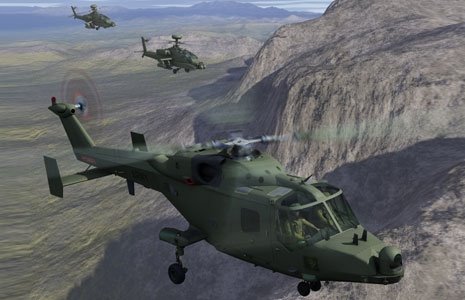
In this, it takes no great expertise (or intellect) to ask the right questions. For instance, there is the issue of whether our forces have enough tactical helicopters. You do not have to be a rocket scientist to wonder whether it is wholly appropriate to go down the "bells and whistles route" and end up buying something like the "Future Lynx" (pictured above) which is so expensive that you can only afford small numbers and then only from 2011, when the need is now.

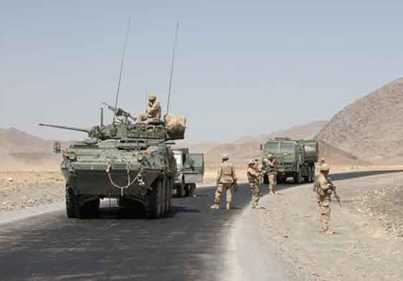
Equally when, according to one national newspaper "Army chiefs" are calling for more armour in Afghanistan, it can hardly be considered too complicated to ask whether tracked vehicles are the answer (or the whole answer), given their huge operating costs and the wear and tear involved, or whether we need a wheeled APC along the lines of the Canadian LAV (pictured right) or both.

This is a massive challenge for the Conservative opposition - which, so far is failing the test - for the media and the blogosphere, both of which are largely avoiding the issue. But here, one can agree with Liam Fox in his conference speech where he declared that, "The price of success in Afghanistan maybe high, but the cost of failure would be catastrophic".

If we cannot afford that failure and can find the time to have earnest debates about whether British Muslim women wear veils or such pressing subjects as civil partnerships, then we must surely make the time to debate how we achieve success.

COMMENT THREAD

Always there when you need them

Things are so much easier to deal with when you take a European approach, with colleagues working in a spirit of solidarity to resolve matters that mere nation states cannot handle. At least, that is what the Europhiles are always telling us.

However – as always – when practice meets theory, it is a slightly different story. With our prisons bursting at the seams, set to reach absolute capacity within days, home secretary John Reid was in Luxembourg yesterday. He was asking his EU counterparts if they would take their own jailed nationals back and bang them up in their own prisons, thus – albeit temporarily – relieving the pressure on the British system.

Of the 79,843 prisoners in England and Wales – against a maximum capacity of 79,968 – it turns out that there are nearly 2,000 from other EU countries, the biggest group - 649 inmates – coming from Ireland. Poland comes a poor second with 155, France is third with 148 and Portugal and Germany have, respectively, 143 and 115. By contrast, less than 800 Brish nationals are banged up in the prisons of EU member states.

But, despite Reid's pleas, the "colleagues" have refused to deliver (or collect, in this case). Apparently, the justice ministers from Slovakia, the Czech Republic, Spain, Ireland and Poland all raised objections to a plan which would allow criminals convicted in any one EU member state to serve their sentences in their home countries.

So far, this idea have been under consideration by justice ministers of the member states for over two years and, despite the urgency of the current situation - with only days left before the Home Office is going to have to dump prisoners in police cells - the EU is still acting with the speed of a somnambulant mollusc. Having failed yet again to reach agreement, ministers do not anticipate reconsidering the issue again until December.

Even then, according to a spokeswoman for the Home Office, an agreement could take "a number of years" and plans are still at the draft stage. Issues which have to be resolved include whether member states could refuse to take back unwanted prisoners and whether prisoners should have a right to refuse transfer.

All this notwithstanding, for once the perfidious British are not being at all unreasonable. Foreign national are twice as likely to commit crimes than the indigenous population and the exponential rise in the prison population has been largely fuelled by foreign nationals.

In 1997, the number stood at 4,677 but, by 2005, the latest year for which data are available, it had surged to 10,089. Thus, in 1997 foreign nationals made up 7.6 percent of the prison population. Last year, they constituted a little under 14 percent.

Needless to say though, this is largely a British problem, reflecting the disproportionately high numbers of immigrants we are accepting. Because of that, one cannot possibly expect the "colleagues" to rush to our aid. We need to remember that "solidarity" is all about give and take. We give – they take – except when we want them to take their criminals back, in which case we find them in an unusually giving mood.

It is so nice to know that our European partners are there for us when we need them.

COMMENT THREAD

06 October 2006

Wrong call

A Rolls-Royce Trent 900 engineThe shock waves from Airbus's incompetence continue to ripple through the system with The Times and others reporting that Rolls-Royce is suspending work on its Trent 900 engine used to power the A380.

The company, we are told, now expects to deliver only 28 of the £10 million engines this year and none next year. Rolls-Royce says it will be reviewing whether any job cuts will be necessary when further clarification on the A380 programme was given by Airbus.

Airbus Chief Executive Christian Streiff, however, does not have that luxury. He has announced the launch of an Airbus revival strategy called "Power 8", which will involve a 30 percent cut in costs, primarily from job losses.

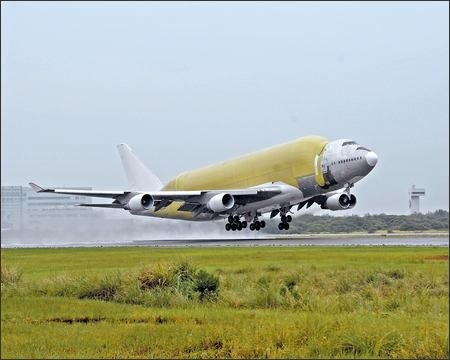
Interestingly, Airbus is also reassessing its production centres, with Streiff understood to be keen to strip out the cost of shipping aircraft parts around Europe. At present, different sections of each aircraft are built in regional plants and then shipped to Toulouse for final assembly.

This model may be changed so that each plant produces one full aircraft, with projected cost savings of €2 billion (£1.35bn) a year from 2010.

The production centre assessment will be completed in about four months' time and will be key to determining the future of the UK division at Broughton in North Wales. The plant makes wings for Airbus that are transported to Toulouse by a tortuous route that includes barges and specially modified lorries.

Yet, at precisely the time Airbus seems to be abandoning dispersed production, Boeing is buying into that model big time, with the launch of a new 747 variant, the so-called "Large Cargo Freighter", an aircraft so ugly that "only a mother could call it pretty."

At least three of these aircraft are planned to deal with shipping 787 components which are being manufactured in all 50 states in the US and in countries as far afield as Japan and Australia.

With A380 wing production at Broughton apparently now also suspended, it is beginning to look as if throwing our lot in with the Europeans was the wrong call.

COMMENT THREAD