09 December 2006

Going backwards

When the news started coming in yesterday about the raid by coalition forces in Basra, details were sparse and I thought it better to wait until we knew more.

A day later and we are not much the wiser. The whole of the publicity seems to have been generated, and is therefore controlled, by the Army. We know what the Army wishes us to know – no more and no less.

One should not be too churlish I suppose. If the Army is to be believed, five "terrorist leaders" were captured, together with a quantity of arms and explosives and some documents of "intelligence value". However, that does seem somewhat small compensation for a raid described as the biggest military operation since the end of the war on 1 May 2003.

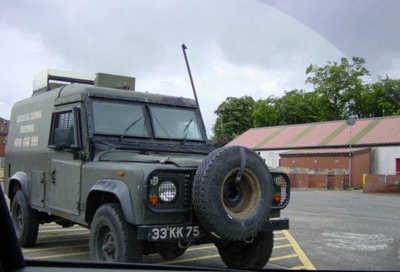
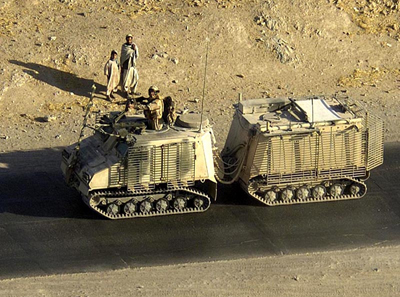
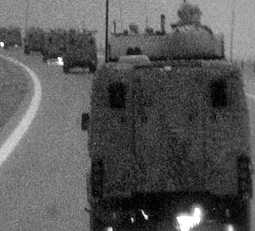
Altogether, over 1000 men took part, including a 250-strong Danish contingent, deploying 14 Challenger II MBTs, 28 Warriors, an unknown number of light armoured vehicles ("Snatch" Land Rovers and Danish MOWAG "Eagles", based on the Humve chassis - illustrated right) and ten assault boats. In support were USAF F-15s which carried out overflights as a diversion and "a show of force".

Mercifully, unlike the 24 November raid, no one was killed. That alone may have justified the scale of the force, which was not unopposed.

But if the size of the force deployed was not excessive (under the circumstances), there was certainly something so gloriously OTT about the Telegraph coverage. It not only included a huge map, occupying the best part of half a page, but was announced by a headline spanning two pages reading: "'Armoured fist' smashes into Basra at dawn, capturing five terrorist leaders." One suspects that the writer (our old friend Thomas Harding) and the editorial team harbour secret ambitions of being comic-strip writers.
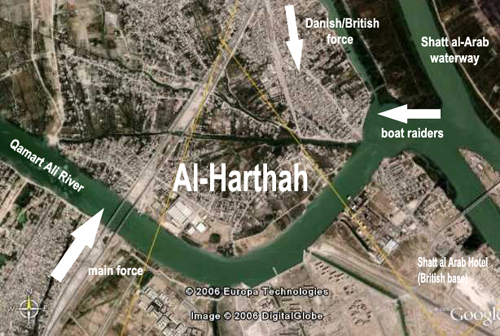
Behind the MoD-supplied details (and photographs), the problem is, as always, that the newspaper presents a breathless view of events which avoids any depth, understanding or analysis. This is not what one would expect from grown-up journalists.

Any such analysis, of course, would not necessarily accompany this piece – and we learnt not from this but from the BBC that one of the objectives of the raid was to deal with "criminals" who were mounting attacks on British bases. Interestingly, the Telegraph's location map miss-positions the Shatt al-Arab Hotel base. It shows it closer to Basra Palace than anywhere, rather than its correct place – well within mortar range of al Harthah. And, as recently as Wednesday, the base was at the receiving end of yet another mortar attack. Was al Harthah the source?

So, here we go again. In June we wrote a piece noting that we have been here before. We remarked on how between 1972 and 1980, mine protection technology emerged, which has been refined and developed as the basis of today's blast-protected vehicles.

But, if the colonials were there before, we were there even before that. A remarkable website shows that in Oman between 1970 and 1973, British forces were operating modified 4-tonners with armour plate fitted to deflect blast from mine strikes.

But even more fascinating is the website of Barry Dunning recounting his exploits in the 10th Royal Hussars (Middle East Land Forces) in Aden in 1965, riding in a Saladin armoured car.

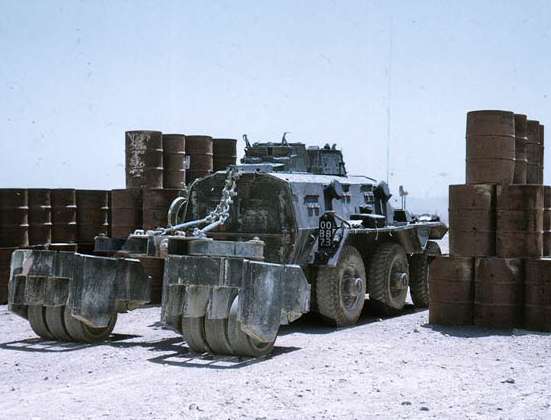
As a boy I recall this vehicle (illustrated). Built on the same chassis as the Saracen armoured personnel carrier, it was specifically designed for mine protection and could continue operating with any one wheel blown off by a mine. For their party trick, Alvis, the manufacturers, used to drive the vehicle round a test track on demonstrations, with one of the front wheels missing.

Anyhow, Dunning writes:

The 12th of September is a day I will never forget!! Coming back from Dhala we went on ahead to pick up the Infantry whom were up on the ridges (to cover the convoy through the wadi). We had just passed Mile Stone 36 when we hit two anti-tank mines and 25lb of plastic explosives. It picked the 14 tons of armoured car and threw us about 25 feet into the air, leaving a crater 30 foot wide and 10 foot deep. We were very lucky the armour did not split open as we were fully loaded with all our shells and bullets... It would have been a real fireworks display if they had gone off, and we were lucky no one was hurt.

Mick had a cut on his cheek where the Browning rounds wrapped around his face. Geordie hit his face on the front driver hatch as he was thrown forwards. It knocked him silly for a moment and he had a bloody nose. Because of the shock the medics could not take any chances with us so they flew us out on an Army Scout helicopter back to camp. The Saladin was brought back on a low loader.
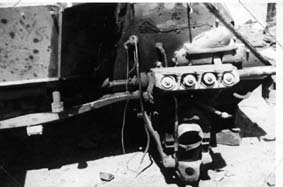
And above right is a close-up picture of the front wheel bay, which took the full force of the explosion. Now imagine if that had been a "Snatch" Land Rover.

As relevant to the predicament of our troops in Basra, however, are the experiences of British forces attached to the Sultan of Oman's army in 1970. Amongst other things we see in another fascinating website is a Saracen APC pressed into duty as a mine clearance vehicle at RAF Salalah. One feature of this vehicle is that it could be driven easily in reverse, a feature used in the illustration, where it is rigged to push a mine roller. Interestingly, we also see sand-filled 40-gallon drums stacked up as blast protection – the predecessor to the "Hesco" containers currently used. There is nothing new under the sun.

Just as relevant though was that the base came under continuous mortar attack. To counter this threat we see the predecessor of the current Mamba and Cobra counter battery sets – the "Green Archer" counter mortar radar in place (in the foreground). Behind the radar is a 25-pounder in a gun pit, ready to return fire once the mortar location has been identified.

But it did not stop there. Out on the tarmac were pairs of Strikemaster light jets, aircraft based on the then RAF basic trainer, the Jet Provost. Despite their provenance as trainers, these were formidable ground attack aircraft and were, in the hands of their RAF pilots, potent weapons.


And, of course, there were the helicopters, also on quick alert ready to transport Omani Scouts to a trouble spot and deal with the insurgents - yes insurgents - who were seeking to overthrow the government.

These, being the Omani's choice - and free from the strictures of the RAF and the then MoD (which hardly seems to have changed) were Bell UH1Ds, the famous "Hueys" of VietNam fame. Now, of course, the RAF has a few, in the form of the Augusta Bell 412, but only for air-sea rescue in Cyprus and for training aircrew. But the Army is not allowed to have them.

There we have it. Over thirty years ago, nearly all the elements of COIN warfare were in place, right down to the mine/blast protected vehicles, which are now no longer on charge. In many respects, therefore - with our inadequate "Snatch" Land Rovers instead of the Saracens (which were also used in Northern Ireland), the absence of light (or any) ground attack capability and an acute shortage of helicopters - we are less well equipped than were our own and even the Omani armies all those years ago.
But there another major difference. Unlike Oman with its wide-open spaces (more like Afghanistan in some respects), weapons like mortars and Katyushas are being fired from highly congested urban areas, with the terrorists using civilians as a screen.

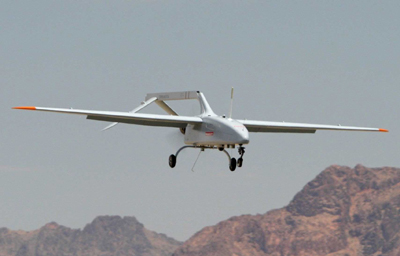
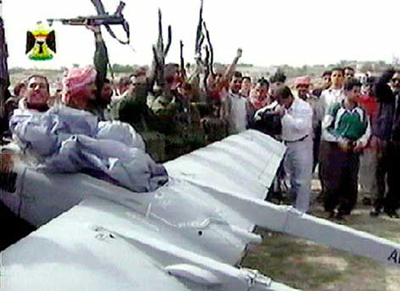
To deal with that, we have other weapons - the C-RAM (and even that is based on 70s technology) and UAVs armed with precision, small-warhead guided weapons. We have no C-RAM though and, as to our UAVs, we have none capable of being used for this function and our attempts at flying off the wrongly-named Phoenix (it does not rise from the ashes) have met with embarassing failure (illustrated above).
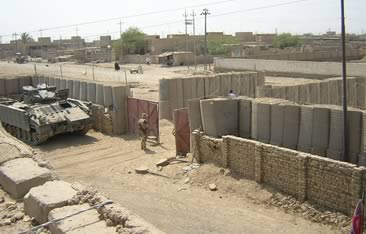
For want of the right equipment, therefore, it seems we must send a 1000 men, backed by tanks, armoured vehicles and aircraft smashing into Basra at dawn, all to arrest five men, before scuttling back to our fortifed bases and the daily barrage of mortars and rockets.

Oddly, Gateway Pundit on Friday hailed as "good news" the optimistic account of the situation in Basra by Iraqi-American Haider Ajina, citing Major General Ali Hamadi chairman of the tri-security agencies in Basra. He claims that operation Sinbad, for security and reconstruction, has achieved important results.

Yeah right. That's why we need a small army to arrest five men, while all our bases are under constant daily attack. Yet, in June 2003, our troops were walking the streets in soft hats. Every which way, in my book, we're going backwards.

COMMENT THREAD

08 December 2006

Where were you?

Yes, Mr Bush, we know it is bad - we've been saying so for a long time. Yes, we agree with you when you tell our prime minister, Tony Blair, that "we need a new approach". And yes, we entirely agree with General Sir Mike Jackson (now retired) that it would be "morally wrong" to pull out of Iraq at the moment.

And we even agree with Jackson when he accused the government in his speech of neglecting soldiers and of "asking too much" of the armed forces.

But what we also want to know is why it has been left until now? What have our professionals and analysts being doing all these years and, in particular, what was the professional head of the Army doing in August 2003?

This blog, of course, didn't exist back then. But General Sir Mike Jackson – or "Macho Jacko" as he was already known - was Chief of General Staff, the professional head of the Army. He had been appointed on 1 January 2003, he had seen the successful assault on Basra by British troops and then enjoyed the short-lived fruits of victory with the official termination of hostilities in Iraq on 1 May 2003.

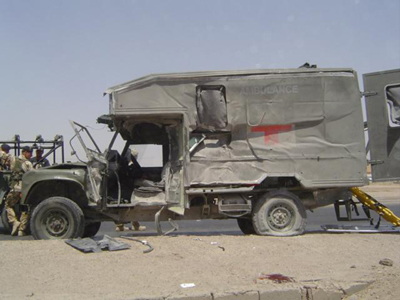
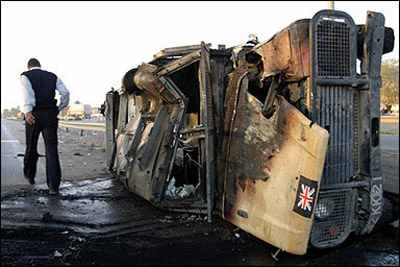
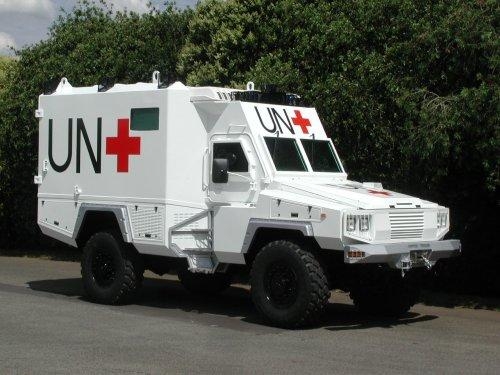
Then, on 14 August - two days after Basra had been swept by organised riots, with mobs protesting against the lack of fuel and electricity in the city – when British forces were shot at and returned fire, killing at least one Iraqi - Captain David Jones was travelling from Basra with his driver in a clearly marked military ambulance (pictured above left), conveying a soldier to the military hospital in the Shaibah logistics base outside the city. He never arrived. Shortly after 9am British time, the vehicle was struck by a roadside bomb, killing Captain Jones and injuring the other two soldiers, and badly damaging the vehicle (illustrated right).

One national newspaper at the time reported that this had been the most serious attack on British forces since six military policemen had been killed in Majar al-Kabir, north of Basra, on 24 June. Furthermore, as this was the very first roadside bomb attack on a British military vehicle, the fear was that the "honeymoon" was over – that British troops in the southern, mostly Shia, part of Iraq, were now to be targeted by guerrilla attacks. Up to date, these had been reserved for American troops in the ethnic Sunni area around Baghdad.

As reported by The Scotsman, the BBC had defence analyst Paul Beaver saying that the attack had been very different to any incident dealt with by British forces in Iraq before then. "This looks like a step up in operations by a group you can only call terrorists," he told BBC News. "This is very much a pre-meditated act of terrorism. There's no doubt at all what we're actually seeing here is someone making capital out of the fact there is now a greater awareness of discontent in the Basra area."

The newspaper suggested that the campaign in Iraq had "entered a dangerous new phase".

One swallow does not make a summer though, but any thoughts General Sir Mike Jackson might have had of disagreeing must have been disabused by reports of an incident on 23 August. Three soldiers from the Royal Military Police - Major Matthew Titchener, Co Sergeant Major Colin Wall and Corporal Dewi Pritchard - were killed in an ambush in central Basra.

Witnesses said the RMPs were riding in a sports utility vehicle in a routine two-vehicle convoy and came under small-arms fire from an unknown number of men in a pick-up truck at around 8.30am. The soldiers returned fire, but appear to have been killed either by a grenade thrown from the other vehicle or when their own vehicle crashed into a wall.

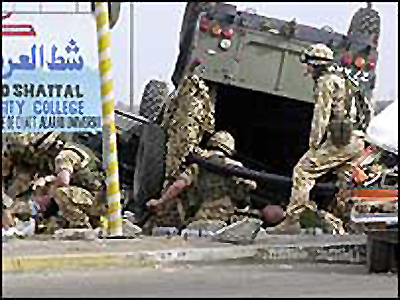
Then, on 27 August, Fusilier Russell Beeston, a Territorial Army soldier in the 52nd Lowland Regiment, was killed on after a crowd surrounded his patrol vehicle in Ali As Sharqi, southern Iraq, and opened fire with guns and rocket-propelled grenades. He was 26 and from Govan. Shortly afterwards, on 7 September, a roadside bomb in Basra exploded when a British diplomatic convoy was passing killing four people of unknown nationalities, wrecking the car and flipping it upside down. When a later explosion killed ten more, there can have been no doubt. The honeymoon was definitely over and an insurgency was in progress.

Now, in his speech entitled, "The Defence Of The Realm In The 21st Century", General Sir Mike Jackson tells us his lecture was "a way of taking stock". He has been considering "what may be demanded for the defence of the Realm in this uncertain century; and how ready we are for those demands."

But he adds: "We also need to be honest as to how well we are meeting these demands now," effectively admitting that we are not doing enough. He says: "we must do better in this complex situation, faced as we are today by a determined and ruthless enemy".

That "determined and ruthless enemy" was to continue slaughtering British troops. But, in August and September and points thereafter, Jackson was not only thinking about the war in Iraq. As befits the professional head of the Army, he was thinking in grander terms, of the longer term. "How should the United Kingdom position and defend itself?" he was asking.

He doesn't actually tell us the timeline but we know from other events that this was the thinking going on in the MoD. The arch Europhile secretary of state for defence, Geoff Hoon, had his own political priorities. They were to put clothes on Tony Blair's 1999 initiative, making good his St Malo promises to co-operate with Jacques Chirac, building a European Rapid Reaction Force.

Through 2003, as the attacks on British troops intensified, Blair's high-level political initiative was filtering down to Army level for implementation. General Sir Mike Jackson was thus required to look at the broader strategy - a European strategy to balance the US-orientated Iraqi strategy. As conveyed to us in the Dimbleby lecture, he rationalised it thus:

The UK cannot isolate itself from the wider world, so I'm not at all sure that it is an available strategy, even if we wanted to choose it. That said, I think perhaps the most fundamental question, is the relationship, the strategic relationship, between the United States and Europe. ...

And the UK's position as between the US and Europe has been a dilemma for this country for many decades. A black or white choice, one way or the other, would be fatally flawed. The fate of this country, given its geography and its history, is to wrestle with the conundrum that whilst we sit unequally in geographical distance between the United States and the mainland continent, of Europe, the political distance is a much more equal proposition.
We had our "special" relationship with the US but, "we are also part of the continent of Europe, and a member of the continent's polity, the European Union." Thus said the General, "...it is inevitable that there will be an ebb and flow to the UK's relationship with these two centres of gravity." We could not sit on the fence, he mused. "We are so closely involved strategically with both the United States and with Europe, that in our strategic posture we must embrace both."

So, instead of concentrating on dealing with the war in Iraq, with its special equipment needs, in November 2003 he palmed the troops off with second-hand "Snatch" Land Rovers, drawn from stocks held in store in Belfast. That done, he then devoted his energies to feeding the European fantasy, as he set about reorganising the Army to fit in with the demands of the ERRF.

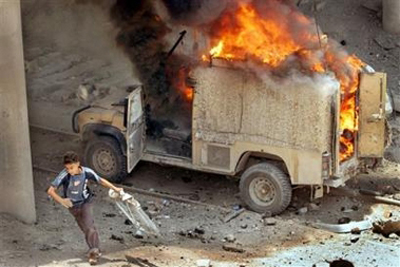
The rest, as they say, is history. The attacks continued, "Snatches" burned and soldiers died.

Except that the history has yet to be written. Thus, in his Dimbleby lecture, General Sir Mike Jackson put in his bid for his version. "We could well be asking too much of our Army," he says.

It all comes down to a question of balance: balance between capabilities within the defence budget - how much of this, how much of that; current operations against what may be required in the future; not only current operations, but current training which is the investment for our capability in the future; people against technology - that's pay for example, accommodation standards for example, against current and future equipment.

This should not be a dilemma incidentally, this should not be a zero sum or an either/or. We should be able to provide what is required for soldiers to be fully and properly equipped, thoroughly trained, decently paid, and, together with their families, decently housed. They deserve nothing less.
So they do, General Sir Michael Jackson, GCB, CBE, DSO., so they do. At a time when even the Americans were beginning to realise that better equipment, like the superb RG-31, was needed (even available as an ambulance), why weren't our soldiers "fully and properly equipped" instead of being palmed off with second-hand Land Rovers?

So, when the real history comes to be written, it will include the question: "Where were you, General Jackson, when the Army really needed you?"

COMMENT THREAD

06 December 2006

Two soldiers lightly hurt

So reads the headline (or part of it) from the Calgary Sun, Canada, with a full account in CTVNews, its report bearing the headline "Canadian convoy attacked on 'Ambush Alley'".

We are, as you might imagine, writing about Kandahar city again, where there has been yet another suicide bomb attack, this time with a fortuitous outcome. In fact, "fortuitous" barely begins to describe it. One casualty, Cpl. Robert Chafe, suffered a cut on the side of his mouth and on the little finger of his left hand. The other, Master Cpl. Greg Keeping, was slightly hurt in the leg.

But we are doing much more than just writing about this incident. In this post, we shall try (and probably fail) to pull together some of the many ideas and arguments being explored as to how we should fight (instead of losing) our battles against insurgents.

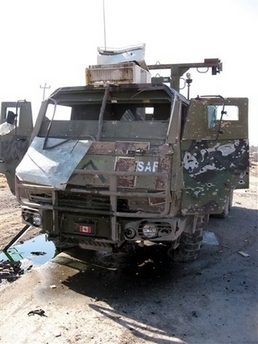
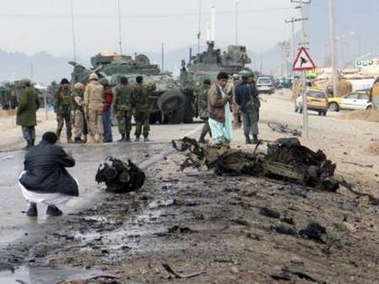
For the moment, though, we are able to start the discussion with a remarkable photograph because, riding in the convoy was a Canadian TV crew. It was just two vehicles behind the targeted truck and able to capture the incident. The first picture (top left) shows the scene seconds after the bomber had struck. This second one (right) shows the suicide bomber's vehicle, illustrating the force of the explosion to which the troops were exposed.

The third picture of our sequence shows the truck that was hit. It can immediately be seen that the cab is armoured, with a heavy armoured glass windscreen, which undoubtedly saved the lives of the men behind it.

Not so the lives of two Afghani civilians who had the misfortune to be beside the truck when the bomb went off - a graphic illustration of the effect of the bomb on unprotected people and, crucially, yet more evidence of the indiscriminate nature of the bombing. The Taliban have shown time and again that they are entirely unconcerned about civilian casualties, be they men, women or children.

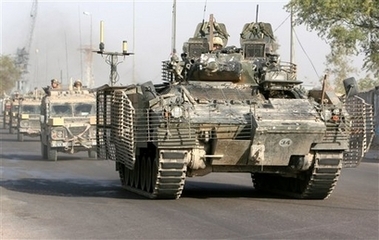
The fourth picture in this sequence shows the convoy in a long-shot, the composition of which indicates why the truck was targeted. Bombers are known to go for the most vulnerable targets and here it can be seen that the convoy escorts are the now-famous RG-31s. Attacking these would be fruitless. The other vehicle in view is an armoured Bison APC, a type that has proved vulnerable to attack when the crew ride with opened hatches - but not on this occasion. This time, in a line of unpromising targets, the truck must have looked the most vulnerable.

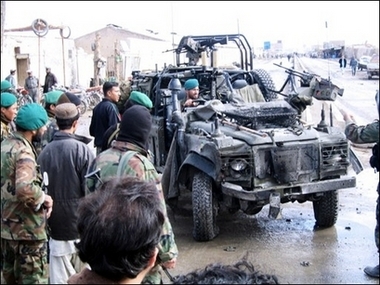
Compare and contrast with the unarmoured British Land Rover targeted by a suicide bomber on Sunday, an incident in which three Royal Marines were injured - one seriously. This shot shows an Afghani policeman attempting to drive the vehicle after the attack, demonstrating - as indeed does the visible condition of the vehicle - that the damage was relatively modest. Yet, in the absence of effective armour, far greater injuries were caused than in the attack than on the armoured Canadian convoy.

This does point up an issue that we have rehearsed time and time again - that we must have more and better armoured vehicles. But we are not talking about any armoured vehicles. They need to be designed specifically to deal with the technical threat of improvised explosive devices, whether in the form of roadside or suicide bombs.

That much is evident from a less happy scenario - another suicide bomb attack in Kandahar, this one on 27 November when two Canadian soldiers riding in a Bison APC were killed. The Light Armoured Vehicle (LAV) - as it is known - is a "conventional" wheeled armoured vehicle, one designed for the European battlefield. Its fatal weakness - in common with most vehicles of the type - is that it is not designed to be operated in a fully closed down condition for long periods of time. Visibility is restricted and crew comfort (especially when it is hot) suffers. By any measure, this equipment is far from ideal for use as convoy escorts or as patrols in counter-insurgency operations.

On the other hand, yesterday, we read reports of yet another Royal Marine being killed (the 42nd British servicemen to die in Afghanistan) and one injured, but this time in what amounts to a conventional attack. The casualties arose when UK troops mounted an offensive on a Taliban-held valley, attacking the village of Garmser. Despite being elite troops, however, backed by airstrikes and artillery fire during the 10-hour battle, they were forced to withdraw after the Taliban launched a ferocious counter-attack with heavy weapons and tried to outflank the British troops.

Here, though, the Canadians - who have scored so well by using RG-31 blast-protected vehicles for their patrols - are again ahead of the game. Having been fully committed to offensive operations throughout the summer, they have learnt from their experiences and introduced Leopard tanks into the equation. On the other hand, the British - with theoretically a more experienced, elite cadre of troops - are committing what is in fact light infantry to a conventional attack, without armoured support. They are perhaps forgetting that the tank, in its original inception, was an infantry support weapon.

What emerges from this is that, effectively, we need two armies - one capable of fighting a largely conventional war and the other specifically equipped to fight insurgents in a mainly urban environment. In equipment and and function, the two roles are so different that they hardly seem compatible.

Looked at this way, one is able to see how ill-equipped the British are. In Iraq, they have a largely conventional army, designed - as we have observed before - to fend off mass armoured attacks by the Warsaw Pact in northern Europe, augmented by equipment developed for dealing with terrorism in Northern Ireland. Quite how inadequate this mix has become is apparent from these photographs taken last Sunday in Basra.

Where once we used to be able to send out foot patrols, conveyed to their locations in unarmoured Land Rovers, we have graduated to 3-vehicle armoured "Snatch" Land Rover patrols and now, as the security situation has deteriorated, the numbers have had to increase. But, the Land Rovers themselves, which were once used as convoy escorts, must now themselves be escorted by Warrior Mechanised Infantry Combat Vehicles (MICVs) front and rear.

On the other hand, for offensive operations in Aghanistan, such as the Garmser attack described above, the Warriors would be ideal, especially if they were backed by their natural partners, the Challenger II Main Battle Tank. That is not to say, of course, that tanks would be suitable for all operations, but commanders are not being given an option. There are no heavy tanks available to the British.

Apart from a few light tanks, the only tracked armoured vehicles issued to the Royal Marines in Afghanistan are the BvS10 "Vikings", delivered with great fanfare in October. Although superb cross country machines and fully amphibious (the latter capability not greatly in demand in land-locked Afghanistan), they do not even begin to compare with the Warrior, much less a Challenger II. As a result, not only did the Marines take casualties yesterday - they also failed to achieve their objectives.

Taking stock.

In order to win, I wrote in an earlier post, we must first stop losing. And the first thing in this context we must do is ensure that our own casualties are minimised. The number of deaths might be minuscule compared with the First and Second World Wars, and even Korea, but such is the sensitivity of this issue that even a few hundred deaths might create a political head of steam which forces our withdrawal from active theatres.

No one is naïve enough to believe that we can fight wars without taking casualties but, what we suggested in earlier pieces (here, here and here) is that the tolerance is lower when the war is unpopular and deaths are seen as unnecessary. Too many of the deaths we have recorded over term seem definitely to come into the "unnecessary" category - not least those arising from the recent attack on the boat using the Shatt al-Arab waterway. Thus we are seeing headlines announcing that troops have been killed, when we need to see more in the manner of the title of this piece, "two soldiers lightly hurt".

Yet, instead of striving for such headlines, this government seems to be going out of its way to prosecute its wars in a way which will ensure that the unnecessary deaths continue. In many respects, we are but one military disaster away from total failure and the government seems to be behaving as if it actually wants failure. Can this really be incompetence?

Mulling over this, I happened today on a piece from the North West Evening Mail which recounted the experiences of "Barrow soldier" Lance Corporal James Larsen, recently returned from Basra after serving with the 2nd Battalion of the Duke of Lancaster's Regiment. While based at the Shatt al-Arab Hotel, he claims to have survived more than 1,000 bomb attacks on his base and had been just 70 metres from a colleague who was killed by a mortar bomb. He adds:

My friends have been thrown on top of me and I have been mortared from 25 metres away when the tent got hit. We had breeze blocks going round our beds. I would roll off the bed and go under it next to the breeze blocks. I soon stopped sleeping on the bed and just lay with the breeze blocks.
We were already aware of the situation at the other main base within the city limits, Basra Palace, which even this week was attacked again with Katyusha rockets. Larsen's experience confirms that Shatt al-Arab Hotel is also under continuous attack.

Yet, although both bases are defensible and, as we pointed out, a range of technology and weaponary exists to counter mortar and rocket attacks, there seems to be a wilful refusal on the part of the British government to provide the wherewithal for defensive action. Contrary to American practice, where helicopters are often scrambled and even British practice in Afghanistan, where Harrier jets have been despatched to seek out mortars, the British military in Iraq seem to take an entirely passive line on such attacks.

What must be done?

The Iraq Study Group Report, out today, tells us: "The situation in Iraq is grave and deteriorating". It adds that, "There is no path that can guarantee success, but the prospects can be improved".

The thrust of the report, however, is towards seeking political solutions to the crisis, on the oft-argued basis that there can be no military solution. However, while it may be true that the military cannot provide the solutions, in the final analysis, without the military, there is no prospect of a political solution. The military underwrites the security to an extent where the political process can develop and take root.

The presence of the military can only be sustained if casualties are kept down. We have no idea what the tipping point might be, which might trigger a political crisis, but it must make sense to take every technically achievable step necessary to increase force protection. We need to see substantial improvements in base protection and in the protection of mobile forces. And then, in the context of a more aggressive approach to attackers, our forces must have the capability to take the battle to the attackers, responding to them with lethal force when they dare to attempt killing our men and women.

But, gradually, that writ must also extend to all the security forces. As in Northern Ireland, where a primary task of the Army was to protect the civilian police, we must ensure that co-operating with the occupying powers is not a death sentence - as it so often is at the moment.

Furthermore, what applies to Iraq must also, to a very great extent, apply to Afghanistan. There, the Taliban has been quite explicit. It aims to kill our people and Nato troops in general, to break our will. In that sense, the currency of this dispute, there as in Iraq, is the lives of our soldiers. Keeping them alive, in theatre while they are actively carrying out their protective roles, is itself a victory. It sends a message to the terrorists that they cannot win.

...to be continued

COMMENT THREAD

01 December 2006

The Egyptian paradox

"Britain gives go-ahead to GMO potato trials", says Reuters. The Press Association, via The Guardian, headlines: "GM potato trials given go-ahead" and tells us that, "The Government has granted permission for genetically modified potatoes to be grown in the UK."

The BBC Website has "GM potato trials given go-ahead" and tells us that, "A plan to grow genetically modified potatoes on two trial sites in England has been approved by the government." The Times gives us, "Trials for GM potatoes agreed" and its story starts: "The Government has agreed to new GM trials for potatoes."

Then we get The New Scientist with: "Gene-modified potatoes get trial go-ahead", adding, "The UK government has approved the growing of genetically modified potatoes in two field trials." The Farmers Weekly though – as you might expect – is more specific, giving you the name of the ministry, declaring: "DEFRA approves BASF's application to plant genetically modified potatoes".

The plants, we are told, will be grown next year on land owned by a scientific research station in Cambridgeshire, and on land secured by the biotechnology firm BASF Plant Sciences in Derbyshire.

Then to sweep up, in this sample of news coverage, we have the dedicated political website, Politics.co.uk, which also refers to the ministry. It's headline is, "Defra approves GM potato trials" and the strap reads: "Defra approves the first GM crop trials for three years".

Technically, all these media are right. The government, through its "Competent Authority", the Department of the Environment, Food and Rural Affairs, has approved trials on GM potatoes. But what none of them say it that the UK government had no choice about this, thus omitting to mention the "elephant in the room", the European Union.

The point is that the approval of the "deliberate release into the environment of genetically modified organisms" is an exclusive EU competence under Directive 2001/18/EC. It was adopted by the European Parliament and the Council of Ministers in February 2001 and entered into force on 17 October 2002, since when member states are required to process applications in accordance with the Directive. In particular, Article 6 refers:

5. The competent authority shall acknowledge the date of receipt of the notification and, having considered, where appropriate, any observations by other Member States made in accordance with Article 11, shall respond in writing to the notifier within 90 days of receipt of the notification by either:

(a) indicating that it is satisfied that the notification is in compliance with this Directive and that the release may proceed; or

(b) indicating that the release does not fulfil the conditions of this Directive and that notification is therefore rejected.
In effect, the member state is merely acting as an agent for the community. Its job is assess whether or not the test protocol complies with the Directive. If it does, the application must be approved – the member state has no discretion in this. Only if it does not, can the application be rejected.

Quite how the news should be reported is a moot point but an accurate or balanced report would include reference to the EU dimension, in terms: UK finds application in conformity with EU law and therefor is required to give a go ahead to the tests.

At least that would put into context the comments of the Friends of the Earth representative, who said the trials posed a "significant contamination threat" to future potato crops. “The government should promote safe and sustainable agriculture, not this half-baked GM potato plan," said Clare Oxborrow.

It would also put into context the statement by environment minister Ian Pearson. He says: "Our top priority on this issue remains protecting consumers and the environment, and a rigorous independent assessment has concluded that these trials do not give rise to any safety concerns.

Neither mentions the EU. Neither acknowledges that the government has not choice.

Perhaps Oxborrow's ignorance is forgivable. She is, after all, only an environmental campaigner. But the minister and the media should know better. He and the Guardian, the BBC, The Times, and all the others are just like the felukka.

Why?

They are all in de Nile.

COMMENT THREAD

The new Byzantium?

The fall of Constantinople in May 1453 – an event that even a pro-Turk like myself cannot help remembering as the Pope visits the Blue Mosque – destroyed the Second Rome. Two of the previous candidates for the Third Rome, Serbia and Bulgaria, had been defeated before. That left Muscovy, soon to be Russia, as the only possible heir to the two Roman empires.

This claim was strengthened by the fact that Ivan III (the Great), Grand Duke of Muscovy, the first to style himself as the Grand Duke of All the Russias, had married the niece of the last Byzantine Emperor, Sophia Palaelogue.

The idea, as so many others, had been brought to Russia from the no longer existent Balkan Orthodox kingdoms by Cyprian, a Bulgarian priest who became Metropolitan of Moscow in 1381. But it was finally crystallized by the monk Filofei in a letter written to Ivan’s son, Grand Duke Vasili III of All the Russias in 1510:
Two Romes have fallen. There stands the Third Rome. There will be no fourth.
And so a great myth was born: Russia’s and the Orthodox Church’s missionary, God-bearing role. Together with the strong and not always justified sense of victimhood (all the Orthodox peoples, particularly the Slav ones, gave as good as they got throughout history) this has caused a great deal of trouble in Eastern and South-Eastern Europe.

There is, however, another aspect to Byzantine history, one covered at length by Procopius and Gibbon: the labyrinthine intrigue laced by extensive usage of poison when other methods had been exhausted. For obvious reasons, it is this aspect that has been pre-eminent in my mind in the last few days.

There seems to be something desperately wrong with events as they have unfolded with Russia. On the one hand there have been attempts to create an agreement with the European Union that have, for the moment, foundered on the Russian government’s traditional inability to negotiate without trying to bully everyone who gets in the way. Even relations with Ukraine could be settled in some other manner but President Putin seems unable to understand that it is now an independent country, which does not want to be part of his single economic and security space. The same applies to Georgia.

Nor is it a particularly sensible idea to suspend import of food from Poland and threaten to suspend it from the whole of EU when Romania and Bulgaria join on January 1, 2007 because of allegedly low hygiene standards. They are almost certainly low but nobody who has ever been on a Russian food market outside the tourist areas can help laughing at the Russian government’s supposed concern.

Added to which there have been the unfortunate poisonings. First, Alexander Litvinenko, the former KGB and FSB officer who had written about the alleged involvement of the FSB in the explosions of the apartment blocks that served as a pretext for the renewal of the ferocious war in Chechnya and propelled Putin, until then a barely known apparatchik, to the presidency.

Now we have news of an apparent attempt to poison Yegor Gaidar, former Prime Minister under Yeltsin, architect of the semi-successful development of Russia into a democratic, capitalist state and, more recently, the Director of a free-market think-tank in Moscow, the Institute of Economic Transition. Gaidar was taken ill on a visit to Ireland and has been in hospital ever since, having spent three hours unconscious. The first suggestion that it was food poisoning has remained unproven and the doctors are puzzled.

Why Gaidar? That is the question most of us asking. Litvinenko’s murder is, at least, comprehensible. In the first place he was “one of us” and turned to the enemy, providing it with information. The Cheka and its many successors, most recently the FSB, have always made it clear that people such as Litvinenko were high on the list of those they would “get” if for no other reason but to teach the others a lesson.

Besides, Litvinenko produced some very valuable details in his account of those explosions. If, on top of that, he really was investigating Anna Politkovskaya’s murder (though what he could do from London is a mystery) then he would be seen as a serious threat. So, why not get rid of him and in the most painful way imaginable? That’ll learn him and anybody else who might consider following his example.

Gaidar, however, had never been in the KGB but was and is an economist. There may be some settling of old debts going on but he has not really been all that prominent for some time. Even his criticisms of Putin have been muted and rarely reported, unlike those of Andreir Illarionov, for instance. The latter, until a few months ago nominally Putin’s adviser, had better watch his step. There are a couple of young children there, too.

It may be that the attempt on Gaidar, if that is what it was, happened precisely because of his relative unimportance. In Russia they know who he is and the two poisonings could be seen as a threat: “And don’t think you can escape us by going abroad, either.”

It could be sheer incompetence, as well. After all, the amount of radiation left behind by the Russian assassination team does not argue highly professional behaviour. One must not forget that the Russian secret service is no more efficient than anybody else’s, just nastier.

The order for Litvinenko’s murder may have been given some time ago and they caught up with him at an inconvenient moment but as the order had not been rescinded, the case went marching on.

The Guardian maintains that it has learnt from some British intelligence sources (who dem?) that a “rogue element” in the FSB was probably responsible for Litvinenko’s murder as Putin’s government can be exonerated. Myself, I wouldn’t go as far as that. How can one possibly exonerate Putin’s government? Besides, that is simply rephrasing the question: which rogue elements and why? As for the difficulties of acquiring Polonium-210, that is tosh. It seems to have industrial uses and is, therefore, available in various ways. Besides, it is some time since we could have said with any certainty that Russian nuclear laboratories were so secure that only a few numbered personnel had access to them.

For all of that, the theory that the murder and the possible attempt were carried out by the FSB is not to be discarded completely. It is possible that the disintegration of Russian society where politicians, bankers and businessmen are routinely murdered (and that ignores the killing of Politkovskaya, which must have been ordered from on high), where the first deputy prosecutor-general gives it as his opinion that the equivalent of $240 billion is given in bribes to officials a year (two and a half times the state’s total revenues) may well have prompted some high-ranking officers to take action that would undermine Vladimir Putin, whom they may well see as responsible for the sorry state of affairs.

Or the boot is on the other foot. Putin is not supposed to stand in the 2008 presidential elections and cannot do so unless there is a change in the constitution. He has said several times that this will not happen. But what if in the course of 2007 the country enters a severe crisis, to do with the economy or social matters or law and order? Would the people of Russia not then demand that the constitution be changed and the strong boss (khozyain) would go on being the president?

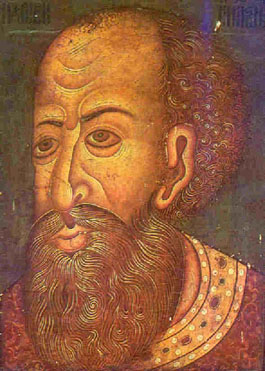
After all, that is, mutatis mutandis, what Vasili III’s son, Ivan IV (the Terrible), did in 1564/5. Incidentally, the behaviour of the Russian army in Chechnya throughout the conflict reminds one of the behaviour of Ivan’s army in Kazan and Greater Novgorod, not to mention the behaviour of the oprichniki, the praetorian guard or early version of secret police across the whole of Russia.

The question is, do we still see Russia as a foremost ally in the fight against terror and a useful partner in the development of energy policy?

29 November 2006

The retreat from politics – Part III

The last piece finished with a contradiction. At one, the implication of both pieces so far written is that the David Cameron and his Conservative Party want to win the next general election. But, in that second piece, I concluded that, for the Boy and his acolytes, winning the next general election was not their game. "They have bigger fish to fry," I wrote, "the total destruction of the Conservative Party."

This contradiction comes with the territory that is politics. In any major party and even (or especially) in the small ones, there are major differences of opinion, mixed motivations and variations in tactics. There is no single view or orthodoxy that will prevail for all time or any length of time. "Shifting sands" hardly does justice to the way sentiment changes within a political party – you can be "in" – flavour of the moment – and seconds later you can be "out", as fashion changes. Nothing is quite so brutal as politics.

Back to the main point then… the Boy does want to win and the Party desperately, desperately yearns to win. It hates being in opposition, has no talent for it and no understanding of the street-fighting needed to claw the party back into power. But the Boy and the Party are not at one.

The Boy wants power, but he believes the only way he will get it is to change the Conservative Party beyond all recognition. He believes that only then will the electorate (the bit left of it that is still prepared to vote) come round to voting for him. At some point though, the Party will have been so changed that it will have ceased to be the Conservative Party in anything else but name – it will have been destroyed. And since that is a precondition of victory - in the mind of the Boy and many of his tight circle of acolytes – the destruction of the Party is their first priority. Only then will it be fit to win and if that means losing the election, in order to win the next, so be it.

But there are darker forces within the Boy's circle – some people (and the cognoscenti know who they are) who want to destroy the Conservative Party as an entity – by which they mean the "right wing" which is naturally liberal, free-thinking and, crucially, Atlanticist and anti-EU. A failure – the fourth in a row – to win could be put down to the Party being dragged down by its right wing, providing the legitimisation for a "night of the long knives", followed perhaps by a re-alignment with the Lib-Dems to create a centre left, anti-American, pro-EU party.

In that scenario, the great battles are yet to come and will be fought out, for the soul of the Party, only after the next election has been lost – an outcome actively desired by many within the senior ranks of the Party.

In politics as elsewhere, however, it is possible to hold two contradictory ideas simultaneously. The Boy, therefore, might actually want to lose the election – but he also wants to win it. At the very least, he must be seen to be making a good fist of a campaign, not least so that any failure can be blamed on the "right-wing".

However, he and his inner circle believe they can run a campaign centrally, relying on heavy money from sponsors and the money men. The key strategy is to build the Cameron persona into an A-list celebrity that will pull in the voters in a latter-day "Big Brother" style contest, where personalities rather than policies - and therefore politics - become the key issue.

Hence the latest party political broadcast, where we are invited to "check out David's new video…". Yuk and double-Yuk! This, from the leader of the Conservative Party? It is an invitation so puerile as to be calculated to engender nausea. In effect, the Boy wants you to vote Brown out of the House, to leave him with the prize.

It is that facile, policy-lite approach which inspired the title to these pieces - "the retreat from politics". The Boy is not interested in politics. He is simply interested in power and, to obtain it, he is seeking to turn the election into a beauty contest.

As for the rest – current MPs and the candidates – these fall into one of two groups. The first is those who are motivated by a sense of outrage, people who get into politics because they think the system needs controlling and changing - who think that peole should come first. The other group comprises those who enjoy the use of power – and the trappings that go with it – for its own sake. Sadly, the latter are more numerous and, as the power drains away to the EU and elsewhere, the trappings assume greater and greater importance to them.

The trouble with these power-mongers in opposition is that they are not prepared to work for power. They assume it is theirs by right and harbour not a little resentment that they are in opposition. There is neither humility nor modesty in the mid-ranking hierarchy.

Furthermore, it is their arrogance of office that will be their undoing. It was there in the dying days of the Major government, coupled with a smug condescension that made them impervious to any new ideas or information. Simply, you could not tell them anything, as they already knew it all and would reward you with a pitying smile if you had the temerity to suggest that there was something that they might not know or understand.

If there is a personal edge to this bit of analysis, it stems in part from dealing with the last Conservative government's attempts to mount a deregulation campaign. It was doomed from the very start as ministers were relying on civil servants to tell them where and how to cut back regulation – the very civil servants who were largely responsible for the mess. But you could tell them nothing.

The experience, however, is shared by others. Talking to a very senior general, now retired, he recalled how he had offered his services freely to the Party to help them construct an effective defence policy. All they had to do was 'phone me, he said. But, after the first meeting, the call never came. He was never asked – and to this day has not been asked – for any help or information.

Thus, we have the upper levels of the Party, the inner circle around the Boy, who believe the election can be run as a policy-free beauty contest. In the middle ranks, we have a huge tranche of unreconstructed careerists, "Tory Boys" of all ages, who display an infuriating arrogance that alienates most of those who seek to help them into office.

At the lower echelons, we have party members who are so anxious to win that they will believe anything – even, and especially, that the Boy is a winner. For that, they will suspend judgement and put their local electoral machines into action. But many will not. They can see though the Boy, his posturing and pretensions. Some – a few – are resigning with a great flourish, but many more are simply walking away, disgusted and ashamed to see how a once great party has declined. They are the activists, the core voters – and they are not going to support the Boy.

If ever there was a losing recipe, that is it.

So, towards the end of a long piece, some readers might consider this analysis an intrusion on private grief – the affairs of an opposition party in a small country anchored just off mainland Europe, a party that has not seen power for over nine years and is unlikely to see it for many more.

But we are a country that is the staunchest ally to the US in the war of terror. Its current prime minister, Tony Blair - for all his ambitions to be at the heart of Europe - has managed to keep the UK alongside the US and has committed troops (but not properly supported them) in important theatres, alongside US troops.

But the Blair reign is about to end. Replacing him, almost certainly, will be Gordon Brown. And for all his familiarity, no one actually knows his politics, what he stands for and where he will take us on a whole range of issues, from the war on terror to EU membership. And, if he fails to perform, it becomes even more vital that we have a strong, credible opposition with a leader who is perceived as a credible prime minister, who could take the incumbent's place.

In what may turn out to be a modern tragedy though, the opposition is the "not-the-Conservative-Party". The man who would be prime minister is David Cameron, a man who never really looked like a credible candidate and looks less so with each passing day. He has made the retreat from politics his guiding principle and it now looks as if politics is going to retreat from him and (what is left of) his party. The price we will all pay for that is Gordon Brown as prime minister for the foreseeable future.

Where that will take us, in an age of uncertainty, no-one knows - but better the devil you don't know than the one you do.

COMMENT THREAD

28 November 2006

Taking the Michael

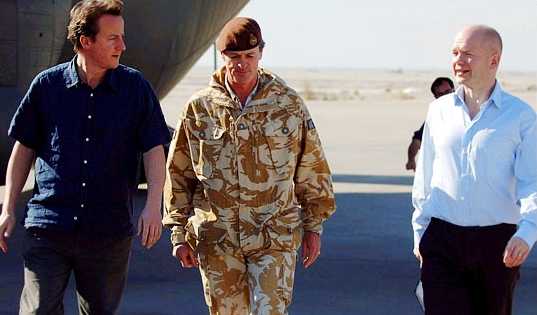
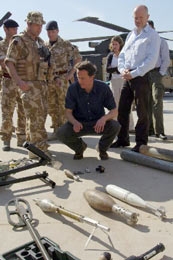
The Boy should be on his way home from Basra (at the time of writing). But there is still a curious lack of photographs of him coming out – one of them shown here, with the Boy inspecting (one presumes) captured weapons and ordnance.

Given that, like it not, the leader of the opposition visiting troops in Basra is a news event, one might have expected some mention on the MoD website. But you will search in vain.

Amusingly, until very recently it had been showing a photograph of the almost unknown Des Browne, defence secretary. Only when you look at the small print do you see that the picture was taken last May. Thus we see no reference to Cameron at all on the site, but an old photo of Browne. The MoD is definitely "taking the Michael" - a rather coy alternative term for removing the product of micturition.


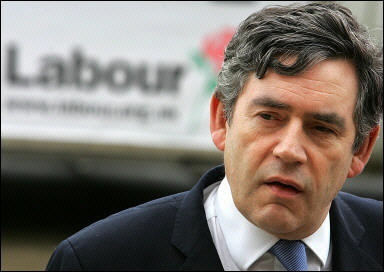
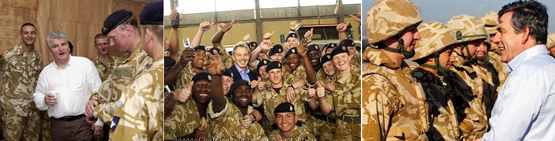
Looking at the MoD photo archive also fails to yield a Cameron photograph, although there are plenty of the prime minister surrounded by smiling troops, And, with the picture agencies still showing photos of chancellor Brown in Basra last week, it looks like the Bs have it – three Bs together. I have posted a composite above.

Browne's presence on the MoD website is to mark his speech to Chatham House on Monday when he confirmed what foreign secretary Beckett had said the previous week in Parliament. It is odd how much attention the media have given to Browne when, what he was saying is not really news. However, for the record, the key part of his speech talked about a definite reduction of troops next year. He went on to say:

...I can tell you that by the end of next year I expect numbers of British forces in Iraq to be significantly lower - by a matter of thousands. The planning for this has been going on for some months, and I have been pressing our planners to look at all the options, to make sure we do not ask a single extra soldier to remain in Iraq longer than is necessary. In the end, of course, it must depend on conditions on the ground - including the level of threat and the capacity of the Iraqis to deal with it - and the final decision will be down to our commanders.
So there it is - we are not "cutting and running", we are just "withdrawing", first back to our bases and then out of the country altogether. One hopes that the Iraqis are able to tell the difference, although they too might have an Arabic phrase for "taking the Michael".

But someone else is taking the Michael - actually, a group. The picture here shows followers of radical anti-American cleric Muqtada al-Sadr marching over the British, American and the Israeli flags in broad daylight in downtown Basra. They are members of the Shiite Mahdi Army and they are celebrating the anniversary of the death of Mohammad Mohammad Baqr al Sadar, the father of cleric Moqtada al Sadr.

This, of course, is happening just as Cameron is visiting Basra - except that he isn't. Ensconsed in the safety of Basra Air Station, he will see no more than you or me and will have to see scenes like this (and the one shown left) the same way we do, through agency pictures.

And the story they tell is stark - and makes a mockery of any idea that we will be handing Basra over to a civil authority that in any way represents the central government in Baghdad. This is the "army" that is going make happen Browne's prediction that, when British troops started to "draw down", the number of insurgent attacks may rise. There is no "may" about it and we are going to see some more flag-draped coffins before this charade is over.

Still, the Boy Cameron will be back tomorrow and he can tell us all about it - if there is anyone listening. Me, as befits my lowly station... I will be taking the Michael.

COMMENT THREAD
27 November 2006

Another costly and wasteful exercise?

According to The Times, the MoD is poised to award BAE Systems a £200 million contract to create the UK's first unmanned fighter jet.
This is a development arising from last December's Defence Industry Strategy, which has profound political implications. As always though, opposition parties and the MSM seem to be unaware of their importance.

The new contract is also important for British industry as, sneaked into the strategy – also largely ignored by the MSM - it emerged that the government had abandoned any plans to build a next-generation manned fighter aircraft. For a heritage which included Camel, Spitfire and Lightning, it was the end of the line.

However, that left open the possibility that the UK was to focus on the producing unmanned aircraft (UAVs), with the government arguing that maintaining a capability in this area is a vital part of our defence sovereignty.

To this blog, this issue has been something of a litmus test. The UK had been heavily involved in UAV development with the United States through the £10 billion FOAS programme, which it had abandoned suddenly in June 2005.

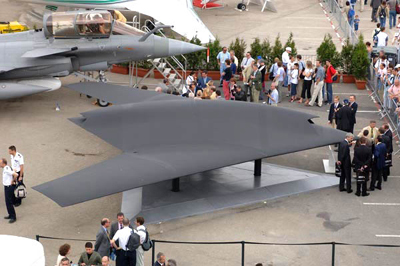
We were then suspicious that the MoD would then join in the French-led Neuron programme (right) to create a pan-European programme, which seemed to be powering ahead.

Our suspicions were strengthened when France and the UK announced they were to co-operate in certain aspects of the technology.

Even then, however, BAE Systems were working on their own UAVs, one known as the Corax, the other the Raven. Then, in June of this year the company unveiled a new machine called the "Herti" standing for: "High Endurance Rapid Technology Insertion" (illustrated, below left).

Now, it would appear that this endeavour is about to be rewarded with the award of the unmanned fighter contract, enabling BAE to develop a "technical demonstrator" version of the aircraft. This will be a full working model with weapons and targeting systems, which will then form the base design for a future generation of fighters.

The Times tells us that the £200 million contract is thought to be the largest experimental project financed by the MoD since it funded the development of the Eurofighter – which this points to one of four important political issues.

First, it should be an issue that the contract has been awarded to BAE Systems, a company with a more than chequered history in keeping defence contracts under control. To give the company yet another £200 million for a project which – if FOAS is any guide – could eventually be worth more than £10 billion, without the most searching of debates, seems unwise.

Secondly, we really need to be asking whether unmanned fighters are the right route to follow, and whether alternatives have been properly considered. Operational experience with UAVs have shown that they chew up bandwidth, which imposes considerable limitations on the number that can be deployed in any given area.

While BAE Systems have been successfully working on autonomous capabilities (enabling the machine to fly itself and make basic mission decisions), thus reducing bandwith requirements, any machine which is to be used to kill a human must have another human in the command loop. We cannot permit automated killing robots. Effective command, however, will require considerable data transmission to ensure that informed decisions are made, in which case there will still be high bandwidth demands and thus limits on the number of machines that can be operated.

Other options include the development of high performance, long-range air-to-air missiles which are so capable that they can be launched from any airborne platform, such as a transport aircraft (like the C-130) an air tanker, or even from an AWACS, dispensing with the need for a high performance fighter. Such developments would make UAVs irrelevant, except that they, themselves could become missile platforms.

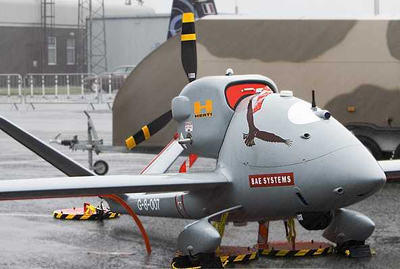
This then relates to the fourth and final issue, one we have discussed before in the context of the chequered history of British UAV projects, with disasters like the Phoenix (illustrated). Despite massive expenditure, British manufacturers have yet to deliver a worthwhile machine so should we be committing any expenditure to British ventures?

This is probably the most political of all the issues as we have a choice of potential partners, the Europeans and the Americans, and choice of either would have considerable political implications.

Already, despite this government's commitment to European defence integration, it has recently incurred the wrath of French by refusing to endorse a three-year spending plan for the European Defence Agency, with Michele Alliot-Marie accusing Britain of undermining efforts to build a common EU defence policy. A go-it-alone policy on UAVs is hardly likely to endear us to our European "partners". And any British Europhiles might be very angry.

On the other hand, we are already co-operating closely with the IS on the operation of the Predator UAV and are purchasing some machines for Afghanistan.

And, while the MoD is paying the French-owned Thales company upwards of £700 million to develop an Israeli design as the Watchkeeper UAV, in one of those convoluted deals that defy comprehension, British-owned BAE Systems – the very one getting £200 million of British money for UAV development – is developing the tactical UAV, called the Skylynx (illustrated) for the US Marine Corps, a system that is, according to BAE Systems, "capable of satisfying current and future Marine Corps requirements".

Of course, all the decisions made, and about to be made, could be perfectly sensible, well-founded and above board, as are so many in defence procurement circles. But then, it is just possible that the UK is about to embark on another costly and wasteful exercise.

Either way, though, one would have thought that a switched-on opposition would want to be sure.

COMMENT THREAD