21 January 2007

An heroic failure

We did the story on Wednesday with a follow-up the following day, in which I was highly critical of the unbelievably amateur graphic published by The Daily Telegraph to illustrate the attempted rescue of Lance Corporal Ford.

Although the attempt was last Monday, it has taken this long for photographs of one of the Apache helicopters actually involved in the rescue attempt to reach the media. These have been picked up by – amongst others - the News of the World, the Mail on Sunday, the Observer and The Sunday Telegraph (print edition only).

The photographs themselves completely support our contention that the riders on the Apaches were strapped to the sides and not, as the Telegraph illustrated in its cack-handed manner, lying prone across the wings.

Some of our readers - well, one in particular - questioned whether the detail mattered, countering our view that there seems little value in using up precious space in a national newspaper with a graphic which offers a false impression of events. Arguably - and we do thus argue - if accuracy is no longer an issue, then we might as well all give up and go home, leaving the newspapers to print whatever they deem fit - right or wrong - without challenge.

But there is more to it than this. Following the incident on the Monday, the Army Air Corps was ordered to put on a demonstration of how the Apache transport was arranged, which it did at its Middle Wallop base on the Wednesday morning. Thus, apart from checking the details on the internet (which we did), the Telegraph had an opportunity to check with the Army as to the details, both that morning and later, when Channel 4 News broadcast footage of the demonstration (video grab illustrated above). That the paper did not, and persevered with publishing an inaccurate graphic, suggests an element of carelessness or even incompetence that does not fit well with a major national daily newspaper.

Even then, we have always regarded this issue as peripheral. We were concerned that, in talking up a procedure that is quite normal in the military - hanging off helicopters - the paper was missing the point. In our Thursday posting, we argued that, in its story accompanying the graphic, it could have been better employed raising the issue that we had brought up, and which had been raised by a Telegraph letter-writer - why were there no proper troop-carrying assault helicopters to convey troops in what was a pre-planned attack?

But it was Channel 4 News, in its Wednesday evening report, that raised an even more important issue. The attack site, suspected of being an important Taliban regional centre, had been under observation for two months. Yet the assault, dubbed "Operation Glacier" - where the attackers' numbers had vastly overwhelmed the defenders - had faltered in the face of ferocious fighting.

This led Channel 4 News corespondent Alex Thompson to observe:

There is, however, no getting away from the central fact of this operation, which was that it was a failure, albeit a heroic failure in some aspects… the Taliban were not flushed out of their fort, and four Marines were injured and one, of course, was killed.
His report concluded, "There will be serious questions as to why months of surveillance and planning ended up in retreat, injury and death."

It takes no imagination at all to surmise the MoD's relief that the Telegraph chose for the following day to concentrate on the "derring do" aspects of the incident, complete with its "Boys' Own" comic-book style graphic, talking up the bravery of the troops.

It must be stressed that we applaud unreservedly the bravery of these troops, but the bravery was going back for their fallen comrade, not riding the outside of a helicopter.

That activity is not even confined to the military. The picture to the right and the one above show civilian electicity workers on the skids of an MD-500, prior to and in the process of repairing high-level electricity cables. Ironically, it is just this type of helicopter that the Army so desperately needs, the "Little Bird" to which Booker referred to in his column.

While other commentators could have given the MoD a hard time as well, however, none did. A media that so lacks perspective and judgement that it is besotted with "Big Brother" fell for the "derring do" story. It shelved its critical functions and went for the easy option, letting the MoD completely off the hook and a "heroic failure" go unchallenged.

And that is important.

14 January 2007

And so to Gerald…

I promised to respond to Gerald Howarth's e-mail, which we published on the blog yesterday. The exercise is useful and valid, not least because Gerald, as shadow minister for defence, is a senior Tory politician and his views give a remarkable insight into the mindset. So, here goes.

From the outset, it must be said of the man that it must take a real in-depth understanding of the political process in order to send an e-mail in which you have insulted the co-editor of one of the leading British political blogs, and then give the recipient carte blanche to circulate it. Not that I have any problem about being insulted in such a way as clearly, in Gerald, we have a master at work, and we can only stand back and admire his political skills.

Actually, that is a bullshit, clever-dick response which is not true. I wrote it in the first draft of this piece, but I have left it up as an example of the line I could have taken – jokey and sardonic. But I mind very much indeed being slagged off by this low-grade example of a politician who cannot even be bothered to get his facts right.

Yes, we know he launched my pamphlet on Galileo at the House of Commons, as he is prone to tell everyone at every opportunity, and we acknowledged this fulsomely. From July 2004, when he hosted the launch, through to November of that year, we mentioned Gerald no less than five times on the blog, each time in glowing terms. During that period, he also enjoyed two favourable mentions in the Booker Column.

But, declares Gerald, "Richard North has some good ideas but gives no credit to anything anyone else does". Well, we gave him ample credit for his action on Galileo and much else. In all, this blog has made 32 mentions of Gerald Howarth (not including this one), most of them favourable, right up to May 2006 when, in a general commentary about defence issues and MPs' involvement, we noted:

It has been left largely to the likes of shadow procurement minister Gerald Howarth and back-bencher Ann Winterton to make the running. Admirable though their efforts have been, they have not been enough, without the support of the wider House.
However, there was another aspect to the way the blog treated Gerald. We have been known, on occasions, to be pretty vicious about some of our subjects, but until recently, Gerald got off exceptionally lightly. For instance, we found it extremely difficult to keep quiet in April 2005 when the government announced an order for over £1 billion-worth of MAN-Nutzfahrzeuge trucks for the Army. This was an order which went to the German firm despite the trucks not meeting "defence planning assumptions" and the home-built vehicles being better, but did Gerald Howarth complain? Well, not exactly. He complained that the MoD had not bought enough of them.

I really had to bite my tongue on that one – this was and remains a betrayal of the Army, dumping substandard equipment on it, for what were evidently political reasons. And Gerald dropped the ball.

Perhaps he might have been more on the ball if he concentrated on his two jobs – the one as constituency MP and the other running his portfolio as defence procurement shadow. But a man who, by his own admission, is far too busy to read EU Referendum, manages to find time to do other day jobs, including having worked in the role of "consultant" for a brace of executive jet charter brokers, Aircraft Zone and European Business Jets Ltd.

Still, if he really was that busy, he could always have asked his assistant Mike Wood to brief him on the essentials - which would have been one way to get publicity - from The Independent on Sunday, at least.

Anyhow, the fact that the Tory group has been so bad at projecting it agenda has not stopped Gerald laying the charge that I have "little understanding of the - often extremely frustrating - political process, or of the power of the Opposition to get the media to focus on the issues we are tackling." Leaving aside his observations about my understanding of the political process for the moment, I readily concede that I have not (recently) got myself on the front page of the Independent on Sunday but who was it that got "Snatch" Land Rovers on the front page of The Sunday Times, to say nothing of several mentions in the Booker Column?

And so to the substantive part of Gerald's critique.

He starts by claiming that "the Opposition has been doing precisely that - opposing." He adds, "Not mindlessly, but intelligently where we believe the Government is wrong." And right here, we fall out with the man. Even in their Parliamentary tactics, we see them fail but, even more fundamentally, they fail on any number of key issues.

Take for instance, the issue of the shortage of helicopters, about which the "Opposition" has been voluble. Yet, although the shortage is here and now, in June last we got a government announcement about the Future Lynx committing the government to a long-term £1 billion project to buy 70 helicopters – averaging £14.2 million each. But, incredibly, they will not be in service until 2014. This was at a time when the Army was down to six Lynx multi-role tactical helicopters in the whole of Iraq and desperately needed (and still needs) more capability.

We had therefore, a situation where the Army was having to wait nearly eight years (longer than the Second World War) for new helicopters. And, while the US Army was paying £3.6 million each for their OH-58D Kiowa Warrior helicopters, we were to pay four times as much. And did we get any complaints from the Opposition? Not a murmur.

The British Army policy on helicopters (largely enforced by a dog-in-the-manger RAF) is insane - the insistence on a single, multi-role aircraft type with the airframe shared with the Navy (combined with an industrial policy of home design and build) means you end up with a camel of an aircraft that is really too expensive for some jobs, too big and heavy for others and not big enough for other roles. In the final analysis, this means you end up with a £14.2 million Rupert taxi which is not big enough to carry a fully-equipped section.

If ever there was something which cried out for full political examination and debate it is this - and this is directly Gerald's responsibility. Yet, as far as I know, he has not asked a single question on the validity of the Future Lynx (even though he hopes it will be his party in government when it comes to paying for the machines). In my view, in addition to a sustained questioning campaign, he should have been pressurising for a Select Committee investigation, forcing the (Conservative) chairman to get off his backside.

Then there was the episode of the Vipir thermal imagers, the lack of which was causing serious complaints amongst our troops in Afghanistan. Did we get any complaints from the Opposition? Well, the Lib-Dems intervened. But we heard nothing at all from Gerald Howarth, or any other Conservative.

Take the appalling episode of the four service personnel killed by a bomb while being transported in an unprotected water taxi, subsequent to which it was established that the passengers were highly vulnerable, not least because there had been 16 previous attacks. But did Gerald or any other Conservative complain? Once again, silence.

We raised the issue of the unarmoured WMIK Land Rovers in Afghanistan, leaving our soldiers dangerously exposed, while other national contingents benefited from armoured vehicles, even the Estonians. Did we hear anything from the Conservatives? Not a thing.

Yet this here is not our only litany of complaint. We set out one here, remarking on Conservative silence on FRES, on their silence on the government's disastrous record on unmanned aerial vehicles, on Gerald's lacklustre performance over the "Snatch" issue and his promotion of the dangerously inadequate Pinzgauer Vectors.

There was also the continuing issue of the Army's inability to deal with hit-and-run mortar raids. Howarth was more than informed. He was invited to supply this blog with a 1000 word piece setting out the Conservative policy on this and allied issues – with a promise that it would gain a reference in the Booker column. Promise there was but response there was none.

Against all this, and much, much more, Gerald tells us that Liam Fox held a press conference on Tuesday which was extremely well-attended, including by George Jones of the Telegraph. He then complains that "very little coverage followed, the Telegraph running not a single column inch."

Yet I set out in this piece how you, as a minority party, set about getting publicity. The one thing I would not do is waste my time with a press conference. Except on very rare and special occasions, they almost never yield results. Despite that, according to the great Gerald Howarth, I am the one that "has little understanding of the … power of the Opposition to get the media to focus on the issues we are tackling."

If I had been handling the publicity for the Conservatives, over Christmas I would have published a wish list. If it had been issued in the name of the Party, instead of this blog, the media would still be talking about it and it would be dominating the agenda.

So, we are supposed to be impressed that Liam spelled out forcefully in a series of PowerPoint displays the extent to which the Armed Forces have been betrayed by this Government? Big deal. Where was Liam months ago – where was he on the detail?

And so far out of touch with the debate is Gerald that he asks us to approve of Fox, when asked if he would increase defence resources if he were Secretary of State today, replying emphatically "yes", thus pre-empting the Prime Minister's remarks. Yet, read The Sunday Telegraph today. Remarkably, Rayment has managed to write something halfway intelligent (it happens occasionally), citing both Maj Gen Julian Thompson, and Col Tim Collins, both agreeing that money must be found from somewhere to upgrade the Armed Forces. But Collins argues that that doesn't mean there is not enough money in defence. “It is just not being spent properly," he says.

We would tend to agree with that. When you have a defence establishment spending £14.2 million each on light attack helicopters, when you can actually buy them – if you are really pushed – for less than £1 million. Throwing money at defence is not the answer. First we have to look at the waste, and the gross overspending.

That sort of makes the rest of Liam's little homilies rather flat and redundant, and it is not surprising that he got little publicity on them. From the sound of it, he had very little of interest to say. But, on other things said during the press conference, it looks like Liam made a bit of a fool of himself, so much so that he got himself in a spot of bother.

However, Gerald feels he could "go on and on" giving examples of what we – the team - have been doing, but confined himself to let me give you just three specifics.

He claims he was the first to raise the issue of armoured vehicles. This he did on his return from Iraq in September 2005. He told John Reid privately that he had to do something to get better protection for the troops facing roadside bombs (privately because he represents a garrison town and knows how careless politicians can cause increased anxiety). According to Gerald, Reid said they (the MoD) were aware of the problem and actively seeking solutions, but would not be specific. Since then, he claims, "we have raised the matter repeatedly."

It is true that once pushed, the Conservative team did have an effect, but it took some pushing, without which, doubtless, the Conservatives would have achieved nothing. That apart, Gerald cannot resist a snide little dig about my expertise, on the comparison between the RG-31 and the Mastiff (actually, the Mastiff is far superior in protection afforded) and he preens himself about establishing that only four have been delivered.

As far as the Pinzgauer Vector is concerned, Gerald is more than a little disingenuous. The vehicle is potentially a killer and has no redeeming features. Yet, while he has given the marque a puff, at no time has he raised the dangerous vulnerability of this machine with the minister, or at all in parliament.

Gerald's second claim to fame is the problem of troop air transport. The RAF is operating clapped-out 40 year old VC-10s and 35 year old Tristars half of
which, he says, we have just established (through Parliamentary Questions, our principal means of trying to get information) are not fit for purpose. That is as maybe but, in raising the issue with the Telegraph, he got it wrong.

We can give him the third issue – the procurement failure of the Landing Ships Docks project, and the appalling management by the MoD. But, in terms of the immediate concerns for our troops in Iraq and Afghanistan, the issue is an irrelevance. One commends the work, but not the sense of priorities.

However, says Gerald, the brutal truth is that we are not in power and not responsible for today's calamitous defence policy. But there he is also being more than a little disingenuous. Which government ordered the Eurofighter? Which government ordered the Storm Shadow – the "million pound bomb"? Which government ordered the EH 101, now called the Merlin, and under whose watch was the disaster that is the Type 45 Destroyer first set in train? Much of the current procurement budget, you will find, is dominated by decisions which were made by previous Conservative governments.

Thus while, say, one would like the opposition to oppose the continued purchase of the Eurofighter, Gerald is not only in favour of it, he is also hopelessly compromised and, therefore, silent. Not from him, therefore, would you get calls for the purchase of, say, a number of AC-130s. In fact, not ever can I recall any Conservative politician coming up with ideas for new kit that had not already been suggested by someone else. And not ever has Gerald pointed out the amount of money wasted on European projects. He simply does not agree that our defence priorities have been distorted by pursuing a European agenda.

Therefore, he tries to ignore the issue and, instead, tells us that the Tories understand the challenges which face our Armed forces and are incomparably best placed to meet them. He claims 14 MPs and Lords with military experience of one sort or another. But, what have they done? The list of the things they have not addressed is endless.

So, coming to a conclusion, Gerald tells us that the team will not always get it right and must be subject to criticism if we get it wrong. But, when he gets criticism, he either ignores it or, as in this case, rejects it outright – not conceding one single element of error. Where, from the torrent of material produced by this blog, has Gerald actually admitted – even once, on one issue, that his fabulous team got it wrong or could have done better?

Yet goodwill he wants. But where is the reciprocation Gerald, the famous quid pro quo? You actually had a great deal of support from us – more than you deserved. You frittered it away, you ignored us, behind the scenes you briefed against us and now, publicly you deride and insult me. And you want goodwill to support and encourage you?

Thus you tell us that the most disastrous outcome would be for the UK to have inflicted on it a Labour Government led by a dour Scottish redistributive socialist who has consistently starved the Armed Forces of the resources they need to do the job and who until recently has distinguished himself by his complete lack of interest in our servicemen and women. That outcome, you say, will be assured unless people get behind the Tory party and rally to our flag.

We have answered you on that. But the odds are, you will not read our answer and, in the unlikely event that you do, you will not accept what we say and act on it. And because of that, Gerald Howarth MP, Member of Parliament for Aldershot & Shadow Defence Minister, you will be a loser.

COMMENT THREAD

31 December 2006

Getting away with it

Even by the standards of our idle media, it would have been news: two soldiers killed in Land Rovers on consecutive days, one in Afghanistan and one in Iraq. But it was not to be and what could possibly be a major story goes begging.

It starts on Thursday, when we get a report from the MoD that a soldier has been killed in Afghanistan, after his vehicle is involved in an explosion. There are no pictures and few details and only later does it emerge that the "explosion" was caused by a landmine. And although the MoD must have known the vehicle type involved, very carefully it does not identify the type. Most likely, though, it is a Land Rover, and quite possibly a "Snatch".

On the Friday, however, The Times, to its credit, questions the type of vehicle, establishing that it is unarmoured. But the rest of the media dutifully copies and pastes the MoD press handout in what passes for news coverage.

The same day we read The Times, we get a report of the death (as we are later told) of Sergeant Graham Hesketh, from a roadside bomb while he is on patrol in Basra. But, in the eyes of the media, there can be no link with the Afghanistan incident. The MoD report makes it quite clear (untypically clear) that the Sergeant Hesketh is riding in a Warrior MICV.

Also, atypically, there are no agency photographs. This is very unusual. Of virtually every bombing incident involving the death of a UK soldier, there are one or more images recording the aftermath. And in this case, as the MoD helpfully informs us that Sergeant Hesketh's patrol "was travelling towards the Old State Building, a British Army Base in the centre of the City, when the device activated."

This is not in some remote part of Iraq so, if not of the actual bombed vehicle, at the very least, one would expect to see agency shots of British troops "securing the scene" - such as the one here after another recent incident. Instead, what we actually get is pictures of an apparently unrelated incident showing two burning "Snatch" Land Rovers after – as we are led to believe – another bomb incident.

These initial reports make no reference to casualties but we then get Reuters yesterday quoting a Captain Olly Pile claiming that "one British soldier was slightly injured", only to be followed by an AFP report today (see below), which states that a roadside bomb hit the patrol, "killing an unidentified soldier".


Already, we have the MoD website offering a picture of Sergeant Hesketh, sitting atop a Warrior, and it makes the direct claim that he was "commanding a Warrior Armoured Fighting Vehicle on a routine security patrol." But, strangely, the report also includes a tribute from Sgt Hesketh's father, Kevin, who writes: "Graham was killed in action while patrolling in Iraq by a kerbside bomb exploding under his Jeep...".

To have two bomb attacks on British vehicles on the same day is very rare - to the point of being unprecedented. Are we therefore being misled (one assumes deliberately) by the MoD about Sergeant Hesketh's death? Was there one incident, not two and was the Sergeant patrolling not in a Warrior but in a "Snatch" Land Rover, which his father describes as a "jeep"?

The question is, would the MoD lie about such a thing? Surely it would be found out? Well, after the bomb attack on the boat on the Shatt al-Arab on 12 November, killing four service personnel, it claimed on the day and then two days later that it was "an attack on a Multi-National Forces boat patrol".

But, as we observed, it never was a patrol. This was an attack on a "water taxi", a routine movement of personnel between Basra Palace and Shatt al-Arab Hotel. And, it transpired, there had been 16 previously recorded attacks, clearly indicating that the use of unprotected boats was highly risky.

Yet, despite there being plenty of questions, the media let the issue ride and the MoD got away with it - for the time being. Clearly, the media prefer to be spoon-fed, so where you get a coroner's report, and the criticism is nicely packaged and "safe", they will go to town on it - nice cheap journalism.

Once again the MoD looks like getting away with it. And it has a lot to hide. Not only are troops still being killed in vulnerable and inadequate Land Rovers, the Minister promised of the Mastiff armoured vehicles that there would be an "effective capability in place in Iraq by the end of the year."

Of course, we fully understand that the media have far more important things to write about. And today, it is this. Gerald Howarth has finally got his name in the papers.

COMMENT THREAD

27 December 2006

The "Snatch" revisited

You can see why the troops who used them in Northern Ireland - where they were first issued in 1992 - had to give them a short name. Officially, the "Snatch" Land Rover - in true Army style - is designated the "Truck utility medium (TUM) hardtop with vehicle protection kit (VPK) Land Rover 110". The current version runs to the 2A, costing the British taxpayers about £60,000 each (not including radios and electronic counter-measures).

We broached the subject of how these vehicles were dangerously vulnerable - leading directly to the death of our soliders in Iraq - formally on this blog on 18 June, having held off to tie in with the Booker column which was published the same day. We had, however, already sent full details to the opposition defence team and it was Lord Astor of Hever on 12 June who raised the issue in Parliament, asking the defence procurement minister Lord Drayson whether the "Snatch" was adequate or whether the RG-31 had a greater resilience to Improvised Explosive Devices (IEDs). Drayson (pictured here on one of his visits to the troops), replied:

My Lords, I do not accept that Snatch Land Rovers are not appropriate for the role. We must recognise the difference between protection and survivability. It is important that we have the trade-offs that we need for mobility. The Snatch Land Rover provides us with the mobility and level of protection that we need.
He then went on to say:

We have looked at the RG-31 alongside a number of alternatives for our current fleet and concluded that the size and profile did not meet our needs. Size is important in the urban environment. The RG-31 cannot access areas that Snatch Land Rovers can get to.
That the RG-31 had "a greater resilience" to IEDs was unarguable, purely in terms of the basic specifications. but the difference was illustrated graphically by both myself and Booker - respectively in the blog and The Sunday Telegraph with the now famous picture of a USMC RG-31 after it had been hit by an IED. In this instance, the crew walked away uninjured and it was clearly evident that, had this been a "Snatch" Land Rover, the crew - at the very least - would have been badly injured.

On the face of it, therefore, the issue was about "mobility" - the fact that the Land Rover could travel down the supposedly narrow streets of Basra meant that it could provide a level of protection in circumstances where the very much larger RG-31 simply could not travel. But there was also the "hearts" and minds" issue. The more aggressive-looking RG-31 would, it was felt, make it more difficult for toops to interact with the local communities. And these arguments gained support from Times defence editor Mick Smith who, in a particularly pompous and ill-informed entry on his blog agreed with the MoD that the RG-31's profile was wrong and that it was also simply "too big for Basra".

There had been some validity in the "hearts and minds" argument but it had long ceased to be the case that British troops could don soft hats and mingle easily with the crowds. So dangerous had it become that "Snatch" Land Rovers, once used as escorts, had to be escorted front and rear by tracked Warrior MICVs, themselves bigger and far more aggressive-looking than RG-31s. The two arguments simply did not stand up.

But there was a third issue - the emergence of a new and supposedly lethal form of IED, the so-called "explosively formed projectile". This was featured by defence correspondent Sean Rayment in The Sunday Telegraph on 25 June, complete with a fanciful graphic showing the device mounted on a launch tripod. And it was Rayment's thesis, proclaimed in his headline, "The precision-made mine that has 'killed 17 British troops'" that it was this new weapon rather than the inadequate Land Rovers per se which was the cause of the problem. So deadly was this supposed to be that it could penetrate four inches of armour. We were told by an anonymous source: "If you are travelling in an armoured Land Rover which is attacked by one of these things, you are in trouble. You have a better chance of surviving if you are in a tank or an armoured vehicle but it will 'kill' the tank."

That seemed totally to contradict the line taken by Booker in the same newspaper, who argued that our troops had been put at risk by the MoD's decision in 2004 to buy a new generation of vehicles suitable for armoured patrolling. On the shortlist had been the RG-31 but, instead of buying this machine, the MoD insisted instead, as part of its "Europe-first" procurement policy, on buying 401 Italian-made Panthers, vehicles which cost nearly twice as much yet provided only a fraction of the protection.

Futhermore, there was another part to this scandal. On June 12, Drayson had tried to disparage the RG31, claiming that the Army had used them in Bosnia and found them wanting. But photographic evidence had shown that this was not true. The vehicles used in Bosnia were not RG31s but an earlier and much less capable vehicle, the Mamba. Later, we were to find that these had been sold off, cut-price. Some were being used by the US security firm Blackwater, to convey US diplomats and other VIPs from Baghdad Airport to the Green Zone, and had survived at least two IED strikes.

The same day that Booker and Rayment were battling it out in the Telegraph, however, The Sunday Times pitched into the fray with a front page story, an editorial and a long "Focus" investigation. And, for this newspaper, there was no argument. Its theme was: "pay up and save lives".

It was an unfortunate coincidence that, in its focus piece, the Times chose to feature former Metropolitan police officer, Roger Bacon, whose son Matthew, 34 - then an army intelligence officer - had been killed in a "Snatch" (pictured). At 11.13am on 11 September 2005, he had been travelling from Basra Palace to Basra air base to catch a flight when an explosively formed projectile had detonated. He was killed instantly. Sitting with his back to the blast, he stood no chance as a copper projectile sliced through the vehicle and went through his chest. Three other occupants of the vehicle were seriously injured.

The image of the vehicle shows a single, clean puncture, although this may have been the exit. If this is the case, Matthew was doubly unfortunate. No only should he not have been there (he was travelling in the "Snatch" because a helicopter which was to convey him to the air base had fallen unserviceable and there was no replacement) but the projectile seems to have functioned in the manner intended. Other images (such as the one above) show more fragmentation and less penetration - suggesting that the weapon is not as potent as Rayment indicated.

In fact, we now know that to be the case. Not only does the bomb come in a wide range of sizes, the machining quality also seems to vary significantly - suggesting anything but a "precision" weapon. Performance will vary widely and may be less than theoretically possible, so much so that the Israelis - who had encountered it in Lebanon and Gaza - reported it as relatively ineffective against armoured vehicles, although "heavier versions" had caused catastrophic results in softer or lightly armoured vehicles.

Nevertheless, the prospect of this "killer weapon" overcoming all armour was enough to spark a lively (and at times ill-tempered) debate on the unofficial Army forum. A strongly argued strand was that, given the ability of the weapon to pentrate all known armour, it would be better to rely on training and tactics than to invest in new armour. But the reality was, as the Sunday Times pointed out, that the "Snatches" were highly vulnerable to attack and the terrorists had started to target them for that very reason.

Fortunately, the subtle (and not so subtle) arguments about the merits of additional armour passed by the politicians and, for once, the political process worked, forcing Des Browne first to announce a review and then the purchase of new armoured vehicles for Iraq and Afghanisan. But they were not to be RG-31s. Formally announced on 24 July, 100 heavily modified US-built Cougars were to be ordered, for deliveries to theatre to start by the end of the year. The new vehicles were to be called the Mastiff (alongside up-armoured FV-432s, which were to be called "Bulldogs"). In some respects, these were better than the RG-31s although it is arguable as to whether all the modifications improved the vehicle

Unfortunately for the troops in Afghanistan, they were not to get this equipment. Instead, it was planned to send them the Pinzgauer Vector, with little more armour than the "Snatch" Land Rover and actually less protection from mines and IEDs. Yet, this is at a time when the Taliban are stepping up attacks on road vehicles, having already destroyed three Land Rovers using suicide bombs, two of the attacks (both on "Snatch" Land Rovers) with lethal results.

That will leave British forces in Afghanistan the least well equipped of all the major contingents. The Australians have their Bushmasters, which have also been sold to the Dutch, the Canadians have RG-31s, the French have VAB armoured personnel carriers and the Germans have their Dingo IIs. And, just before Christmas, the vehicle pictured turned up in US colours - a Cougar - hitherto used for ordnance disposal officers - equipped as a patrol vehicle.

Despite the promises from Mr Browne, the Mastiffs have still not arrived in Iraq and, for want of suitable armour, soldiers are still patrolling - and dying - in "Snatch" Land Rovers in both Iraq and Afghanistan. But, if it is the politicians who are ultimately responsible for the deaths of many fine young men (and women), that they were palmed off with second-hand Land Rovers in the first place was because General Jackson allowed it.

COMMENT THREAD

19 December 2006

All I want for Christmas...

Any credible foreign policy for a mid-ranking, internationalist power like the United Kingdom relies on effective military forces to back it up. However, while our forces are undoubtedly first-rate, they are equipped primarily to deal with a Soviet-era threat. Yet the greatest demand in the post 9-11 scenario is for counter-insurgency forces, which need different types of equipment, issued on a different scale.

Very little of the equipment needed is actually new in concept. What in many cases makes (or should make) the difference is the scale of issue. A counter-insurgency force, for instance, will need far more light attack helicopters than a conventional armoured formation. There also needs to be a strong emphasis on force protection, focused on base defences and patrol/convoy survivability.

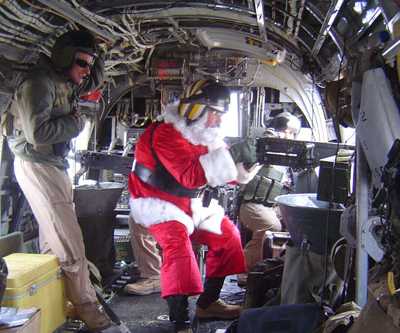
These are areas where the British Army is heavily deficient and to redress the inadequacies and the imbalances, we have produced our own Christmas list for Santa. It might as well be addressed to Santa for the chances of our own politicians (much less the media) paying any attention to it are pretty remote - although discussion of the list would make a fascinating feature in a Sunday newspaper. Anyhow, here goes:

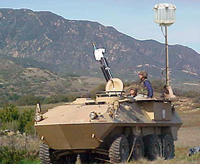
Number one on our list is dedicated to base defence. This is the US-developed lightweight counter-mortar radar, in this case mounted on a USMC Light Armoured Vehicle (LAV) which itself is equipped with an advanced 120mm mortar for counter-battery fire. The combination is a potent weapon for base and tactical commanders having to deal with hit-and-run mortar and rocket attacks on their positions - whether they be large, established bases like the Shatt al-Arab Hotel in Basra or temporary positions such as those occupied by 3rd Para in Afghanistan.

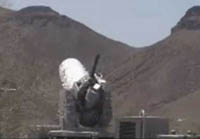
Option number two is for large, static bases - the C-RAM (Counter Rocket, Artillery and Mortar) gun based on the naval Phalanx system. This can be used to shoot down incoming mortar bombs and rockets, with an 80 percent success rate. The guns have the added advantage that the automatic firing provides audible warning of an attack, giving time for those at risk to run for cover.

The third piece of kit we desperately need is a medium tactical, high endurance UAV - or to be more specific, a UCAV (Unmanned Combat Aerial Vehicle) - the distinction being that this can carry weapons. The vehicle illustrated is the Hunter and, although there are other UAVs with similar performance, this has been fully developed to deliver low-yield precision guided missiles.

The Hunter can either be used for reconnaissance - locating enemy forces and relaying their positions to commanders, who can task other assets to deal with them - or it can be used as an attack weapon in its own right, firing missiles to take out small groups of the enemy (such as a rocket or mortar teams).

And this is the missile of choice - the Viper Strike. Originally designed as an anti-tank missile, it has been adapted to function in an anti-personnel role, with a capability also to take out light vehicles. Where so much fighting is carried out in urban environments with civilians present, the urgent need is for a weapon which minimises collateral damage. This missile has the ability to kill the occupants of one vehicle in a line, without damaging the others. Another characteristic of the weapon is its very steep attack profile - contrasting with the shallow flight-path of the typical missile - which makes it ideal for urban canyons.

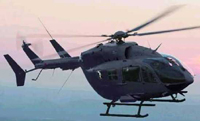
Number five on our list is a light tactical helicopter, of which many are needed. Smaller than the Lynx, they can either be one of the Eurocopter versions, an MD Enforcer or similar. They should be able to carry 4-5 troops as a rapid response force, stretchers for casevac, light weapons (including rocket pods) in the light attack role, and/or surveillance equipment for the search and observation roles. The crucial issue is the price, with their relative cheapness enabling the military to buy larger numbers of machines than at presently planned with the Future Lynx.

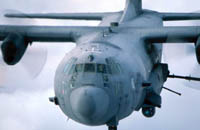
And, giving our commanders yet another option is the AC-130. With its array of gatling guns, cannon and its 105mm howitzer, its sensors and all-weather target acquisition capability, the "Spooky" as it is known, is a powerful - if expensive - addition to any armoury. It is capable both of laying down saturation fire to break up attacks and precision fire to take out specific targets. These formidable machines should be available in both Afghanistan and Iraq.

And alongside the "Spooky" we also need high-endurance, long range UAV/UCAVs such as the Predator or the more advanced MQ-9 Reaper. Although the government is currently acquiring three of these machines for Afghanistan, this seems a question of "too little - too late". We need enough to have at least one flying over every area of operation, with an organic UCAV capability. Reading just a fragment of the spec demonstrates why the MQ-9 comes into the "must have" category: it will be able to deploy the GBU-12 and EGBU-12 bombs and 500lb GBU-38 JDAM (Joint Direct Attack Munition). Flight trials have also taken place with the General Atomics Lynx SAR (Synthetic Aperture Radar) payload. Lynx also features ground moving target indicator technology...

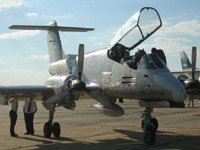
From the sublime to the ridiculous. The aircraft shown is the Argentinian-built Pucara, a twin turbo-prop ground attack aircraft used during the Falklands war. Not for one moment would I suggest that we have some of these but the picture is used to illustrate the concept of a light, cheap ground attack aircraft. At a time when the trend is towards greater sophistication, complexity and cost, against a relatively unsophisticated enemy, the "cheap and cheerful" concept ensures that there is always some capacity, as opposed to none at all - which is so often the case at the moment.

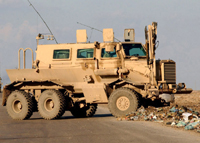
For the next item, we have the Force Protection Buffalo - equipped for mine and IED clearance. This machine is currently in service in Iraq where it provides invaluable service in detecting IEDs that would otherwise kill and main. So far, with the Cougars, which are used by bomb disposal officers, these vehicles have received over 1,000 hits from IEDs, without a single fatality. The British forces rely on a man walking in front of a vehicle (surprisingly they do not give him a red flag) and the bomb disposal officers have unarmoured "Duro" trucks. Neither is acceptable.

Then we need a mine/blast protected patrol and convoy escort vehicle, to replace the "Snatch" and "Wimik" Land Rovers. The 6x6 versions of the Cougar being bought by the MoD (and re-named the Mastiff) are too big and cumbersome to be used. The vehicle illustrated is the RG-31. It has proved its worth time and time again in Canadian and US hands, saving many lives in circumstances where Land Rover crews would have been killed. Nevertheless, the Australian Bushmaster would be just as acceptable as would - at a pinch - the German Dingo II.

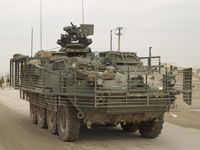
This picture shows a US Stryker wheeled armoured personnel carrier. Operations by the US in Iraq and by the Canadians in Afghanistan with their Bisons, have demonstrated the value of wheeled carriers. They are faster, quieter, more comfortable and cheaper to run - also requiring less maintenance. For sure, they do not have the cross-country performance of tracked carriers, but no one is suggesting that our Warriors should be dispensed with. Alongside tracks, though, there is a role for wheels. We need some.

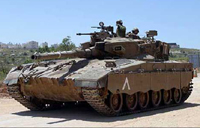
And finally... we need a new tank. The British Challenger II MBT (and the US Abrams) were built for taking out Soviet T82s at long range under all conditions. They were not built for counter-insurgency. Pictured is an Israeli-built Merkava MBT. It is not perfect but, with a personnel and stores carrying capability, it is better than other Western tanks. They performed well in Lebanon and provide a good model on which to base new designs. Not for this Christmas then, but in years to come, we want a new MBT from Santa.

As for the price tag - well, no one asks the price of Santa's gifts. If really pushed, one would have to concede that a decent number of the toys illustrated would set Gordon back several billions - perhaps as much as £5 billion. But since he is paying £15 billion a year to the EU, there is one very obvious place where he could get the money - and have some change. That would enable us to buy some more Hercules C-130J airlifters and some CH-47 Chinooks, which we also need, leaving £5 million to spend on more Vipir thermal imagers.

However, this is only my idea for a list. What would yours be? And what would the Conservatives suggest?

COMMENT THREAD