Showing posts with label basra. Show all posts

31 December 2006

Getting away with it

Even by the standards of our idle media, it would have been news: two soldiers killed in Land Rovers on consecutive days, one in Afghanistan and one in Iraq. But it was not to be and what could possibly be a major story goes begging.

It starts on Thursday, when we get a report from the MoD that a soldier has been killed in Afghanistan, after his vehicle is involved in an explosion. There are no pictures and few details and only later does it emerge that the "explosion" was caused by a landmine. And although the MoD must have known the vehicle type involved, very carefully it does not identify the type. Most likely, though, it is a Land Rover, and quite possibly a "Snatch".

On the Friday, however, The Times, to its credit, questions the type of vehicle, establishing that it is unarmoured. But the rest of the media dutifully copies and pastes the MoD press handout in what passes for news coverage.

The same day we read The Times, we get a report of the death (as we are later told) of Sergeant Graham Hesketh, from a roadside bomb while he is on patrol in Basra. But, in the eyes of the media, there can be no link with the Afghanistan incident. The MoD report makes it quite clear (untypically clear) that the Sergeant Hesketh is riding in a Warrior MICV.

Also, atypically, there are no agency photographs. This is very unusual. Of virtually every bombing incident involving the death of a UK soldier, there are one or more images recording the aftermath. And in this case, as the MoD helpfully informs us that Sergeant Hesketh's patrol "was travelling towards the Old State Building, a British Army Base in the centre of the City, when the device activated."

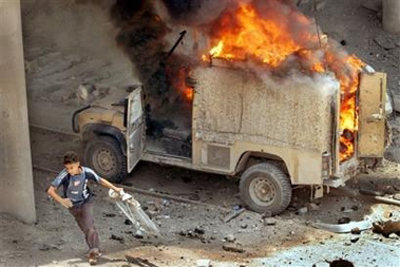
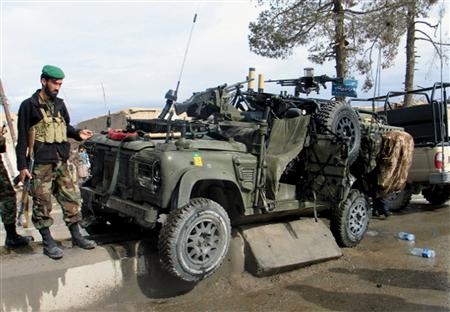
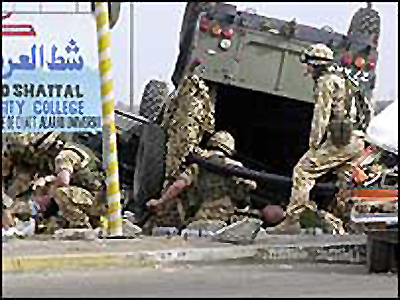
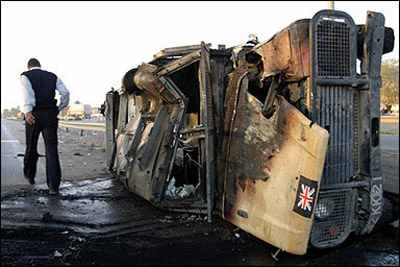
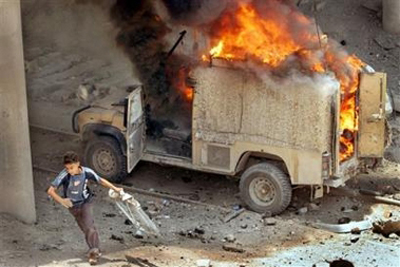
This is not in some remote part of Iraq so, if not of the actual bombed vehicle, at the very least, one would expect to see agency shots of British troops "securing the scene" - such as the one here after another recent incident. Instead, what we actually get is pictures of an apparently unrelated incident showing two burning "Snatch" Land Rovers after – as we are led to believe – another bomb incident.

These initial reports make no reference to casualties but we then get Reuters yesterday quoting a Captain Olly Pile claiming that "one British soldier was slightly injured", only to be followed by an AFP report today (see below), which states that a roadside bomb hit the patrol, "killing an unidentified soldier".


Already, we have the MoD website offering a picture of Sergeant Hesketh, sitting atop a Warrior, and it makes the direct claim that he was "commanding a Warrior Armoured Fighting Vehicle on a routine security patrol." But, strangely, the report also includes a tribute from Sgt Hesketh's father, Kevin, who writes: "Graham was killed in action while patrolling in Iraq by a kerbside bomb exploding under his Jeep...".

To have two bomb attacks on British vehicles on the same day is very rare - to the point of being unprecedented. Are we therefore being misled (one assumes deliberately) by the MoD about Sergeant Hesketh's death? Was there one incident, not two and was the Sergeant patrolling not in a Warrior but in a "Snatch" Land Rover, which his father describes as a "jeep"?

The question is, would the MoD lie about such a thing? Surely it would be found out? Well, after the bomb attack on the boat on the Shatt al-Arab on 12 November, killing four service personnel, it claimed on the day and then two days later that it was "an attack on a Multi-National Forces boat patrol".

But, as we observed, it never was a patrol. This was an attack on a "water taxi", a routine movement of personnel between Basra Palace and Shatt al-Arab Hotel. And, it transpired, there had been 16 previously recorded attacks, clearly indicating that the use of unprotected boats was highly risky.

Yet, despite there being plenty of questions, the media let the issue ride and the MoD got away with it - for the time being. Clearly, the media prefer to be spoon-fed, so where you get a coroner's report, and the criticism is nicely packaged and "safe", they will go to town on it - nice cheap journalism.

Once again the MoD looks like getting away with it. And it has a lot to hide. Not only are troops still being killed in vulnerable and inadequate Land Rovers, the Minister promised of the Mastiff armoured vehicles that there would be an "effective capability in place in Iraq by the end of the year."

Of course, we fully understand that the media have far more important things to write about. And today, it is this. Gerald Howarth has finally got his name in the papers.

COMMENT THREAD

19 December 2006

All I want for Christmas...

Any credible foreign policy for a mid-ranking, internationalist power like the United Kingdom relies on effective military forces to back it up. However, while our forces are undoubtedly first-rate, they are equipped primarily to deal with a Soviet-era threat. Yet the greatest demand in the post 9-11 scenario is for counter-insurgency forces, which need different types of equipment, issued on a different scale.

Very little of the equipment needed is actually new in concept. What in many cases makes (or should make) the difference is the scale of issue. A counter-insurgency force, for instance, will need far more light attack helicopters than a conventional armoured formation. There also needs to be a strong emphasis on force protection, focused on base defences and patrol/convoy survivability.

These are areas where the British Army is heavily deficient and to redress the inadequacies and the imbalances, we have produced our own Christmas list for Santa. It might as well be addressed to Santa for the chances of our own politicians (much less the media) paying any attention to it are pretty remote - although discussion of the list would make a fascinating feature in a Sunday newspaper. Anyhow, here goes:

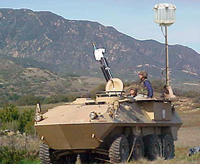
Number one on our list is dedicated to base defence. This is the US-developed lightweight counter-mortar radar, in this case mounted on a USMC Light Armoured Vehicle (LAV) which itself is equipped with an advanced 120mm mortar for counter-battery fire. The combination is a potent weapon for base and tactical commanders having to deal with hit-and-run mortar and rocket attacks on their positions - whether they be large, established bases like the Shatt al-Arab Hotel in Basra or temporary positions such as those occupied by 3rd Para in Afghanistan.

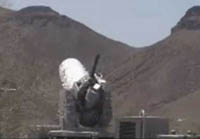
Option number two is for large, static bases - the C-RAM (Counter Rocket, Artillery and Mortar) gun based on the naval Phalanx system. This can be used to shoot down incoming mortar bombs and rockets, with an 80 percent success rate. The guns have the added advantage that the automatic firing provides audible warning of an attack, giving time for those at risk to run for cover.

The third piece of kit we desperately need is a medium tactical, high endurance UAV - or to be more specific, a UCAV (Unmanned Combat Aerial Vehicle) - the distinction being that this can carry weapons. The vehicle illustrated is the Hunter and, although there are other UAVs with similar performance, this has been fully developed to deliver low-yield precision guided missiles.

The Hunter can either be used for reconnaissance - locating enemy forces and relaying their positions to commanders, who can task other assets to deal with them - or it can be used as an attack weapon in its own right, firing missiles to take out small groups of the enemy (such as a rocket or mortar teams).

And this is the missile of choice - the Viper Strike. Originally designed as an anti-tank missile, it has been adapted to function in an anti-personnel role, with a capability also to take out light vehicles. Where so much fighting is carried out in urban environments with civilians present, the urgent need is for a weapon which minimises collateral damage. This missile has the ability to kill the occupants of one vehicle in a line, without damaging the others. Another characteristic of the weapon is its very steep attack profile - contrasting with the shallow flight-path of the typical missile - which makes it ideal for urban canyons.

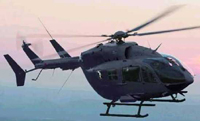
Number five on our list is a light tactical helicopter, of which many are needed. Smaller than the Lynx, they can either be one of the Eurocopter versions, an MD Enforcer or similar. They should be able to carry 4-5 troops as a rapid response force, stretchers for casevac, light weapons (including rocket pods) in the light attack role, and/or surveillance equipment for the search and observation roles. The crucial issue is the price, with their relative cheapness enabling the military to buy larger numbers of machines than at presently planned with the Future Lynx.

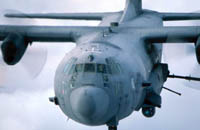
And, giving our commanders yet another option is the AC-130. With its array of gatling guns, cannon and its 105mm howitzer, its sensors and all-weather target acquisition capability, the "Spooky" as it is known, is a powerful - if expensive - addition to any armoury. It is capable both of laying down saturation fire to break up attacks and precision fire to take out specific targets. These formidable machines should be available in both Afghanistan and Iraq.

And alongside the "Spooky" we also need high-endurance, long range UAV/UCAVs such as the Predator or the more advanced MQ-9 Reaper. Although the government is currently acquiring three of these machines for Afghanistan, this seems a question of "too little - too late". We need enough to have at least one flying over every area of operation, with an organic UCAV capability. Reading just a fragment of the spec demonstrates why the MQ-9 comes into the "must have" category: it will be able to deploy the GBU-12 and EGBU-12 bombs and 500lb GBU-38 JDAM (Joint Direct Attack Munition). Flight trials have also taken place with the General Atomics Lynx SAR (Synthetic Aperture Radar) payload. Lynx also features ground moving target indicator technology...

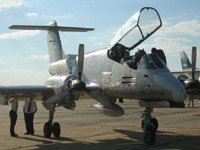
From the sublime to the ridiculous. The aircraft shown is the Argentinian-built Pucara, a twin turbo-prop ground attack aircraft used during the Falklands war. Not for one moment would I suggest that we have some of these but the picture is used to illustrate the concept of a light, cheap ground attack aircraft. At a time when the trend is towards greater sophistication, complexity and cost, against a relatively unsophisticated enemy, the "cheap and cheerful" concept ensures that there is always some capacity, as opposed to none at all - which is so often the case at the moment.

For the next item, we have the Force Protection Buffalo - equipped for mine and IED clearance. This machine is currently in service in Iraq where it provides invaluable service in detecting IEDs that would otherwise kill and main. So far, with the Cougars, which are used by bomb disposal officers, these vehicles have received over 1,000 hits from IEDs, without a single fatality. The British forces rely on a man walking in front of a vehicle (surprisingly they do not give him a red flag) and the bomb disposal officers have unarmoured "Duro" trucks. Neither is acceptable.

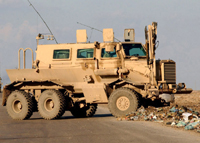
Then we need a mine/blast protected patrol and convoy escort vehicle, to replace the "Snatch" and "Wimik" Land Rovers. The 6x6 versions of the Cougar being bought by the MoD (and re-named the Mastiff) are too big and cumbersome to be used. The vehicle illustrated is the RG-31. It has proved its worth time and time again in Canadian and US hands, saving many lives in circumstances where Land Rover crews would have been killed. Nevertheless, the Australian Bushmaster would be just as acceptable as would - at a pinch - the German Dingo II.

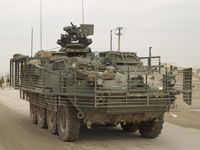
This picture shows a US Stryker wheeled armoured personnel carrier. Operations by the US in Iraq and by the Canadians in Afghanistan with their Bisons, have demonstrated the value of wheeled carriers. They are faster, quieter, more comfortable and cheaper to run - also requiring less maintenance. For sure, they do not have the cross-country performance of tracked carriers, but no one is suggesting that our Warriors should be dispensed with. Alongside tracks, though, there is a role for wheels. We need some.

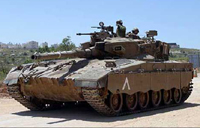
And finally... we need a new tank. The British Challenger II MBT (and the US Abrams) were built for taking out Soviet T82s at long range under all conditions. They were not built for counter-insurgency. Pictured is an Israeli-built Merkava MBT. It is not perfect but, with a personnel and stores carrying capability, it is better than other Western tanks. They performed well in Lebanon and provide a good model on which to base new designs. Not for this Christmas then, but in years to come, we want a new MBT from Santa.

As for the price tag - well, no one asks the price of Santa's gifts. If really pushed, one would have to concede that a decent number of the toys illustrated would set Gordon back several billions - perhaps as much as £5 billion. But since he is paying £15 billion a year to the EU, there is one very obvious place where he could get the money - and have some change. That would enable us to buy some more Hercules C-130J airlifters and some CH-47 Chinooks, which we also need, leaving £5 million to spend on more Vipir thermal imagers.

However, this is only my idea for a list. What would yours be? And what would the Conservatives suggest?

COMMENT THREAD

18 December 2006

Reflected glory

With the coroner's report on Sergeant Steve Roberts's death just out, for a brief moment, lack of Army equipment is in the news. Roberts was the soldier who, for want of body armour, was killed in a "friendly fire" incident on 24 March 2003, as he manned a checkpoint outside the southern Iraqi city of Az Zubayr.

But this issue has been smouldering in the background for a long time, largely ignored by the politicians and the media. The former seem more interested in exploiting the military for their "photo opportunities" while the latter seem to treat military affairs as a source of cheap copy. Neither seem to be devoting any time or energy to ensuring that our armed forces are properly equipped.

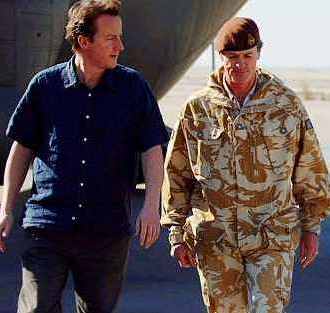
In this context, the "real" war - i.e., the one the politicians are most interested in - is the battle for the photo-op. For instance, when David Cameron visited the troops in Basra, the government made sure there were no photographs of him addressing soldiers. The few that were published, well after the event, in the main showed the Tory leader talking to (or at) senior officers.

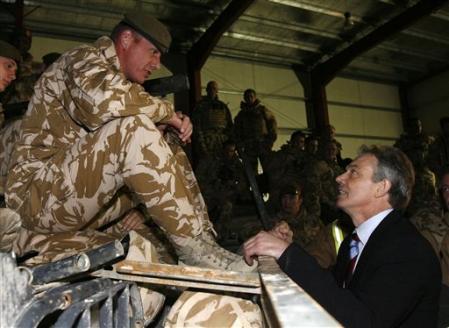
On the other hand, within hours of the great leader Tony's flying visit to Basra Air Station yesterday, we had dozens of photographs to chose from, ranging from the formal address, to the casual and informal, and the "touching", with Blair writing a good luck message on a Warrior MICV.

This cannot, just cannot be a coincidence. I have absolutely no doubt that private polling by the political parties (which produce the detailed results, the like of which we do not see) show that politicians who are seen associating with the military score well in the polls. Hence the succession of Labour ministers making their pilgrimages to both Afghanistan and Iraq, the ready accessibility of the photographs taken and the lengths to which the government goes to ensure that Conservative politicians do not have the same facility.

What we may be seeing – and in my view almost certainly are seeing – is an attempt to capitalise on reflected glory - and, in the context of continued and massive shortages of equipment - doing it on the cheap. For sure, political sophisticates can see through this, but adverse comment has a limited circulation and a short shelf-life. The subliminal message conveyed by a picture of Blair surrounded by "admiring" troops has, I would suggest, a more widespread and lasting effect, which drowns out the cynicism. And, if Balir can get this without coughing up the money for the kit, what should he change?

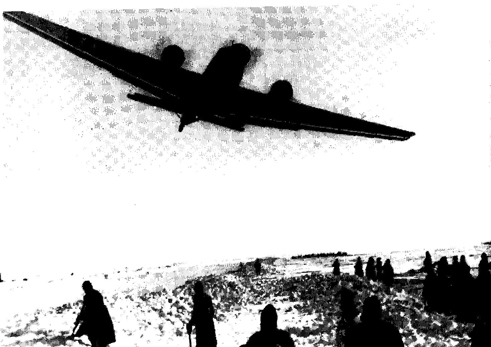
Similarly, I remain suspicious of the torrent of medals being awarded to troops in the field, something to which I drew attention in an earlier piece, noting the parallel between this government the last days of the siege of Stalingrad, when Junkers 52s from Hitler's Luftwaffe were dispatched to airdrop container-loads of Iron Crosses to the beleaguered troops of the 6th Army.

That, as I wrote at the time, is not in any way to disparage the bravery of our troops, and particularly the likes of Cpl. Bryan Budd, VC, about whom Joe Katzman wrote a moving tribute on his Winds of Change blog.

But, to this old cynic, to find his story recounted in detail on the MoD site - the output of an intensely political government ministry – somehow jars. How convenient it is to have such tales of derring-do which cannot help but invoke positive feelings – with some of the glory inescapably rubbing off on the Ministry. And how much cheaper it is to buy off the troops with medals rather than equip them properly.

It is the same with the tragic deaths of service personnel in theatre - often the result of equipment shortages or inadequacies. Note, for instance, the careful attention to detail following the deaths arising from the bomb on the Shatt al-Arab, the emotive personal pictures and the carefully staged photographs of the repatriation of their bodies.

All right and proper you might say and you would have to have a heart of stone not to be moved by the details. But, as we recorded on this blog, how selective were those details. And, even to this day, further details have to be dragged out of the MoD, viz the answer to another written parliamentary question from the dogged Mike Hancock MP, who has asked how many incidents of British service personnel coming under attack on the Shatt al-Arab waterway took place before the 12 November bombing.

The answer came again from bully-boy Ingram, which stated: "Centrally held records show that between 15 June 2003 and 23 November 2006 there have been 16 attacks on British forces transiting the Shatt al-Arab waterway". Note the use of "centrally held records", which means there were almost certainly more than 16 attacks which suggests that – as we have indicated – that there was an extremely high risk of a fatal incident.

You will, of course, note no reference to this question on the MoD website, nor will you see any of the information conveyed on that website. And such selectivity suggests that the MoD is exploiting the courage and suffering of its "employees" while being highly economical about the circumstances in which they occurred.

By that measure, perhaps personal details relating to service personnel should not appear on the MoD site but on the respective sites maintained by each service, with a degree of detachment from the MoD.

The trouble is though that you will not get support from the media for such a quest. Journalists appreciate the quickness and convenience of the one-stop-shop and are, in any case, in the exploitative business themselves, capitalising on what is actually cheap copy. Thus you get the saturation coverage in the Telegraph and in the manner of this newspaper, which is so quick to defend its own intellectual property, there is not a whisper of a suggestion that its source was MoD press handouts, its coverage being merely edits of the free copy provided.

But a particularly odious player in the exploitation game is Mike Smith of The Times, who uses the courage (and the death) of Corporal Bryan Budd (pictured) as a foil to make a series of points in his own blog, the post headed – with the lack of imagination for which the man is famous – "Lions Led By Whitehall Donkeys".

He writes (again without acknowledging his sources) of the failure of the RAF to deliver supplies to the troops holed up in Sangin, due in part to the unserviceability of the Hercules tasked to support them and then to a drop missing its target, supplies falling into the centre of the town in a mosque controlled by the Taliban.

He describes how the US stepped in with their helicopters, to deliver rations and how further supplies were delivered by a Canadian relief convoy, "making a mockery of government claims that the British had enough troops and resources of their own." And then, as 3rd Para soldiers repulsed the Taliban again and again, Smith writes:

By now the Taliban were reluctant to make direct attacks and concentrated on rocket and mortar attacks, one of which killed L/Cpl Luke McCulloch of the Royal Irish Regiment, a week into the deployment. He was the eighth British soldier to die in Sangin.
What makes the difference between this and, say, the purely descriptive pieces in the Telegraph and the measured piece by Katzman it that Smith uses the detail to snipe at the government – but he does not use his power to fight for better equipment.

In fact, this is the man who swallowed the MoD propaganda on "Snatch" Land Rovers, and buys in uncritically to the idea of armoured Pinzgauers.

Inevitably, therefore, as he writes about L/Cpl Luke McCulloch being killed in one of the many rocket and mortar attacks, he does not think to ask why the British Army in this day and age is so vulnerable to such primitive weapons, why it is not taking countermeasures and why technology which has been available for decades is not being used.

This is where editorialising over the unfortunate death of Sergeant Steve Roberts can actually be harmful.

It is all very well tut-tutting about the lack of kit in 2003, but the MoD has since made heroic efforts to ensure that all troops in operation areas are equipped with the very latest in body armour. This, therefore, is no longer an issue and, in the final analysis, it was only (partially) responsible for the death of one man. Many more have been killed through inadequate vehicles and through failing to deal with the mortar menace.

Roberts's widow Samantha herself noted that the body armour issue had been resolved. "This is Steve's legacy," she said. Referring to MoD supply failures, she added, "but we must ensure that these failures are not repeated with other basic kit."

Just focusing on body armour, therefore, will simply allow the MoD to wriggle off the hook, evading scrutiny for the serious shortage of kit, which is now current, such as the Vipir thermal imager, UAV's, light helicopters and much else.

Typically though one can see the media going for the cheap and easy option, exploiting others' grief and misfortune, but not seeking to prevent more of it. Then, in giving the impression of "supporting our boys", it is also going for the reflected glory. In that way, the media are as bad as the politicians.

What we actually need from both the media and the politicians is clear, clinical detail on what our troops need and then active campaigns to ensure that they get it. This is where the opposition should be up front and making itself heard. Moralising and pontificating about issues long past - or merely uttering generalised waffle - is not good enough.

All we are hearing from Tory defence spokesman Liam Fox is the view that: "To send soldiers into combat without the appropriate equipment is utterly inexcusable and in a more honourable government it would have resulted in resignations. The story of this government's defence policy is too little, too late."

He adds that, "We still hear stories which reinforce the point that Tony Blair's government is all too willing to commit our forces to battle without committing the appropriate resources to our armed forces."

That certainly is not good enough. What is he going to do about it?

11 December 2006

That strange disconnected feeling

Although we gave defence issues a bashing over the weekend, this simply reflected the fairly heavy coverage in the MSM and the fact that events seem to be coming to a head.

Thus, there can be no let-up in coverage, not least as today there were also defence questions in the Commons. Courtesy of the internet, we were able to watch with growing incredulity as Des Browne claimed that the training of Iraqi police was progressing well and that Operation Sinbad was delivering results.

Somehow, somewhere, there seems to be something of a "disconnect" between what the secretary of state is saying and even the limited coverage that we get in the MSM and from other sources.

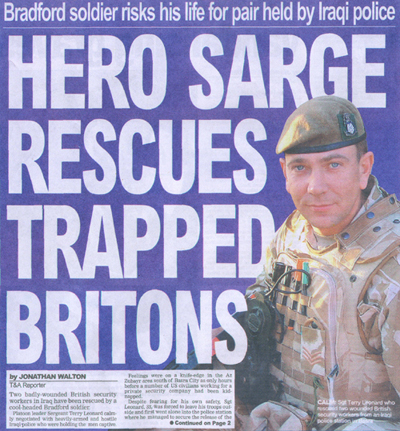
For instance, in today's Telegraph & Argus – EU Referendum's local paper – we see a headline on how a "hero sarge" rescued "trapped Britons". The strap gives further detail and the story itself reveals all – that two badly injured British contractors had to be rescued from heavily armed and hostile Iraqi police, in order for them to receive urgent medical treatment.
Er… excuse me? A British soldier had to rescue two British citizens from the local police? Said Sgt. Leonard: "They were armed to the teeth with snipers and heavy machine guns on the nearby rooftops and all the weapons were pointed our way".

Such testimony adds to the growing body of evidence that suggests that the Iraqi police are highly unreliable and thus, while we hail the gallant and cool Sergeant but wonder whether he inhabits the same world as the secretary of state, where everything is going so swimmingly well.

Equally do we wonder when reading a report today in The Scotsman, from which we learn that the commanding officer of the Black Watch in Iraq has warned that insurgent attacks will rise ahead of the planned security handover to local forces in the Basra area next year.

This is not news at all to the followers of this blog. Says Major Wrench: "What we feel is that the insurgents, or terrorists and criminals as we refer to them, are operating from the north and moving south. We are beginning to see increased activity coming from the north as groups try to jostle for position, knowing that at some stage we will be withdrawing."

But what we also learn from the report is that, in the early hours of last Friday, a British soldier was seriously injured in a rocket attack on the base at the Shatt al-Arab hotel. We know also from another report that there was also a rocket attack on the base last Wednesday and we had the additional report which indicated that, in recent months, the base had taken over 1000 mortar and rocket attacks.

If all this is happening already and Major Wrench is predicting that attacks are going to intensify, then our troops look to be in for a pretty miserable and dangerous time. Just because most of the attacks miss their targets does not mean that the potential for enormous carnage is not there – these things are dangerous, as can be seen from this dramatic shot of a mortar attack on the British Abu Naji base in al-Amarah.

It seems almost inevitable, therefore, that we will be seeing more soldiers making their trip back to Blighty in coffins.

All that brings me to the editorial in The Sunday Telegraph yesterday, headed "Lions supplied by donkeys". One should not be too rude about it, I suppose, but do we really need a "comprehensive strategic review"? We already know what is needed. What is missing is the political will and the determination to ensure that our troops get the weapons and protection they need.

COMMENT THREAD

09 December 2006

Going backwards

When the news started coming in yesterday about the raid by coalition forces in Basra, details were sparse and I thought it better to wait until we knew more.

A day later and we are not much the wiser. The whole of the publicity seems to have been generated, and is therefore controlled, by the Army. We know what the Army wishes us to know – no more and no less.

One should not be too churlish I suppose. If the Army is to be believed, five "terrorist leaders" were captured, together with a quantity of arms and explosives and some documents of "intelligence value". However, that does seem somewhat small compensation for a raid described as the biggest military operation since the end of the war on 1 May 2003.

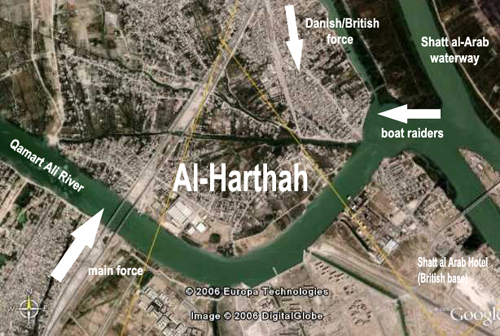
Altogether, over 1000 men took part, including a 250-strong Danish contingent, deploying 14 Challenger II MBTs, 28 Warriors, an unknown number of light armoured vehicles ("Snatch" Land Rovers and Danish MOWAG "Eagles", based on the Humve chassis - illustrated right) and ten assault boats. In support were USAF F-15s which carried out overflights as a diversion and "a show of force".

Mercifully, unlike the 24 November raid, no one was killed. That alone may have justified the scale of the force, which was not unopposed.

But if the size of the force deployed was not excessive (under the circumstances), there was certainly something so gloriously OTT about the Telegraph coverage. It not only included a huge map, occupying the best part of half a page, but was announced by a headline spanning two pages reading: "'Armoured fist' smashes into Basra at dawn, capturing five terrorist leaders." One suspects that the writer (our old friend Thomas Harding) and the editorial team harbour secret ambitions of being comic-strip writers.

Behind the MoD-supplied details (and photographs), the problem is, as always, that the newspaper presents a breathless view of events which avoids any depth, understanding or analysis. This is not what one would expect from grown-up journalists.

Any such analysis, of course, would not necessarily accompany this piece – and we learnt not from this but from the BBC that one of the objectives of the raid was to deal with "criminals" who were mounting attacks on British bases. Interestingly, the Telegraph's location map miss-positions the Shatt al-Arab Hotel base. It shows it closer to Basra Palace than anywhere, rather than its correct place – well within mortar range of al Harthah. And, as recently as Wednesday, the base was at the receiving end of yet another mortar attack. Was al Harthah the source?

So, here we go again. In June we wrote a piece noting that we have been here before. We remarked on how between 1972 and 1980, mine protection technology emerged, which has been refined and developed as the basis of today's blast-protected vehicles.

But, if the colonials were there before, we were there even before that. A remarkable website shows that in Oman between 1970 and 1973, British forces were operating modified 4-tonners with armour plate fitted to deflect blast from mine strikes.

But even more fascinating is the website of Barry Dunning recounting his exploits in the 10th Royal Hussars (Middle East Land Forces) in Aden in 1965, riding in a Saladin armoured car.

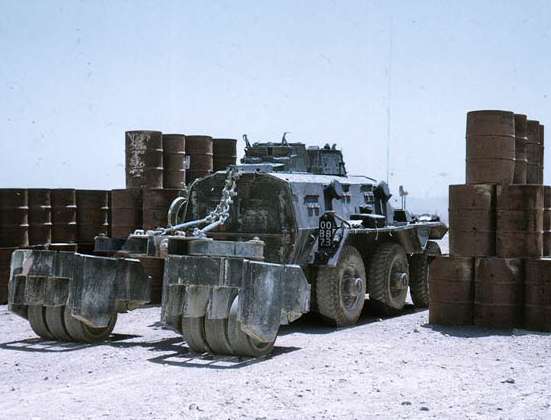
As a boy I recall this vehicle (illustrated). Built on the same chassis as the Saracen armoured personnel carrier, it was specifically designed for mine protection and could continue operating with any one wheel blown off by a mine. For their party trick, Alvis, the manufacturers, used to drive the vehicle round a test track on demonstrations, with one of the front wheels missing.

Anyhow, Dunning writes:

The 12th of September is a day I will never forget!! Coming back from Dhala we went on ahead to pick up the Infantry whom were up on the ridges (to cover the convoy through the wadi). We had just passed Mile Stone 36 when we hit two anti-tank mines and 25lb of plastic explosives. It picked the 14 tons of armoured car and threw us about 25 feet into the air, leaving a crater 30 foot wide and 10 foot deep. We were very lucky the armour did not split open as we were fully loaded with all our shells and bullets... It would have been a real fireworks display if they had gone off, and we were lucky no one was hurt.

Mick had a cut on his cheek where the Browning rounds wrapped around his face. Geordie hit his face on the front driver hatch as he was thrown forwards. It knocked him silly for a moment and he had a bloody nose. Because of the shock the medics could not take any chances with us so they flew us out on an Army Scout helicopter back to camp. The Saladin was brought back on a low loader.
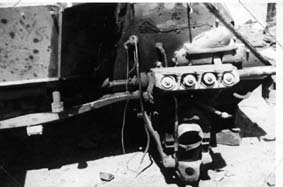
And above right is a close-up picture of the front wheel bay, which took the full force of the explosion. Now imagine if that had been a "Snatch" Land Rover.

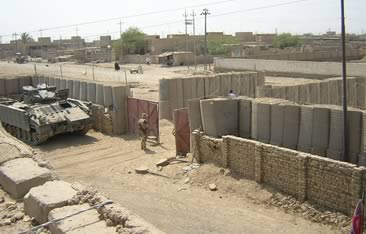
As relevant to the predicament of our troops in Basra, however, are the experiences of British forces attached to the Sultan of Oman's army in 1970. Amongst other things we see in another fascinating website is a Saracen APC pressed into duty as a mine clearance vehicle at RAF Salalah. One feature of this vehicle is that it could be driven easily in reverse, a feature used in the illustration, where it is rigged to push a mine roller. Interestingly, we also see sand-filled 40-gallon drums stacked up as blast protection – the predecessor to the "Hesco" containers currently used. There is nothing new under the sun.

Just as relevant though was that the base came under continuous mortar attack. To counter this threat we see the predecessor of the current Mamba and Cobra counter battery sets – the "Green Archer" counter mortar radar in place (in the foreground). Behind the radar is a 25-pounder in a gun pit, ready to return fire once the mortar location has been identified.

But it did not stop there. Out on the tarmac were pairs of Strikemaster light jets, aircraft based on the then RAF basic trainer, the Jet Provost. Despite their provenance as trainers, these were formidable ground attack aircraft and were, in the hands of their RAF pilots, potent weapons.


And, of course, there were the helicopters, also on quick alert ready to transport Omani Scouts to a trouble spot and deal with the insurgents - yes insurgents - who were seeking to overthrow the government.

These, being the Omani's choice - and free from the strictures of the RAF and the then MoD (which hardly seems to have changed) were Bell UH1Ds, the famous "Hueys" of VietNam fame. Now, of course, the RAF has a few, in the form of the Augusta Bell 412, but only for air-sea rescue in Cyprus and for training aircrew. But the Army is not allowed to have them.

There we have it. Over thirty years ago, nearly all the elements of COIN warfare were in place, right down to the mine/blast protected vehicles, which are now no longer on charge. In many respects, therefore - with our inadequate "Snatch" Land Rovers instead of the Saracens (which were also used in Northern Ireland), the absence of light (or any) ground attack capability and an acute shortage of helicopters - we are less well equipped than were our own and even the Omani armies all those years ago.

But there another major difference. Unlike Oman with its wide-open spaces (more like Afghanistan in some respects), weapons like mortars and Katyushas are being fired from highly congested urban areas, with the terrorists using civilians as a screen.

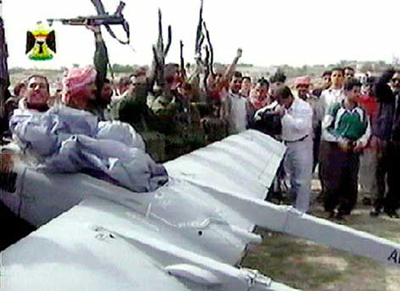
To deal with that, we have other weapons - the C-RAM (and even that is based on 70s technology) and UAVs armed with precision, small-warhead guided weapons. We have no C-RAM though and, as to our UAVs, we have none capable of being used for this function and our attempts at flying off the wrongly-named Phoenix (it does not rise from the ashes) have met with embarassing failure (illustrated above).

For want of the right equipment, therefore, it seems we must send a 1000 men, backed by tanks, armoured vehicles and aircraft smashing into Basra at dawn, all to arrest five men, before scuttling back to our fortifed bases and the daily barrage of mortars and rockets.

Oddly, Gateway Pundit on Friday hailed as "good news" the optimistic account of the situation in Basra by Iraqi-American Haider Ajina, citing Major General Ali Hamadi chairman of the tri-security agencies in Basra. He claims that operation Sinbad, for security and reconstruction, has achieved important results.

Yeah right. That's why we need a small army to arrest five men, while all our bases are under constant daily attack. Yet, in June 2003, our troops were walking the streets in soft hats. Every which way, in my book, we're going backwards.

COMMENT THREAD

08 December 2006

Where were you?

Yes, Mr Bush, we know it is bad - we've been saying so for a long time. Yes, we agree with you when you tell our prime minister, Tony Blair, that "we need a new approach". And yes, we entirely agree with General Sir Mike Jackson (now retired) that it would be "morally wrong" to pull out of Iraq at the moment.

And we even agree with Jackson when he accused the government in his speech of neglecting soldiers and of "asking too much" of the armed forces.

But what we also want to know is why it has been left until now? What have our professionals and analysts being doing all these years and, in particular, what was the professional head of the Army doing in August 2003?

This blog, of course, didn't exist back then. But General Sir Mike Jackson – or "Macho Jacko" as he was already known - was Chief of General Staff, the professional head of the Army. He had been appointed on 1 January 2003, he had seen the successful assault on Basra by British troops and then enjoyed the short-lived fruits of victory with the official termination of hostilities in Iraq on 1 May 2003.

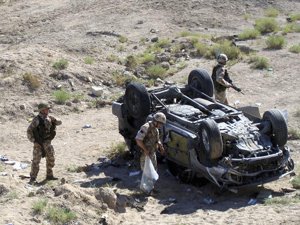
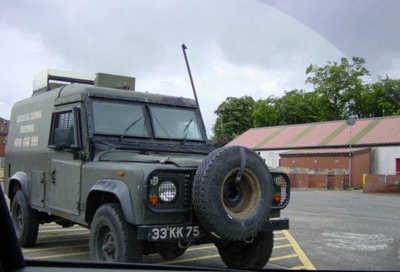
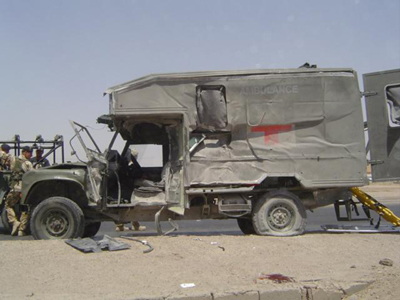
Then, on 14 August - two days after Basra had been swept by organised riots, with mobs protesting against the lack of fuel and electricity in the city – when British forces were shot at and returned fire, killing at least one Iraqi - Captain David Jones was travelling from Basra with his driver in a clearly marked military ambulance (pictured above left), conveying a soldier to the military hospital in the Shaibah logistics base outside the city. He never arrived. Shortly after 9am British time, the vehicle was struck by a roadside bomb, killing Captain Jones and injuring the other two soldiers, and badly damaging the vehicle (illustrated right).

One national newspaper at the time reported that this had been the most serious attack on British forces since six military policemen had been killed in Majar al-Kabir, north of Basra, on 24 June. Furthermore, as this was the very first roadside bomb attack on a British military vehicle, the fear was that the "honeymoon" was over – that British troops in the southern, mostly Shia, part of Iraq, were now to be targeted by guerrilla attacks. Up to date, these had been reserved for American troops in the ethnic Sunni area around Baghdad.

As reported by The Scotsman, the BBC had defence analyst Paul Beaver saying that the attack had been very different to any incident dealt with by British forces in Iraq before then. "This looks like a step up in operations by a group you can only call terrorists," he told BBC News. "This is very much a pre-meditated act of terrorism. There's no doubt at all what we're actually seeing here is someone making capital out of the fact there is now a greater awareness of discontent in the Basra area."

The newspaper suggested that the campaign in Iraq had "entered a dangerous new phase".

One swallow does not make a summer though, but any thoughts General Sir Mike Jackson might have had of disagreeing must have been disabused by reports of an incident on 23 August. Three soldiers from the Royal Military Police - Major Matthew Titchener, Co Sergeant Major Colin Wall and Corporal Dewi Pritchard - were killed in an ambush in central Basra.

Witnesses said the RMPs were riding in a sports utility vehicle in a routine two-vehicle convoy and came under small-arms fire from an unknown number of men in a pick-up truck at around 8.30am. The soldiers returned fire, but appear to have been killed either by a grenade thrown from the other vehicle or when their own vehicle crashed into a wall.

Then, on 27 August, Fusilier Russell Beeston, a Territorial Army soldier in the 52nd Lowland Regiment, was killed on after a crowd surrounded his patrol vehicle in Ali As Sharqi, southern Iraq, and opened fire with guns and rocket-propelled grenades. He was 26 and from Govan. Shortly afterwards, on 7 September, a roadside bomb in Basra exploded when a British diplomatic convoy was passing killing four people of unknown nationalities, wrecking the car and flipping it upside down. When a later explosion killed ten more, there can have been no doubt. The honeymoon was definitely over and an insurgency was in progress.

Now, in his speech entitled, "The Defence Of The Realm In The 21st Century", General Sir Mike Jackson tells us his lecture was "a way of taking stock". He has been considering "what may be demanded for the defence of the Realm in this uncertain century; and how ready we are for those demands."

But he adds: "We also need to be honest as to how well we are meeting these demands now," effectively admitting that we are not doing enough. He says: "we must do better in this complex situation, faced as we are today by a determined and ruthless enemy".

That "determined and ruthless enemy" was to continue slaughtering British troops. But, in August and September and points thereafter, Jackson was not only thinking about the war in Iraq. As befits the professional head of the Army, he was thinking in grander terms, of the longer term. "How should the United Kingdom position and defend itself?" he was asking.

He doesn't actually tell us the timeline but we know from other events that this was the thinking going on in the MoD. The arch Europhile secretary of state for defence, Geoff Hoon, had his own political priorities. They were to put clothes on Tony Blair's 1999 initiative, making good his St Malo promises to co-operate with Jacques Chirac, building a European Rapid Reaction Force.

Through 2003, as the attacks on British troops intensified, Blair's high-level political initiative was filtering down to Army level for implementation. General Sir Mike Jackson was thus required to look at the broader strategy - a European strategy to balance the US-orientated Iraqi strategy. As conveyed to us in the Dimbleby lecture, he rationalised it thus:

The UK cannot isolate itself from the wider world, so I'm not at all sure that it is an available strategy, even if we wanted to choose it. That said, I think perhaps the most fundamental question, is the relationship, the strategic relationship, between the United States and Europe. ...

And the UK's position as between the US and Europe has been a dilemma for this country for many decades. A black or white choice, one way or the other, would be fatally flawed. The fate of this country, given its geography and its history, is to wrestle with the conundrum that whilst we sit unequally in geographical distance between the United States and the mainland continent, of Europe, the political distance is a much more equal proposition.
We had our "special" relationship with the US but, "we are also part of the continent of Europe, and a member of the continent's polity, the European Union." Thus said the General, "...it is inevitable that there will be an ebb and flow to the UK's relationship with these two centres of gravity." We could not sit on the fence, he mused. "We are so closely involved strategically with both the United States and with Europe, that in our strategic posture we must embrace both."

So, instead of concentrating on dealing with the war in Iraq, with its special equipment needs, in November 2003 he palmed the troops off with second-hand "Snatch" Land Rovers, drawn from stocks held in store in Belfast. That done, he then devoted his energies to feeding the European fantasy, as he set about reorganising the Army to fit in with the demands of the ERRF.

The rest, as they say, is history. The attacks continued, "Snatches" burned and soldiers died.

Except that the history has yet to be written. Thus, in his Dimbleby lecture, General Sir Mike Jackson put in his bid for his version. "We could well be asking too much of our Army," he says.

It all comes down to a question of balance: balance between capabilities within the defence budget - how much of this, how much of that; current operations against what may be required in the future; not only current operations, but current training which is the investment for our capability in the future; people against technology - that's pay for example, accommodation standards for example, against current and future equipment.

This should not be a dilemma incidentally, this should not be a zero sum or an either/or. We should be able to provide what is required for soldiers to be fully and properly equipped, thoroughly trained, decently paid, and, together with their families, decently housed. They deserve nothing less.
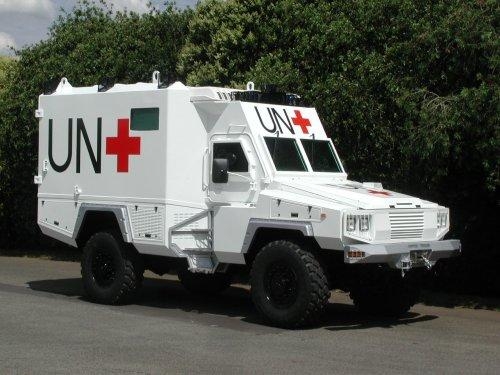
So they do, General Sir Michael Jackson, GCB, CBE, DSO., so they do. At a time when even the Americans were beginning to realise that better equipment, like the superb RG-31, was needed (even available as an ambulance), why weren't our soldiers "fully and properly equipped" instead of being palmed off with second-hand Land Rovers?

So, when the real history comes to be written, it will include the question: "Where were you, General Jackson, when the Army really needed you?"

COMMENT THREAD