Showing posts sorted by relevance for query mortar. Sort by date Show all posts

19 November 2006

For the record


Where lies the prestige of a nation, still until recently the fourth largest economy on earth, which once ruled an empire comprising half the peoples of that earth, upon which the sun quite literally never set?

Where lies the prestige of a nation which has a defence budget measured in billions - larger than the entire GDP of some countries - which is able still to keep up with the best in technology and innovation and which maintains armed forces that are amongst the best in the world?

Where lies the prestige of a nation which is being held to ransom by small groups of largely ill-educated religious fanatics, intent on causing murder and mayhem, equipped with cheap, second hand weapons, and in particular the mortar, a weapon which in its present from goes back to before the First World War?

Where lies the prestige of a nation which is failing to deal with this threat, not because the technology does not exist, not because it cannot be done, but simply because it chooses not to spend the money, or expend the energy or the political capital to ensure the threat is neutralised?

Where lies the prestige of that nation which has a military establishment which seems unable for fight for the effective solutions, a media which seems to be unaware that solutions even exist and shows no inclination either to report on them or agitate for their acquisition.

And where lies a nation blessed with political classes which seem entirely unconcerned that we are being humiliated, that our entire foreign policy is at risk and that we stand to lose the prize of an independent and democratic Iraq, also losing the blood and billions in treasure so far expended on that ambition?
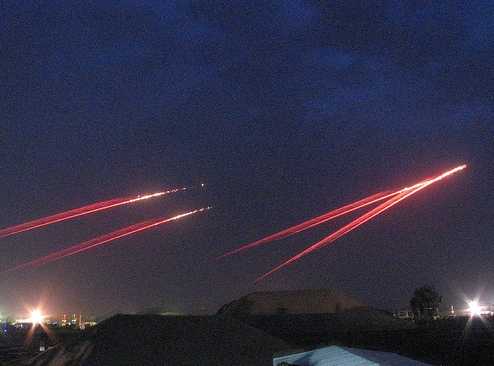
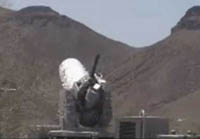
The irony is that the technology not only exists to deal with hit-and-run mortar attacks. In its various components, it is already in use by other forces, as this photograph illustrates, but not by the United Kingdom.

If assembled and deployed in an orderly and coherent fashion by our forces, the resultant systems could serve to fustrate those to whom murder and mayhem is a desirable state and thus send a message that the Western democracies are not prepared to be held to ransom. It would tell the world (and our own population of Muslims) that we have the technology, the expertise, the resources and - most importantly - the political will to defeat violence and the evil men who seek to gain from it.
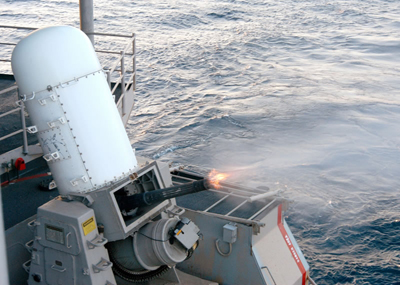
The equipment which makes the agreeable patterns seen above is an adaptation of the Phalanx Close-in Weapons System (CIWS), originally devised in the 1970s for the US Navy to provide last-ditch protection for its ships from anti-ship missiles, when all else had failed. Quite simply, Phalanx is a radar-controlled gun capable of firing 4,500 20mm shells a minute. It blasts missiles out of the sky.

But, while it was developed as a naval weapon, the US military, plagued like us by increasingly bold insurgents - who are now using the mortar as their main weapon after the Improvised Explosive Device (IED) - hit upon a startlingly simple idea. They would shoot down the relatively slow-moving mortar bombs.
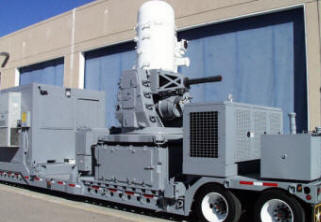
With a speed for which the cumbersome US defence procurement system is not famous, Phalanx was put to the test. In a series of land trials, it proved remarkably effective against mortar bombs - being able to destroy about 80 percent of those fired - and also the parallel threat of Katyusha rockets. Naval sets were converted for land use, acquiring the acronym C-RAM (Counter-Rocket, Artillery and Mortar) in the process. By June 2005, the first were being deployed in Iraq and a programme to cover all US bases is currently being rolled out.
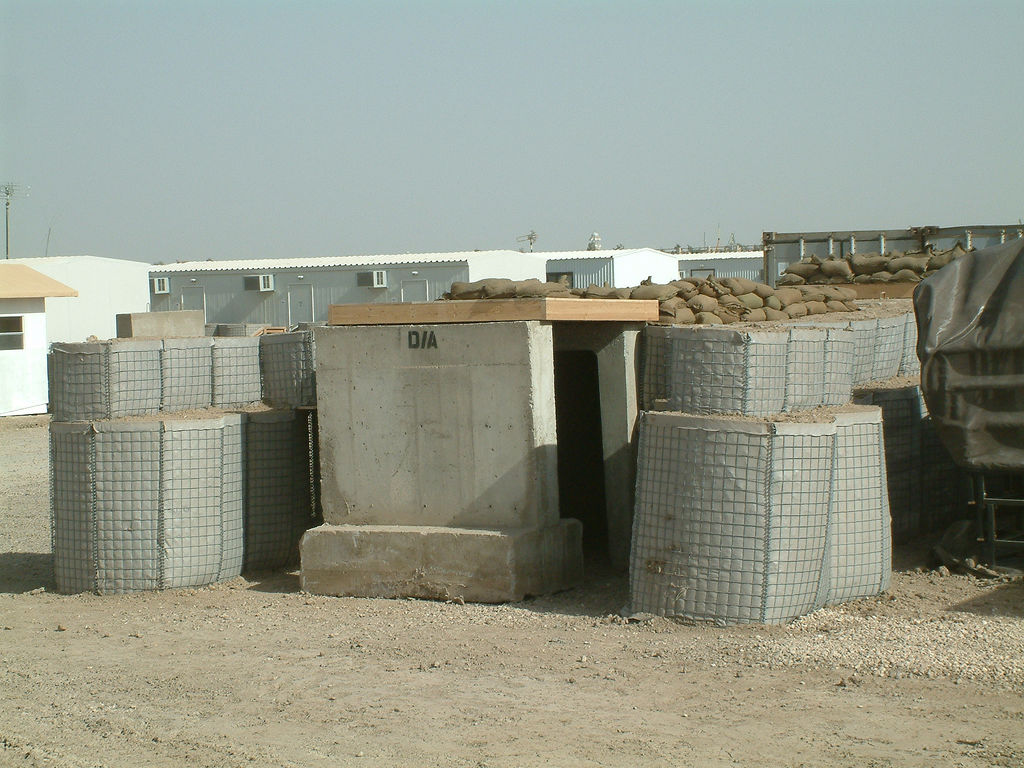
The system is not entirely foolproof with, as we indicated, only an 80 percent success rate (maximum).

But it is entirely automatic and, even if it fails to destroy an incoming bomb, the characteristic sound of its firing gives audible warning of a mortar strike. By constructing a network of easily-reached refuges and bunkers on bases - often made from the now famous Hesco - the risk to personnel has been very substantially reduced. It is even doing good service in the Baghdad "green zone".

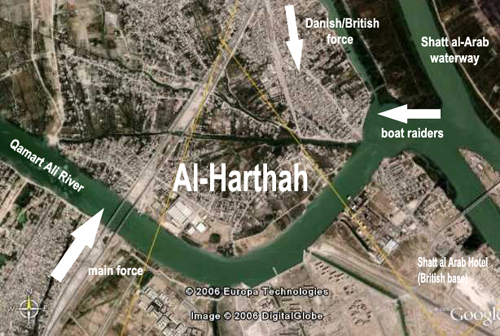
In a highly congested urban environment, such a system might have limited utility. But this is not the case with the base where, recently, a British soldier was killed and another seriously injured. The attack was on the Shatt al-Arab Hotel, when mortar bombs landed inside the base perimeter.

One of the 15 mortar rounds directed at the base actually missed its target and landed on a nearby home, killing two children and injuring a third.
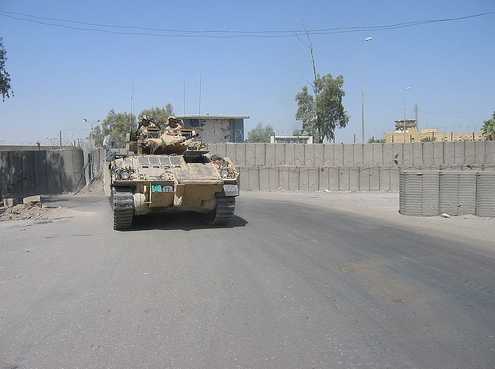
But, as can be seen from the satellite photograph of the base (above), there are clear lines of fire and there is plenty of room to deploy numerous weapons systems.

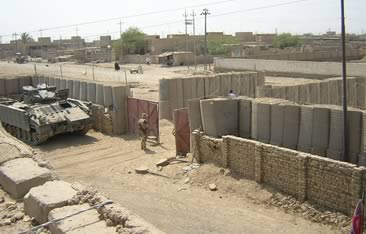
The ground photograph shown (right) - although presenting a limited view - also shows a spacious area, with a Hesco barrier perimeter which could be protected by a suitably deployed weapons system. (The main building can be seen to the right, in the distance, behind the perimeter.)
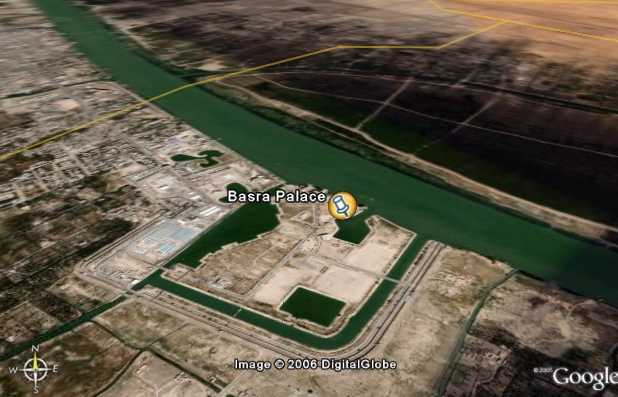
Nor indeed should deployment of C-RAM prove a problem at Basra Palace, where the Foreign Office recently evacuated the Consulate because of continued mortaring and there troops stationed in the complex have also been subjected to intense mortar fire.

Once again from the satellite photograph, we can see a spacious site, but with some added extras. As one of Saddam Hussein's former palaces, the site is surrounded by a security moat and the areas immediately around the perimeter have been cleared or naturally lack cover. Deployed weapons would have clear lines of sight and be able to cope with incoming mortar bombs in good time.

However good the system is though, it can only provide passive defence - and it should never be the case that an attacker should have free rein. Active counter-measures should always be taken.

For the British forces, we have argued that this could be provided by helicopter assault troops, guided by counter-mortar radar, which, as we have noted, is already available to our forces. That same radar is an integral part of the C-RAM system, providing the initial targeting information to direct the gun radar.
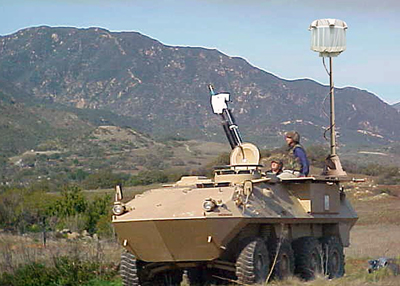
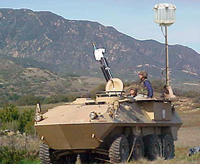
The development of lightweight counter mortar radar, however, has opened up new possibilities which have been exploited by the US Marine Corps. They have mounted the radar on a Light Armoured Vehicle (LAV), which is also fitted with a rapid-fire 120mm mortar, known as Dragon Fire. So sophisticated is this that it can be linked to the rader and rigged to fire automatically at the point from which an enemy mortar is fired.

Despite its effectiveness, though, this system will always have its limitations. As long as insurgents are prepared fire their weapons from crowded urban areas, counter-battery fire will always be restricted. The risks of colateral damage is simply too high.

In this case, precision-targeted weapons - such as the Hellfire missile - come into their own, launched by helicopters, UAVs and ground attack aircraft. But even then, the risk of colateral damage is relatively high and, in any case, few of such weapons are designed to attack targets in urban areas. One that is though, we have mentioned previously. It is the Viper Strike, laser-guided precision missile. With a 7lb warhead and a "top attack" facility, it is an important addition to the armoury.

More recently, it has been mated with a new version of a long-endurance UAV, the MQ-5B version of the Hunter, which can carry two Viper Strike missiles on a 16-hour mission.
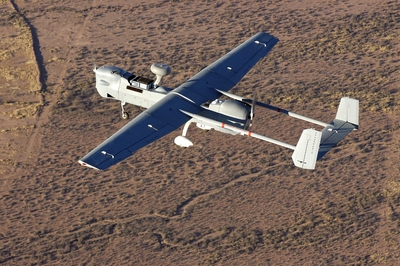
With just one of these UAVs orbiting a site like the Basra Palace complex, instant retribution could be dispensed to any mortar crew foolhardy enough to risk an attack, making them not only dangerous but, ultimately, futile. And, without the weight of the weapons, Northrop Grumman's new system has demonstrated an ability to fly for more than 21 hours, with a fully-capable surveillance package. Given the UK's lacklustre performance with UAV projects, here is a system which could provide an exceptionally useful asset in the fight against insurgents.

It was only last month that Tony Blair announced that our armed forces could have whatever they need to finish the job. Well, for the record, this post has detailed some of the tools that are needed, the sort of equipment that would avoid the extraordinary situation where we see the British Army evacuate a base, simply because it was being mortared. But now read this from the Mail on Sunday today:


Nothing less than our prestige as a nation rests on the willingness of our government to provide the tools needed to do the job. Can it rise to the challenge? And have we got to the point where we have ceased even to care whether it does, and are content to see our troops run away?

On the current evidence, it looks like our troops are going to be running.

COMMENT THREAD

22 January 2007

A glimmer of hope

The picture shows tent fabric after being exposed to a mortar bomb explosion in Basra. The damage doesn't look much but each hole has been made by a red-hot jagged fragment of steel, big enough to do serious harm to anyone the other side. And, in Iraq, tent fabric is all that stands between many of our soldiers and death or injury, soldiers who are exposed to a barrage of rocket and mortar fire every single day.

The nature of the damage is more obvious here, on the steel cover of an air-conditioning unit which has been "splashed" by mortar fragments. The photograph was taken on a British base last year. So common is this type of damage that soldiers scarcely take any notice of it, although the bombs remain just as deadly, their frequency is increasing and the accuracy of the insurgents is improving.

As of now, virtually every building on some of the bases is pock-marked with mortar damage. Steel and concrete however, are more forgiving than flesh - both deaths and injuries are mounting and, at the present rate it is only a matter of time before there is a major incident.

Yesterday was a light day with the Shatt Al-Arab Hotel exposed early in the morning to an attack by five mortar bombs, while the Basra Palace was attacked by six Katyusha rockets.

Fortunately, there were no injuries, but that was not the case last Thursday when six British soldiers were wounded in a series of attacks against Basra Palace camp. We asked, "Now will they do something?" after the camp had come under fire the three times from a mixture of mortars, rockets and small arms. One soldier was said to have been seriously injured and five others received lesser injuries.

Yesterday though was also the MP's turn to ask questions. Ann Winterton, Conservative MP for Congleton, was able to challenge the Secretary of State for Defence, Des Browne. Having already asked him last December if he would consider providing the anti-mortar equipment, C-RAM, she asked him whether:

In the light of the tragic incident at Basra palace camp last Thursday in which six soldiers were injured, one seriously, will the Secretary of State reconsider evaluation of the C-RAM anti-mortar system and counter battery radar, in order to give our bases in Iraq considerably better protection and a retaliatory response, given that existing, so-called "layered" protection methods are clearly not working?
Browne, who had been batting away questions from a variety of Conservative MPs, was surprisingly emollient. "I give the hon. Lady my reassurance," he said, "that we keep everything under review." He then added:

I know that the commanding officer in Basra keeps the issue of force protection constantly under review, and I will specifically ask him to advise me again on the capability that she asks about. However, I do not want to leave the House with the impression that there is no capability to counteract the indirect fire threat. There is indeed a very specific capability…
He would, he said, ensure that he was given a view on that in the light of the event that she mentioned, and would write to her.

Someone who did not fare as well was shadow defence secretary Liam Fox who, as we feared, relied on the substance of yesterday's Sunday Telegraph story for his attack, where Sean Rayment alleged that troops in Afghanistan had been denied essential equipment on cost grounds.

Such equipment as is required – beyond that normally acquired through the standard procurement process – is obtained though a procedure called the Urgent Operational Requirement (UOR). With that in mind, Liam Fox asked:

Can the Secretary of State tell us how many urgent operational requirements have been made of the Ministry of Defence in the past year from Afghanistan, and how many have been turned down?
Here, Browne was adamant. "All urgent operational requirements that have been approved by the chain of command have been acceded to," he said:

That is entirely as it should be, and the process of urgent operational requirements has been approved and commented upon favourably by independent investigations on a number of occasions. Contrary to media speculation over the weekend, no such requirements have been turned down on financial grounds. Indeed, over the past couple of years more than half a billion pounds have been invested in urgent operational requirements in relation to supporting our troops in both theatres. It is part of the nature of urgent operational requirements that they continually come forward and are approved.
One thing the Fox did do, though was refer to the Apache "rescue" and (rightly) point out that the Army needed a smaller helicopter. Browne's answer was odd. An alternative helicopter was available, he said, and could have been made available, but a tactical decision was made by the commandos to deploy the Apache in this particular way. This simply does not compute and, I suspect, we will be returning to this issue.

As to helicopters in general though, Browne referred to Brigadier Jerry Thomas, the commander of British Forces in Afghanistan who had stated: "I have not asked for additional helicopters and the supply system is working well, with no soldiers or marines running out of supplies." After a brief homily about the difficulty in buying these machines, he then delivered the coup de grĂ¢ce, staring down Fox with the words:

Let me also say to him that there is no truth in the suggestion that urgent operational requirements in relation to night-vision goggles were turned down for financial reasons, as was reported in the press.
Although the helicopter question was good, Fox is going to need to know more about why the top brass are so reluctant to demand more machines before he is able to dent Browne. And dent Browne, he was unable to do. Relying on flawed information, he left himself wide open to attack, with no comeback. As expected, Browne exploited the opening and the game was over.

However, at least, through Ann Winterton, Browne is looking seriously at force protection. He now knows his card is marked in that, if there is a disaster in the future, he can be held directly and personally responsible. In that, there is a glimmer of hope that we might save some lives. It is only a glimmer, mind you. And imagine how quickly action would be taken if the Houses of Parliament were being mortared each day and the MPs had to sleep in unprotected tents in Palace Yard.

COMMENT THREAD
19 December 2006

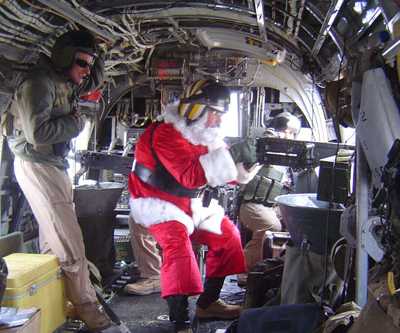
All I want for Christmas...

Any credible foreign policy for a mid-ranking, internationalist power like the United Kingdom relies on effective military forces to back it up. However, while our forces are undoubtedly first-rate, they are equipped primarily to deal with a Soviet-era threat. Yet the greatest demand in the post 9-11 scenario is for counter-insurgency forces, which need different types of equipment, issued on a different scale.

Very little of the equipment needed is actually new in concept. What in many cases makes (or should make) the difference is the scale of issue. A counter-insurgency force, for instance, will need far more light attack helicopters than a conventional armoured formation. There also needs to be a strong emphasis on force protection, focused on base defences and patrol/convoy survivability.

These are areas where the British Army is heavily deficient and to redress the inadequacies and the imbalances, we have produced our own Christmas list for Santa. It might as well be addressed to Santa for the chances of our own politicians (much less the media) paying any attention to it are pretty remote - although discussion of the list would make a fascinating feature in a Sunday newspaper. Anyhow, here goes:

Number one on our list is dedicated to base defence. This is the US-developed lightweight counter-mortar radar, in this case mounted on a USMC Light Armoured Vehicle (LAV) which itself is equipped with an advanced 120mm mortar for counter-battery fire. The combination is a potent weapon for base and tactical commanders having to deal with hit-and-run mortar and rocket attacks on their positions - whether they be large, established bases like the Shatt al-Arab Hotel in Basra or temporary positions such as those occupied by 3rd Para in Afghanistan.

Option number two is for large, static bases - the C-RAM (Counter Rocket, Artillery and Mortar) gun based on the naval Phalanx system. This can be used to shoot down incoming mortar bombs and rockets, with an 80 percent success rate. The guns have the added advantage that the automatic firing provides audible warning of an attack, giving time for those at risk to run for cover.

The third piece of kit we desperately need is a medium tactical, high endurance UAV - or to be more specific, a UCAV (Unmanned Combat Aerial Vehicle) - the distinction being that this can carry weapons. The vehicle illustrated is the Hunter and, although there are other UAVs with similar performance, this has been fully developed to deliver low-yield precision guided missiles.

The Hunter can either be used for reconnaissance - locating enemy forces and relaying their positions to commanders, who can task other assets to deal with them - or it can be used as an attack weapon in its own right, firing missiles to take out small groups of the enemy (such as a rocket or mortar teams).

And this is the missile of choice - the Viper Strike. Originally designed as an anti-tank missile, it has been adapted to function in an anti-personnel role, with a capability also to take out light vehicles. Where so much fighting is carried out in urban environments with civilians present, the urgent need is for a weapon which minimises collateral damage. This missile has the ability to kill the occupants of one vehicle in a line, without damaging the others. Another characteristic of the weapon is its very steep attack profile - contrasting with the shallow flight-path of the typical missile - which makes it ideal for urban canyons.

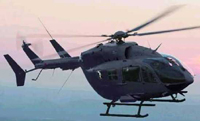
Number five on our list is a light tactical helicopter, of which many are needed. Smaller than the Lynx, they can either be one of the Eurocopter versions, an MD Enforcer or similar. They should be able to carry 4-5 troops as a rapid response force, stretchers for casevac, light weapons (including rocket pods) in the light attack role, and/or surveillance equipment for the search and observation roles. The crucial issue is the price, with their relative cheapness enabling the military to buy larger numbers of machines than at presently planned with the Future Lynx.

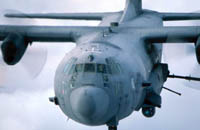
And, giving our commanders yet another option is the AC-130. With its array of gatling guns, cannon and its 105mm howitzer, its sensors and all-weather target acquisition capability, the "Spooky" as it is known, is a powerful - if expensive - addition to any armoury. It is capable both of laying down saturation fire to break up attacks and precision fire to take out specific targets. These formidable machines should be available in both Afghanistan and Iraq.

And alongside the "Spooky" we also need high-endurance, long range UAV/UCAVs such as the Predator or the more advanced MQ-9 Reaper. Although the government is currently acquiring three of these machines for Afghanistan, this seems a question of "too little - too late". We need enough to have at least one flying over every area of operation, with an organic UCAV capability. Reading just a fragment of the spec demonstrates why the MQ-9 comes into the "must have" category: it will be able to deploy the GBU-12 and EGBU-12 bombs and 500lb GBU-38 JDAM (Joint Direct Attack Munition). Flight trials have also taken place with the General Atomics Lynx SAR (Synthetic Aperture Radar) payload. Lynx also features ground moving target indicator technology...

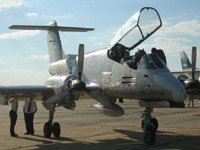
From the sublime to the ridiculous. The aircraft shown is the Argentinian-built Pucara, a twin turbo-prop ground attack aircraft used during the Falklands war. Not for one moment would I suggest that we have some of these but the picture is used to illustrate the concept of a light, cheap ground attack aircraft. At a time when the trend is towards greater sophistication, complexity and cost, against a relatively unsophisticated enemy, the "cheap and cheerful" concept ensures that there is always some capacity, as opposed to none at all - which is so often the case at the moment.

For the next item, we have the Force Protection Buffalo - equipped for mine and IED clearance. This machine is currently in service in Iraq where it provides invaluable service in detecting IEDs that would otherwise kill and main. So far, with the Cougars, which are used by bomb disposal officers, these vehicles have received over 1,000 hits from IEDs, without a single fatality. The British forces rely on a man walking in front of a vehicle (surprisingly they do not give him a red flag) and the bomb disposal officers have unarmoured "Duro" trucks. Neither is acceptable.

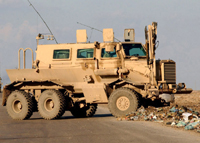
Then we need a mine/blast protected patrol and convoy escort vehicle, to replace the "Snatch" and "Wimik" Land Rovers. The 6x6 versions of the Cougar being bought by the MoD (and re-named the Mastiff) are too big and cumbersome to be used. The vehicle illustrated is the RG-31. It has proved its worth time and time again in Canadian and US hands, saving many lives in circumstances where Land Rover crews would have been killed. Nevertheless, the Australian Bushmaster would be just as acceptable as would - at a pinch - the German Dingo II.

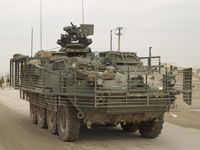
This picture shows a US Stryker wheeled armoured personnel carrier. Operations by the US in Iraq and by the Canadians in Afghanistan with their Bisons, have demonstrated the value of wheeled carriers. They are faster, quieter, more comfortable and cheaper to run - also requiring less maintenance. For sure, they do not have the cross-country performance of tracked carriers, but no one is suggesting that our Warriors should be dispensed with. Alongside tracks, though, there is a role for wheels. We need some.

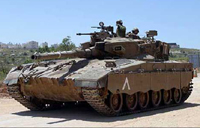
And finally... we need a new tank. The British Challenger II MBT (and the US Abrams) were built for taking out Soviet T82s at long range under all conditions. They were not built for counter-insurgency. Pictured is an Israeli-built Merkava MBT. It is not perfect but, with a personnel and stores carrying capability, it is better than other Western tanks. They performed well in Lebanon and provide a good model on which to base new designs. Not for this Christmas then, but in years to come, we want a new MBT from Santa.

As for the price tag - well, no one asks the price of Santa's gifts. If really pushed, one would have to concede that a decent number of the toys illustrated would set Gordon back several billions - perhaps as much as £5 billion. But since he is paying £15 billion a year to the EU, there is one very obvious place where he could get the money - and have some change. That would enable us to buy some more Hercules C-130J airlifters and some CH-47 Chinooks, which we also need, leaving £5 million to spend on more Vipir thermal imagers.

However, this is only my idea for a list. What would yours be? And what would the Conservatives suggest?

COMMENT THREAD

30 October 2006

Taurus excretus

Sometimes you have a piece of information which is highly relevant to a particular subject but it doesn't "click" and you don’t put two and two together.


But ever since this morning, reading about the evacuation of civilian workers from the British consulate in Basra, the mind has been working overtime – and it has come up with this.

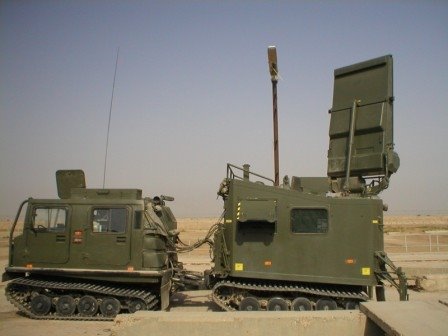
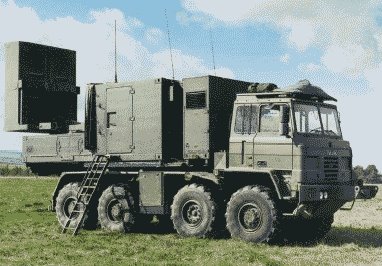
The link is to an undated extract from the Defence Management Journal extolling the virtues of an interesting piece of kit which has been in Iraq since 2004 – the Mamba counter battery radar (pictured left). What is particularly interesting though is the gushing tone of the extract:

It may be brand spanking new but already the Royal Artillery's futuristic Mamba radar system has saved the lives of countless British troops based at Camp Abu Naji, Iraq. The system, which is mounted on a Alvis Hagglunds BV206 tracked vehicle, can detect virtually any airborne missile launched within a 20km radius and provide an early warning of exactly where and when it will impact.

This is good news for the battle-weary soldiers of Abu Naji, near Al Amarah, who have been mortared on an almost daily basis. Sitting in the cool, air-conditioned cab of his Mamba, Sgt Patrick Murray, K Battery, 5 Regiment RA, heaped praise on the vehicle. He said: "Make no mistake this is the future of warfare. Not only can we give our men on the ground a warning of incoming fire but the Mamba will also tell us exactly where the missile or round was fired from and where it will land. In normal circumstances that would allow us to strike back at the enemy firing party almost immediately. But because of the risk of civilian casualties in Iraq we have to pass on the map coordinates to a patrol who will deal with the attackers."
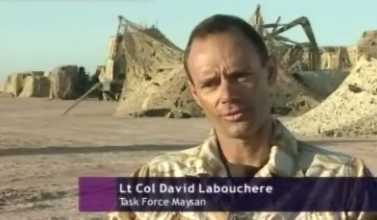
As we now know, of course, Camp Abu Naji was abandoned in August 2006 for precisely the reason that it was so often targeted by mortar attacks, viz Lt. Col. David Labouchere speaking to the Washington Post :

Almost every night for months, rockets and mortar rounds had pounded Abu Naji, the outpost where British forces made their home outside Amarah, Maysan's provincial capital. In the base's last five months of use, 281 rockets or mortar rounds hit Abu Naji, Labouchere said. Young soldiers would slip out of base at night to try to find the attackers. They would return in the morning as frustrated as when they left, he said. "The boys felt they were powerless," Labouchere said. So the British forces packed up. The night before they left, mortars gave Abu Naji a farewell pounding.
Interestingly, there is no mention here of the Mamba equipment yet, by all accounts, it was technically highly successful. So what went wrong?


Well, the pictures above illustrate the problem – mortar equipment is both lightweight and highly portable. Terrorists can arrive in a van on a vacant lot, set up their mortar, fire off four or five bombs and then pack up their kit and drive away, all within the space of minutes, long gone before any ground patrol could reach them.

However, with the help of radar location, hit-and-run mortar teams can be can be beaten, as graphically documented by Michael Yon. But to do so requires the use of unmanned aerial vehicles (UAVs), helicopters and fast response ground units. The technology makes it possible so it is a question of resources.

There is the problem. As we know, our government simply has not provided the resources. So, with only five Lynx helicopters in the whole theatre, no UAVs and no suitable patrol vehicles, there is simply nothing that can be done except suffer the hits or run away.

But, to read the MoD hype, you could easily gain the impression that everything in the garden was rosy – until we get news like we did this morning. Then we know that it is all taurus excretus.

COMMENT THREAD

09 December 2006

Going backwards

When the news started coming in yesterday about the raid by coalition forces in Basra, details were sparse and I thought it better to wait until we knew more.

A day later and we are not much the wiser. The whole of the publicity seems to have been generated, and is therefore controlled, by the Army. We know what the Army wishes us to know – no more and no less.

One should not be too churlish I suppose. If the Army is to be believed, five "terrorist leaders" were captured, together with a quantity of arms and explosives and some documents of "intelligence value". However, that does seem somewhat small compensation for a raid described as the biggest military operation since the end of the war on 1 May 2003.

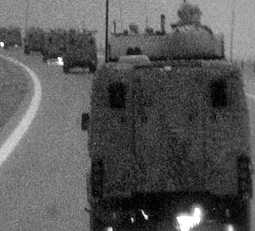
Altogether, over 1000 men took part, including a 250-strong Danish contingent, deploying 14 Challenger II MBTs, 28 Warriors, an unknown number of light armoured vehicles ("Snatch" Land Rovers and Danish MOWAG "Eagles", based on the Humve chassis - illustrated right) and ten assault boats. In support were USAF F-15s which carried out overflights as a diversion and "a show of force".

Mercifully, unlike the 24 November raid, no one was killed. That alone may have justified the scale of the force, which was not unopposed.

But if the size of the force deployed was not excessive (under the circumstances), there was certainly something so gloriously OTT about the Telegraph coverage. It not only included a huge map, occupying the best part of half a page, but was announced by a headline spanning two pages reading: "'Armoured fist' smashes into Basra at dawn, capturing five terrorist leaders." One suspects that the writer (our old friend Thomas Harding) and the editorial team harbour secret ambitions of being comic-strip writers.

Behind the MoD-supplied details (and photographs), the problem is, as always, that the newspaper presents a breathless view of events which avoids any depth, understanding or analysis. This is not what one would expect from grown-up journalists.

Any such analysis, of course, would not necessarily accompany this piece – and we learnt not from this but from the BBC that one of the objectives of the raid was to deal with "criminals" who were mounting attacks on British bases. Interestingly, the Telegraph's location map miss-positions the Shatt al-Arab Hotel base. It shows it closer to Basra Palace than anywhere, rather than its correct place – well within mortar range of al Harthah. And, as recently as Wednesday, the base was at the receiving end of yet another mortar attack. Was al Harthah the source?

So, here we go again. In June we wrote a piece noting that we have been here before. We remarked on how between 1972 and 1980, mine protection technology emerged, which has been refined and developed as the basis of today's blast-protected vehicles.

But, if the colonials were there before, we were there even before that. A remarkable website shows that in Oman between 1970 and 1973, British forces were operating modified 4-tonners with armour plate fitted to deflect blast from mine strikes.

But even more fascinating is the website of Barry Dunning recounting his exploits in the 10th Royal Hussars (Middle East Land Forces) in Aden in 1965, riding in a Saladin armoured car.

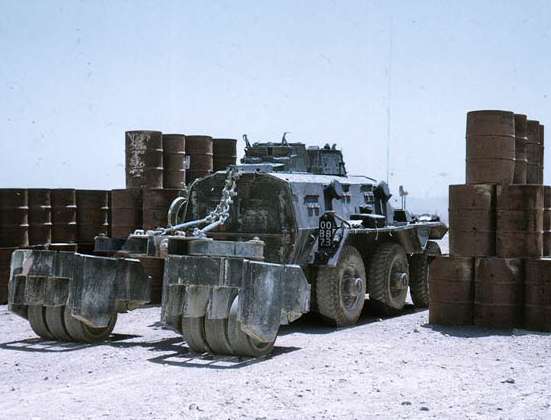
As a boy I recall this vehicle (illustrated). Built on the same chassis as the Saracen armoured personnel carrier, it was specifically designed for mine protection and could continue operating with any one wheel blown off by a mine. For their party trick, Alvis, the manufacturers, used to drive the vehicle round a test track on demonstrations, with one of the front wheels missing.

Anyhow, Dunning writes:

The 12th of September is a day I will never forget!! Coming back from Dhala we went on ahead to pick up the Infantry whom were up on the ridges (to cover the convoy through the wadi). We had just passed Mile Stone 36 when we hit two anti-tank mines and 25lb of plastic explosives. It picked the 14 tons of armoured car and threw us about 25 feet into the air, leaving a crater 30 foot wide and 10 foot deep. We were very lucky the armour did not split open as we were fully loaded with all our shells and bullets... It would have been a real fireworks display if they had gone off, and we were lucky no one was hurt.

Mick had a cut on his cheek where the Browning rounds wrapped around his face. Geordie hit his face on the front driver hatch as he was thrown forwards. It knocked him silly for a moment and he had a bloody nose. Because of the shock the medics could not take any chances with us so they flew us out on an Army Scout helicopter back to camp. The Saladin was brought back on a low loader.
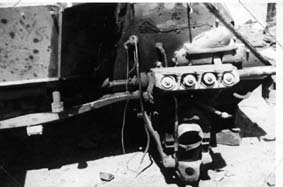
And above right is a close-up picture of the front wheel bay, which took the full force of the explosion. Now imagine if that had been a "Snatch" Land Rover.

As relevant to the predicament of our troops in Basra, however, are the experiences of British forces attached to the Sultan of Oman's army in 1970. Amongst other things we see in another fascinating website is a Saracen APC pressed into duty as a mine clearance vehicle at RAF Salalah. One feature of this vehicle is that it could be driven easily in reverse, a feature used in the illustration, where it is rigged to push a mine roller. Interestingly, we also see sand-filled 40-gallon drums stacked up as blast protection – the predecessor to the "Hesco" containers currently used. There is nothing new under the sun.

Just as relevant though was that the base came under continuous mortar attack. To counter this threat we see the predecessor of the current Mamba and Cobra counter battery sets – the "Green Archer" counter mortar radar in place (in the foreground). Behind the radar is a 25-pounder in a gun pit, ready to return fire once the mortar location has been identified.

But it did not stop there. Out on the tarmac were pairs of Strikemaster light jets, aircraft based on the then RAF basic trainer, the Jet Provost. Despite their provenance as trainers, these were formidable ground attack aircraft and were, in the hands of their RAF pilots, potent weapons.


And, of course, there were the helicopters, also on quick alert ready to transport Omani Scouts to a trouble spot and deal with the insurgents - yes insurgents - who were seeking to overthrow the government.

These, being the Omani's choice - and free from the strictures of the RAF and the then MoD (which hardly seems to have changed) were Bell UH1Ds, the famous "Hueys" of VietNam fame. Now, of course, the RAF has a few, in the form of the Augusta Bell 412, but only for air-sea rescue in Cyprus and for training aircrew. But the Army is not allowed to have them.

There we have it. Over thirty years ago, nearly all the elements of COIN warfare were in place, right down to the mine/blast protected vehicles, which are now no longer on charge. In many respects, therefore - with our inadequate "Snatch" Land Rovers instead of the Saracens (which were also used in Northern Ireland), the absence of light (or any) ground attack capability and an acute shortage of helicopters - we are less well equipped than were our own and even the Omani armies all those years ago.

But there another major difference. Unlike Oman with its wide-open spaces (more like Afghanistan in some respects), weapons like mortars and Katyushas are being fired from highly congested urban areas, with the terrorists using civilians as a screen.

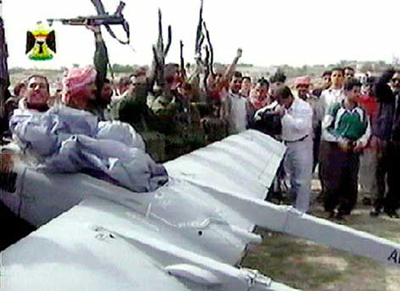
To deal with that, we have other weapons - the C-RAM (and even that is based on 70s technology) and UAVs armed with precision, small-warhead guided weapons. We have no C-RAM though and, as to our UAVs, we have none capable of being used for this function and our attempts at flying off the wrongly-named Phoenix (it does not rise from the ashes) have met with embarassing failure (illustrated above).

For want of the right equipment, therefore, it seems we must send a 1000 men, backed by tanks, armoured vehicles and aircraft smashing into Basra at dawn, all to arrest five men, before scuttling back to our fortifed bases and the daily barrage of mortars and rockets.

Oddly, Gateway Pundit on Friday hailed as "good news" the optimistic account of the situation in Basra by Iraqi-American Haider Ajina, citing Major General Ali Hamadi chairman of the tri-security agencies in Basra. He claims that operation Sinbad, for security and reconstruction, has achieved important results.

Yeah right. That's why we need a small army to arrest five men, while all our bases are under constant daily attack. Yet, in June 2003, our troops were walking the streets in soft hats. Every which way, in my book, we're going backwards.

COMMENT THREAD
02 November 2006

All we hear is silence

Take a very stupid man, dress him up in a blue flak jacket, and send him to Basra to work for The Daily Telegraph as its defence correspondent and you still have a very stupid man. All you are going to get out of him is very stupid journalism.

This particular piece by Thomas Harding is headed, "Southern Iraq approaches the tipping point" but today the Telegraph excels itself by adding another stupid piece written by this blog's favourite village idiot, none other than Boris Johnson. Between the pair of them, they typify all that is wrong with modern journalism and demonstrate why we are not going to sort ourselves out until morons like this are no longer given space to air their vacuous views.

We need not detain ourselves with Johnson at the moment. In a truly vacuous piece, he informs us that we have already lost the battle – heedless of the fact that it is still in the balance. That is left to the brainless Harding to evaluate and he starts his piece with a bit of lurid prose:

Sheltering under a table on the dining room floor of Basra Palace with 200 soldiers, seconds after a mortar round had been 10ft away from penetrating the roof and causing carnage, it would have been difficult to argue that the British Army was making progress in Iraq…

… From dawn till dusk we had been rocketed or mortared 15 times in Basra Palace — one of the two main British barracks in the southern Iraq capital. There was the usual fear and thrill of coming under enemy fire but that was just for 12 hours and by the evening the novelty was beginning to tire.
Harding actually uses this as a launch pad to argue, as his title implies, that southern Iraq is at a "tipping point" with everything being staked on the Army's "Operation Sinbad", and that it could go either way – towards partition and bloody ethnic cleansing or a new "Dubai", a beacon of hope for the rest of the country.

That is actually as far as need to go for, right up front – without Harding even beginning to understand it – is the very reason that "Operation Sinbad" is failing and is going to end up in failure. If the Army cannot even secure its own headquarters, and is suffering continued mortar attacks of the nature described by Harding – having already deserted its bases at Abu Naji for the same reason – while civilians are being evacuated from Basra Palace, then this is not an organisation which has the situation under control. It has no credibility and is not going to succeed.

Think about it. This is not rocket science. If the Army cannot even secure its own headquarters, the chances of it securing the rest of the province is exactly nil. As soon as it walks away, the militias will take over.

Turning it round, we are continuing to struggle to find reasons why this problem is not dealt with. As we have pointed out, responding to mortar attacks is not technically difficult.

In the first instance, the Army needs counter-battery radar but, as we have, already established, this equipment is available in the form of the Mamba, and it works. If this is not sufficient, then there is also Cobra (illustrated), bought recently at great expense.

With this equipment, we know that a mortar can be detected within seconds of it being fired, before its first bomb has landed. As we also know, though, a team can be away within minutes, long before a ground patrol can arrive at the firing point. Therefore, it should go without saying that, at the very least, we need helicopters. Unmanned aerial vehicles would be nice – and more economic - but not absolutely essential. But without helicopters, there is no game.

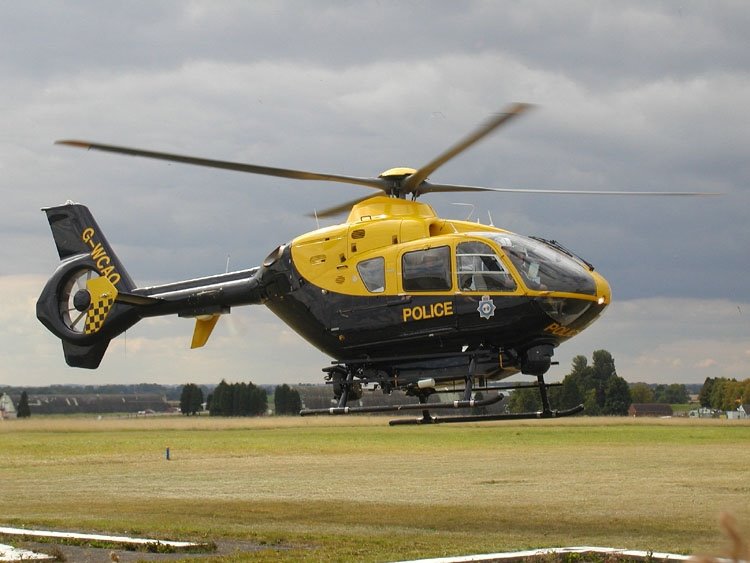
Now, in the UK, there are only three of the 40 police forces that do not have helicopters. Even Surrey, with an area of 1,663 square kilometers, has its own machine, like the one illustrated here. And there – as far as we know – there is no shooting war. The Constabulary enjoys one of the lowest crime rates in England.

Yet, in Basra province, the Army is supposed to support police functions and suppress an insurgency in an area of 19,070 square kilometers – more than ten times the size of Surrey, with an estimated population of about 2,600,000 people. To do that, it has available to it a mere six Lynx helicopters, which also have to carry out multiple other functions. In effect, the Army is being asked to do a job with less equivalent resource than the chief constable of Surrey.

This brings us back to Boris Johnson. As we have pointed out before – and as he keeps reminding us – he is a Member of Parliament. And while some doubtless will be entertained by his vacuous outpourings, I cannot find any trace of evidence that suggests that he has ever explored the technical issues involved in fighting and defeating an insurgency.

Instead of mouthing off, is that not what he should have been doing? As it is, with his demonstrable lack of knowledge, who is he to pontificate on whether we have won or lost?

But that leaves us with the ultimate puzzle. Although it is not possible to say that, with the right number of helicopters, the insurgency in southern Iraq can be defeated, there can be no doubt at all that, without them, it cannot. And, at current rates, £4 million buys you a state-of-the art MD Explorer (illustrated) or equivalent, equipped with the very latest in surveillance equipment. All you have to do is paint it green.

The puzzle is: where is the clamour? Where is the media – the likes of Thomas Harding? Where are the Parliamentarians – the likes of Boris Johnson? And where, for that matter, is the blogosphere? On this substantive issue, all we hear is silence.

COMMENT THREAD